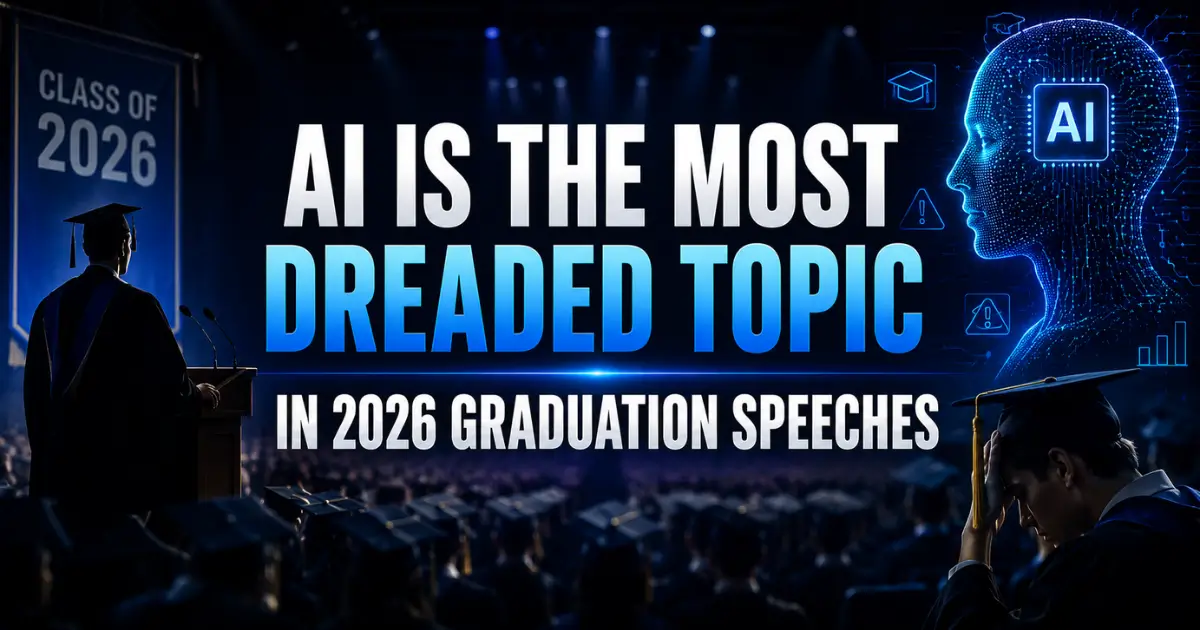
Commencement speakers across the country are learning the hard way: do not bring up AI. Graduates are booing, heckling, and walking out when speakers reference artificial intelligence as an opportunity rather than a threat. The backlash reflects a generation entering the workforce at the exact moment AI is eliminating the entry-level jobs they spent four years preparing for.
What Is Happening at Graduations
Multiple commencement speeches this spring have been derailed by AI references. At one ceremony, a tech executive told graduates to embrace AI as a collaborator. The audience responded with sustained booing. At another, a venture capitalist suggested that AI would create more jobs than it destroys. Students held up signs reading "AI took my job offer."
The pattern is consistent. When speakers frame AI as an opportunity, graduates hear it as a dismissal of their anxieties. When speakers acknowledge the risks but pivot to optimism, the audience does not follow. The gap between how the tech industry talks about AI and how young people experience it has never been wider.
Why Graduates Are Angry
The anger is not abstract. Entry-level hiring at the top 15 tech companies dropped 25 percent between 2023 and 2024. The decline has continued into 2026. LinkedIn data shows that AI is reshaping the job market in ways that disproportionately affect young workers. And 64 percent of Gen Z workers say they are worried about losing their job to AI.
The specific jobs that graduates expected to fill — junior analyst, associate copywriter, entry-level developer, research assistant — are exactly the roles that AI tools handle most effectively. Companies are not hiring junior employees to do work that ChatGPT, Claude Code, or Microsoft Copilot can do instead.
Cloudflare said AI made 1,100 positions obsolete. Cisco just cut 4,000 jobs to fund AI while posting record revenue. Match Group froze hiring to pay for AI tools. For graduates watching these announcements, the message is clear: companies are investing in AI instead of investing in you.
The Jensen Huang Problem
Nvidia CEO Jensen Huang told the Milken Institute that AI creates an enormous number of jobs. His words have become a lightning rod at graduation ceremonies. Several speakers have quoted Huang's optimism. Each time, the audience has responded with hostility.
The disconnect is predictable. Huang runs the company that profits most from AI adoption. Every chip sold, every data center built, every model trained generates revenue for Nvidia. His incentive to frame AI as positive is as large as his company's $5 trillion market cap.
For a 22-year-old with $50,000 in student debt and a rescinded job offer, Huang's optimism sounds like the CEO of a weapons company saying war creates jobs. Technically arguable. Emotionally tone-deaf.
The Stanford Gap Widens
The commencement backlash connects to the Stanford research documenting a growing gap between AI experts and the public. Experts remain broadly optimistic about AI's potential. The public is increasingly anxious. Graduates are at the sharp end of that anxiety — old enough to understand the technology, young enough to feel its impact on their careers before any benefits materialize.
OpenAI's own policy paper proposed robot taxes and public wealth funds to cushion AI's impact. Anthropic's CEO warned of Depression-era unemployment. Even the companies building AI acknowledge that the transition will be painful. But commencement speakers keep serving optimism to audiences that want honesty.
What Speakers Should Say Instead
The graduates who are booing are not anti-technology. They are anti-dismissal. They want acknowledgment that the economy they are entering is fundamentally different from the one their parents navigated. They want honesty about which jobs are at risk and which skills will matter. And they want to hear that the people building AI are thinking about the people it displaces — not just the shareholders it enriches.
A commencement speech that says "AI will be hard for your generation, the transition will be painful, and here is how to navigate it" would land differently than one that says "AI is the greatest opportunity of your lifetime." The first is honest. The second is a press release.
The Bigger Picture
The commencement speech backlash is a cultural signal. It tells the AI industry that its messaging is failing with the generation that matters most. Gen Z will live with AI's consequences longer than anyone else. If they enter the workforce feeling dismissed rather than supported, the political and social backlash against AI will grow far beyond graduation ceremonies.
The tech industry spent years selling AI as the future. The class of 2026 is asking a simple question: whose future?