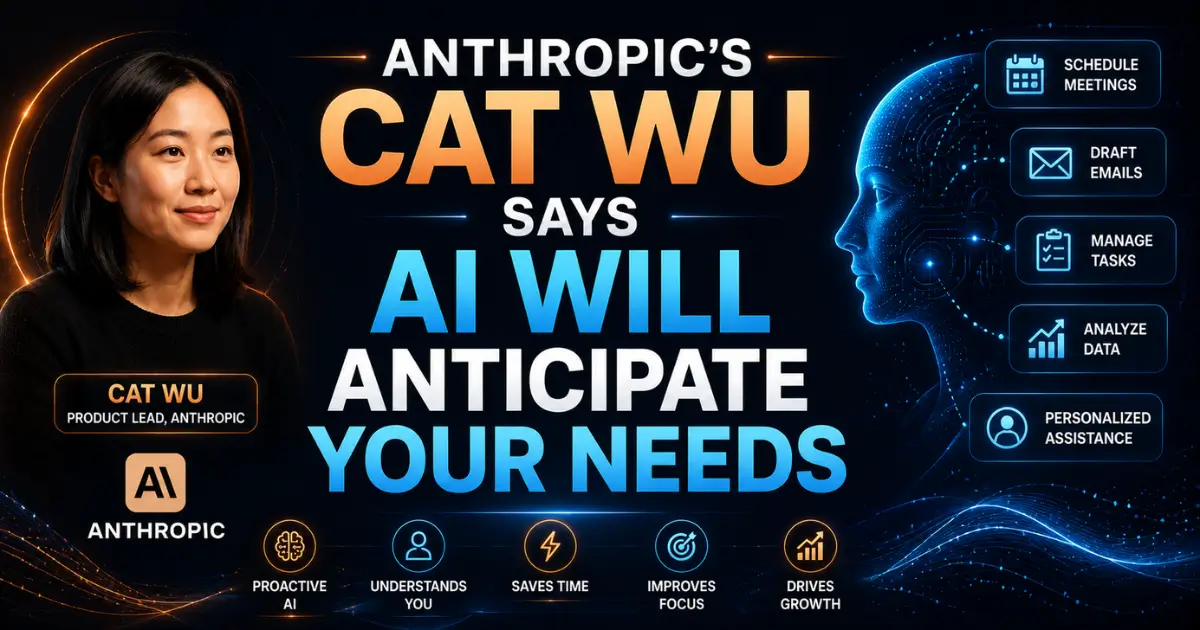
Anthropic head of consumer product Cat Wu told TechCrunch that the company is building toward a future where Claude anticipates what users need before they ask. The vision goes beyond today's reactive chatbot model — where users type a prompt and wait for a response — toward proactive AI that monitors context, recognizes patterns, and takes action on your behalf. Wu described it as the difference between a tool you use and an assistant that knows you.
From Reactive to Proactive
Wu explained that current AI interactions follow a rigid pattern. The user initiates. The AI responds. Nothing happens in between. That model works for answering questions and completing tasks. But it misses the potential for AI to be genuinely useful in everyday life.
The next phase, according to Wu, involves AI that understands the context of your day — your calendar, your email, your work patterns, your preferences — and acts before you ask. A flight gets delayed. Claude rebooks it. A meeting runs long. Claude reschedules the next one. A deadline approaches. Claude prepares the materials.
The vision connects to what several companies are already building. Skye designed an AI-powered home screen that surfaces information proactively. Google's Workspace Intelligence uses email, calendar, and document data to assist across productivity tools. And Microsoft Copilot now operates in Agent Mode by default across Office. Wu says Anthropic intends to go further.
Why Anthropic Can Do This
Anthropic has been building the infrastructure for proactive AI across multiple recent launches. Claude for Small Business automates bookkeeping, ad campaigns, and business insights through Claude Cowork. The enterprise joint venture with Blackstone embeds Claude engineers inside client organizations. And Claude for Legal connects to document management and legal research platforms through MCP.
Each of these products gives Claude deeper access to the context it needs to anticipate rather than just respond. A Claude that knows your QuickBooks data, your calendar, your Docusign contracts, and your email can predict what you need next. That prediction capability is what Wu described as the next frontier.
The company's Ramp data milestone — more business customers than OpenAI — suggests the strategy is working. Businesses are choosing Claude not just for chat but for workflow automation that requires deep contextual understanding.
The Privacy Tension
Proactive AI that anticipates your needs requires access to your most personal data. Email content. Calendar entries. Financial records. Document history. Browsing patterns. The more data the AI has, the more useful it becomes. But the more data it accesses, the greater the privacy risk.
Wu acknowledged the tension. She said Anthropic is building privacy controls that let users specify exactly what Claude can see and what it cannot. The goal is granular permission management — not all-or-nothing access.
The approach mirrors what Google has done with Workspace Intelligence and what Perplexity offers with its Computer agent. Users who restrict data access get a less capable assistant. Users who grant full access get something closer to a digital chief of staff. The tradeoff is explicit.
The Agent Commerce Connection
Wu's vision also connects to Anthropic's Project Deal experiment — the test marketplace where AI agents bought and sold goods on behalf of real people. If Claude can anticipate your needs, it can also act on them autonomously. Book a restaurant. Order supplies. Negotiate a contract. The path from proactive awareness to autonomous action is short.
That path raises its own questions. When an AI agent acts on your behalf without explicit instruction, who is responsible if it makes a mistake? If Claude rebooks your flight to the wrong destination or orders supplies you did not need, the liability question becomes real.
What It Means
Wu's comments preview where Anthropic is heading with its consumer product. The company has dominated the enterprise market with Claude Code and developer tools. The small business launch expands its reach downmarket. And the proactive AI vision positions Claude as something more than a chatbot — an ambient assistant that understands your life well enough to act before you ask.
Whether users embrace that vision or find it intrusive will depend on execution. But the direction is clear. The AI industry is moving from tools you talk to toward systems that know you. Anthropic wants Claude to get there first.