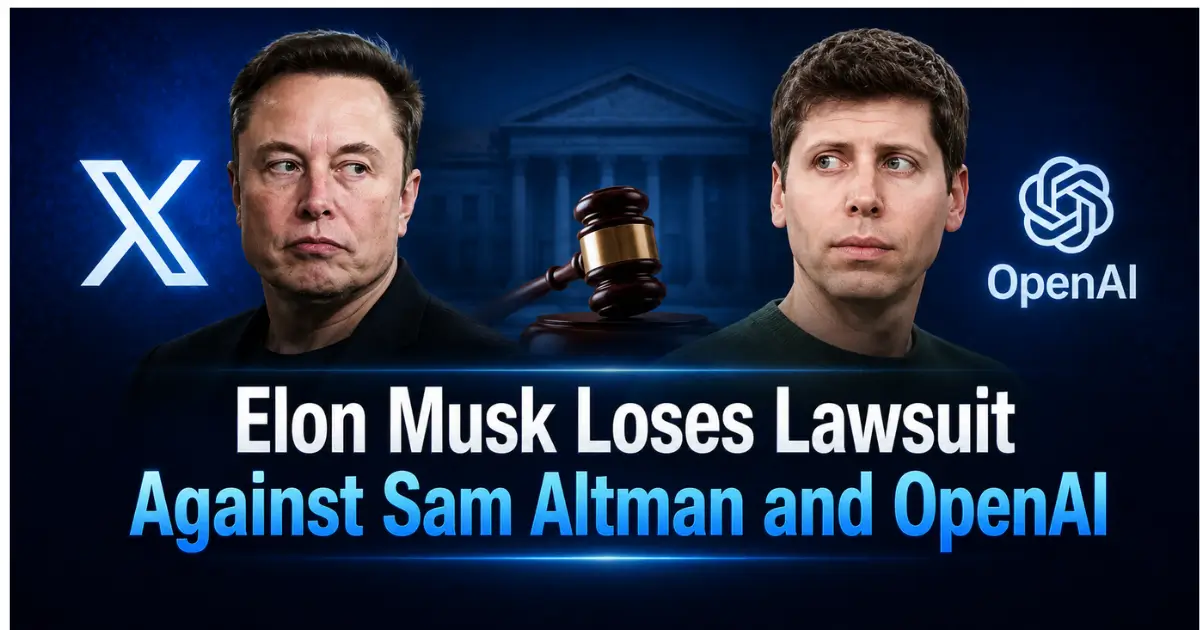
Elon Musk has lost his lawsuit against Sam Altman and OpenAI. Judge Yvonne Gonzalez Rogers ruled Sunday that Musk failed to prove his claims of unjust enrichment and breach of charitable trust. The advisory jury had reached the same conclusion earlier in the week. The ruling ends the most closely watched trial in AI history — and leaves OpenAI's $852 billion for-profit structure intact.
What the Judge Ruled
Judge Gonzalez Rogers found that while Musk raised legitimate questions about OpenAI's nonprofit-to-profit conversion, he did not meet the legal standard required to prove either claim. On unjust enrichment, the judge ruled that Musk's $38 million in contributions were voluntary donations to a nonprofit. He was not promised equity, board control, or financial returns. The fact that the nonprofit later became enormously valuable does not entitle him to retroactive compensation.
On breach of charitable trust, the ruling was more nuanced. The judge acknowledged that OpenAI's conversion raised governance concerns. But she found that the nonprofit retained a 26 percent stake in the for-profit entity, that independent directors maintained oversight authority, and that the conversion followed a process that — while imperfect — did not constitute a legal breach.
The $134 billion in damages Musk sought was denied entirely. His request to unwind OpenAI's corporate structure was rejected. And his demand to remove Altman and Brockman from their positions was dismissed.
How the Trial Unraveled for Musk
The verdict caps a trial that went badly for Musk from the start. On the stand, he was trapped by his own tweets — contradicting claims about Tesla pursuing AGI and inflating his OpenAI investment from $38 million to $100 million. He admitted that xAI trained Grok by distilling OpenAI's models. He threatened Brockman before the trial, texting that he and Altman would become the most hated men in America unless they settled.
Altman testified that Musk proposed handing OpenAI to his children to maintain control. Brockman testified that Musk left after the board rejected his demand for majority equity. And Musk's only AI expert witness, Stuart Russell, delivered compelling testimony about AGI risks — but could not connect those risks specifically to the corporate conversion.
The cumulative effect was devastating. What began as a case about charitable mission and AI safety became a case about a co-founder who wanted control, did not get it, and used the legal system to pursue what the boardroom denied.
What OpenAI Wins
The ruling removes the most significant legal threat to OpenAI's corporate structure. The company can proceed with its planned IPO without the overhang of a potential court-ordered unwinding. Its Microsoft partnership, Amazon deal, and enterprise joint ventures are no longer at risk. And Altman and Brockman remain in their roles.
The victory also strengthens OpenAI's negotiating position. Investors who were uncertain about the legal risk can now commit with confidence. Enterprise customers who worried about structural instability can sign long-term contracts. And the company's Infosys partnership, Codex Labs, and superapp vision can proceed without distraction.
What Musk Loses
Beyond the legal defeat, Musk's credibility took significant damage. His contradictory testimony, the distillation admission, and the threatening texts painted a picture of a litigant motivated by competitive grievance rather than public interest. His ranking of Anthropic above xAI under oath undermined his positioning as a frontier AI leader. And the revelation that he proposed giving OpenAI to his family members contradicted his public framing as a selfless defender of AI safety.
Musk still owns xAI, which recently sold a data center to Anthropic. He still controls SpaceX, which has a $60 billion option to buy Cursor. And his unpermitted Memphis data center continues operating. But his legal campaign against OpenAI is over.
What It Means for AI
The ruling sets a precedent that will shape AI governance for years. It effectively validates the nonprofit-to-profit conversion model that OpenAI pioneered. Future AI organizations that start as nonprofits and later convert will point to this ruling as legal cover.
Critics will argue the opposite — that the ruling lets founders escape their charitable commitments once the money gets large enough. Barry Diller's warning that trust in individual leaders is irrelevant as AGI approaches remains relevant regardless of who won in court.
For the AI industry, the trial is over. The questions it raised — about safety, governance, and who controls the most powerful technology ever built are not.