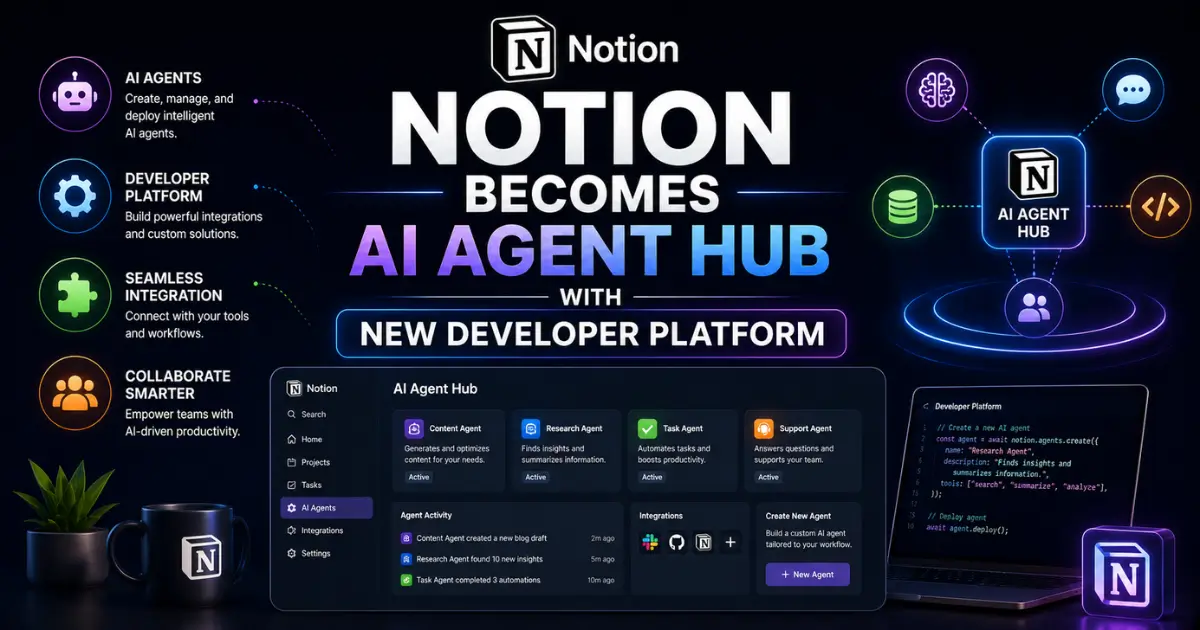
Notion has launched a developer platform that turns its workspace into a hub for AI agents. Teams can now connect external agents like Claude Code, Cursor, and Codex directly into Notion. They can sync data from Salesforce, Zendesk, and Postgres into Notion databases. And they can deploy custom code that runs inside Notion's cloud. The update transforms Notion from a note-taking app into programmable infrastructure for the agentic era.
What Is New
The launch includes four major capabilities. First, Workers — a cloud-based environment where teams deploy custom code inside Notion without external infrastructure. Workers run in secure sandboxes. They can sync data, build custom tools, and trigger automated workflows through webhooks. The feature is free through August.
Second, database sync lets teams pull live data from any external database with an API directly into Notion. Salesforce records. Zendesk tickets. Postgres tables. The data stays current. Notion CEO Ivan Zhao described the feature as turning Notion's database into a canvas that powers both workflows and AI agents.
Third, external agent integration. Teams can now chat with agents from Claude Code, Cursor, Codex, and Decagon directly inside Notion. They can assign work. Track progress. And manage external agents as if they were Notion's own custom agents. More partner agents are coming.
Fourth, an External Agent API that lets companies connect their own internal agents to Notion. This means a custom AI agent built for a specific company's needs can interact with Notion data without manual integration.
Why Notion Made This Move
Since launching Custom Agents in February, Notion customers have built over 1 million agents. But those agents had limitations. They could not access external data. They could not run custom logic. And external agents from other platforms had no way to connect into Notion workspaces.
The developer platform removes those barriers. By becoming programmable, Notion positions itself not as a document tool with AI features but as an orchestration layer — a system that coordinates AI work across multiple tools and data sources.
The shift reflects a broader trend. Every major productivity platform is racing to become the hub where agents operate. Microsoft Copilot operates in Agent Mode across Office. Google Workspace embeds Gemini across every productivity tool. Otter expanded from meeting notes to enterprise search via MCP. And CopilotKit raised $27 million for an open protocol connecting agents to app UIs.
Notion's bet is that the workspace where teams already organize their knowledge is the natural home for agents that act on that knowledge.
The MCP Connection
Notion's platform supports MCP — the Model Context Protocol that is becoming the standard for connecting AI tools to external data and services. But Workers go beyond MCP. When connecting through a standard protocol is not enough, teams can write custom logic that runs inside Notion's cloud.
The combination gives developers two paths. Use MCP for standard integrations. Use Workers for anything custom. The flexibility matters because enterprise environments are messy. Every company has unique data structures, workflows, and tools. A one-size-fits-all approach does not work.
The Competition
Notion is late to the developer platform game compared to larger competitors. But it has advantages they lack. Notion's user base is deeply engaged. Teams use it daily for documentation, project management, and knowledge bases. That usage creates rich context that agents can leverage.
SAP blocked unauthorized agents from its platform. Notion is doing the opposite — opening its doors and inviting every agent in. The contrasting strategies reflect different bets about whether controlling or opening the agent ecosystem wins in the long run.
What It Means
Notion's developer platform launch is a significant moment for the productivity software market. The company is betting that the future of work is not humans using tools. It is humans directing agents that use tools on their behalf. And the workspace where those agents live — where they access data, coordinate with other agents, and report their progress — is the most valuable layer of the enterprise AI stack.
Any data. Any tool. Any agent. That is Notion's pitch. Whether teams adopt it at scale will determine whether Notion becomes core infrastructure for the agentic era or remains a note-taking app with ambitions above its station.