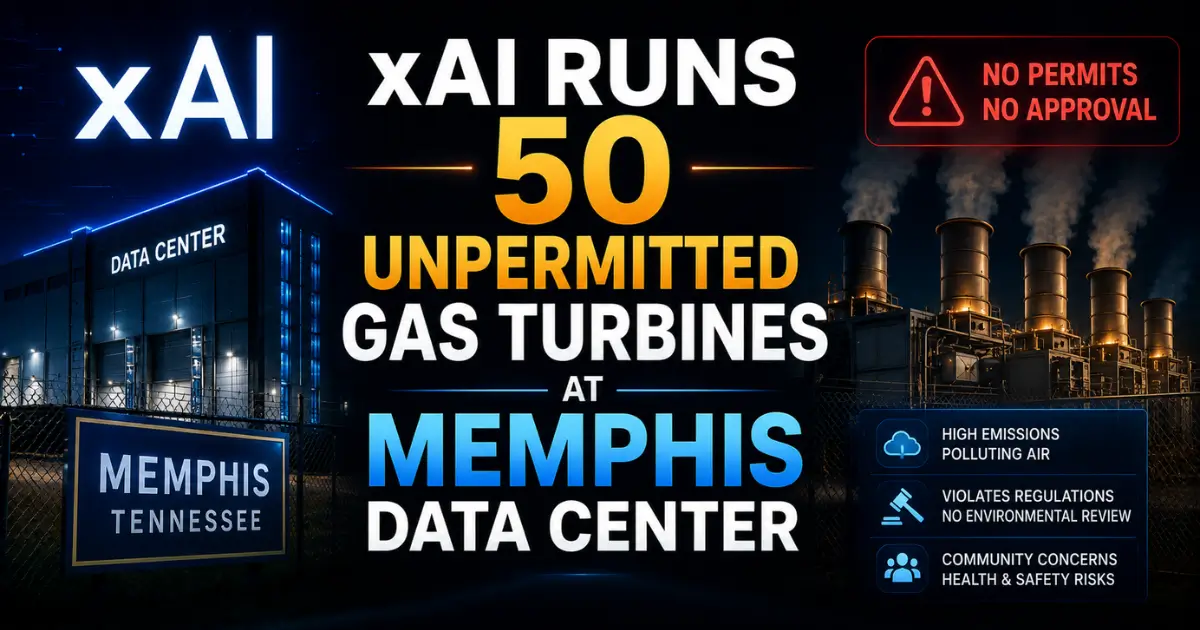
Elon Musk's xAI is operating nearly 50 gas turbines at its Memphis, Mississippi data center without air quality permits. The Environmental Integrity Project reports that the facility — which houses the Colossus supercomputer — is releasing pollutants including nitrogen oxide, carbon monoxide, and volatile organic compounds into the surrounding community without the regulatory oversight required by the Clean Air Act.
What Is Happening
xAI's Memphis data center runs on natural gas-powered turbines that generate electricity for its AI operations. The facility operates approximately 50 of these turbines. Under normal circumstances, an industrial facility of this scale would require air quality permits from the state and federal government before beginning operations.
xAI does not have those permits. The company began operating the turbines while its permit applications were still under review. Environmental groups say this violates the Clean Air Act, which requires facilities to obtain permits before releasing pollutants — not after.
The Environmental Integrity Project filed a complaint detailing the emissions. The pollutants being released include nitrogen oxide, which contributes to smog and respiratory problems. Carbon monoxide, which is toxic at high concentrations. And volatile organic compounds, which react with sunlight to create ground-level ozone.
The Community Impact
The data center sits in a predominantly Black community in Memphis. Environmental justice advocates have raised concerns that the facility is disproportionately affecting residents who were not consulted about the health risks before operations began.
Local residents have reported increased air quality concerns since the facility became operational. The combination of industrial-scale gas turbines running without permits in a residential area raises both environmental and civil rights questions.
The situation echoes broader concerns about AI data center siting. As the AI industry builds massive infrastructure at unprecedented speed, the communities hosting that infrastructure often bear the environmental costs while receiving limited benefits. Wisconsin has already banned new data center construction. Other regions are pushing back against the energy demands of AI facilities.
Why xAI Is Rushing
The unpermitted operation reflects the extreme urgency driving xAI's infrastructure buildout. Musk has been racing to scale xAI's compute capacity. The Colossus supercomputer — claimed to have power equivalent to a million Nvidia H100 chips — is central to xAI's competitive strategy.
xAI recently sold all the compute at its Colossus 1 facility to Anthropic, moving its own operations to the newer Colossus 2. The SpaceX-Cursor partnership also depends on xAI's compute infrastructure. And the upcoming SpaceX IPO creates pressure to demonstrate that xAI's data centers generate revenue.
That urgency does not excuse operating without permits. But it explains why xAI chose to build first and seek permission later — a pattern that mirrors Musk's approach at other companies, where regulatory compliance often follows rather than precedes action.
The Broader AI Energy Problem
xAI's unpermitted turbines are an extreme example of a problem facing the entire AI industry. Training and running frontier AI models requires enormous energy. Google Cloud cannot meet demand because of capacity constraints. AWS is spending billions on infrastructure. Meta is exploring space-based solar. And companies are building their own rockets to launch data centers into orbit.
The desperation for power is real. But running 50 unpermitted gas turbines in a residential community is not the same as exploring innovative energy solutions. It is an industrial facility operating outside the law while polluting a neighborhood.
ASML's CEO warned that nothing in AI can be priceless. The Milken conference panelists said the AI economy is hitting physical limits. xAI's Memphis facility illustrates what happens when companies hit those limits and choose to push through them rather than wait.
The Trial Irony
The timing adds another layer of irony to the Musk vs Altman trial. Musk is suing OpenAI for allegedly betraying its commitment to public benefit. His own AI company is running unpermitted industrial equipment in a residential community. The juxtaposition between Musk's courtroom arguments about protecting humanity and xAI's environmental practices in Memphis is difficult to reconcile.
What Comes Next
Environmental groups are pushing for enforcement action. If regulators require xAI to shut down unpermitted turbines until permits are granted, it could significantly disrupt the facility's operations and reduce the compute capacity that xAI depends on.
For the AI industry, the Memphis situation is a warning. Building AI infrastructure at the speed the industry demands requires navigating real-world constraints — energy, land, permits, and community consent. Companies that skip those steps may move faster in the short term. But the environmental, legal, and reputational costs eventually come due.