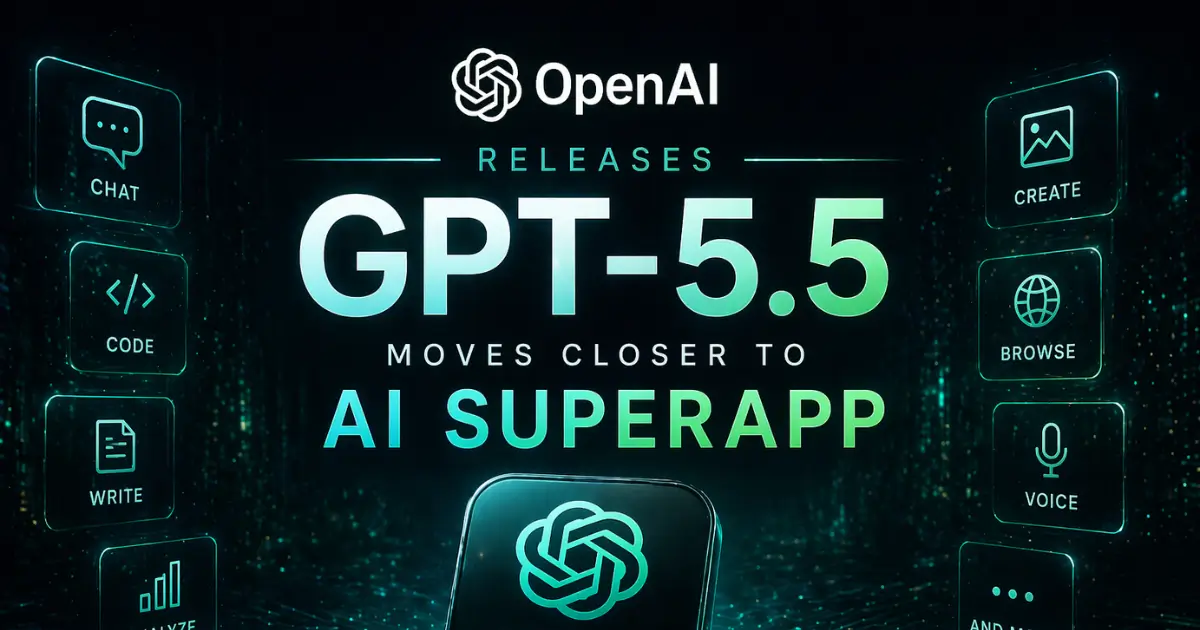
OpenAI has released GPT-5.5, calling it its smartest and most intuitive model to date. The release comes just weeks after the company launched GPT-5.4 and signals a relentless pace of model releases that co-founder Greg Brockman says is bringing the company closer to its vision of a unified AI superapp — a single platform combining ChatGPT, Codex, and an AI browser into one service for consumers and enterprises.
What GPT-5.5 Can Do
OpenAI describes GPT-5.5 as a faster, sharper thinker that uses fewer tokens than its predecessor. The model is designed to be broadly capable across enterprise workloads including agentic coding, knowledge work, mathematics, and scientific research. Chief research officer Mark Chen said the model shows meaningful gains in scientific and technical research workflows and could accelerate drug discovery, an area of growing interest across the AI industry.
OpenAI released benchmark data showing GPT-5.5 outperforming its own previous models as well as competitors' offerings including Google's Gemini 3.1 Pro and Anthropic's Claude Opus 4.5. The model is available immediately to Plus, Pro, Business, and Enterprise users in ChatGPT, with GPT-5.5 Pro rolling out to Pro, Business, and Enterprise tiers.
Chief scientist Jakub Pachocki suggested the pace of improvement will only accelerate, saying the company expects significant gains in the short term and extremely significant gains in the medium term. He added that the last two years had been surprisingly slow by the company's internal expectations — a remarkable statement given the pace at which the industry has been moving.
The Superapp Vision
Brockman used the GPT-5.5 launch to reiterate OpenAI's ambition to build what it calls a superapp — a multi-purpose platform that combines all of the company's AI tools into a single unified service. The vision, which Brockman and CEO Sam Altman have been developing publicly, would merge ChatGPT's conversational abilities, Codex's coding capabilities, and an AI-powered browser into one desktop application.
The concept echoes Elon Musk's stated goal of turning X into its own superapp — a comparison that highlights just how closely the former OpenAI colleagues continue to compete across multiple fronts, from AI models to platform strategy to hardware deals.
For enterprise customers, a superapp could simplify procurement and integration by replacing multiple AI subscriptions with a single platform. For OpenAI, it represents a path to significantly higher revenue per user — a critical goal for a company that raised $122 billion at an $852 billion valuation and needs to demonstrate that its products can generate returns at that scale.
The Anthropic Rivalry
The OpenAI-Anthropic competition was front and center during the press briefing. When asked whether GPT-5.5 would include capabilities similar to Anthropic's Mythos cybersecurity tool — which has been in the news recently after an unauthorized group gained access to it — OpenAI's Mia Glaese said the company has a strong and long-standing strategy for deploying models toward digital defense.
The response was notably measured, avoiding a direct comparison while signaling that OpenAI takes the cybersecurity application seriously. The framing reflects a broader dynamic: Anthropic's restricted release of Mythos generated enormous attention and positioned the company as more cautious and security-focused than OpenAI, which has faced criticism over its public image and strategic direction.
Meanwhile, Anthropic's revenue has surged past OpenAI's, driven primarily by enterprise customers and Claude Code adoption. GPT-5.5 is partly a response to that momentum — an attempt to recapture technical leadership at the model level while the superapp strategy addresses distribution and product cohesion.
The Pace of Releases
The speed at which OpenAI is shipping new models is itself a statement. GPT-5.5 comes just weeks after GPT-5.4, which launched in March. That followed a December release and a November release before it. The company has effectively shifted to a near-monthly release cadence — a pace that puts enormous pressure on competitors to keep up.
For enterprise customers, the rapid release cycle creates both opportunities and challenges. Each new model offers potential performance gains, but the frequency of updates can complicate deployment planning and testing. Companies that just finished integrating GPT-5.4 into their workflows are now being asked to evaluate its successor.
What It Means
GPT-5.5 is not a revolutionary leap — it is an incremental improvement delivered at a pace designed to maintain competitive pressure. The real story is not the model itself but the strategic context around it: OpenAI's push toward a superapp, its ongoing rivalry with Anthropic, and the question of whether faster model releases can compensate for the enterprise momentum Anthropic has built with Claude Code.
For now, OpenAI is shipping faster than anyone else. Whether that velocity translates into sustainable competitive advantage — or simply raises the cost of staying in the race — will define the next chapter of the AI industry.