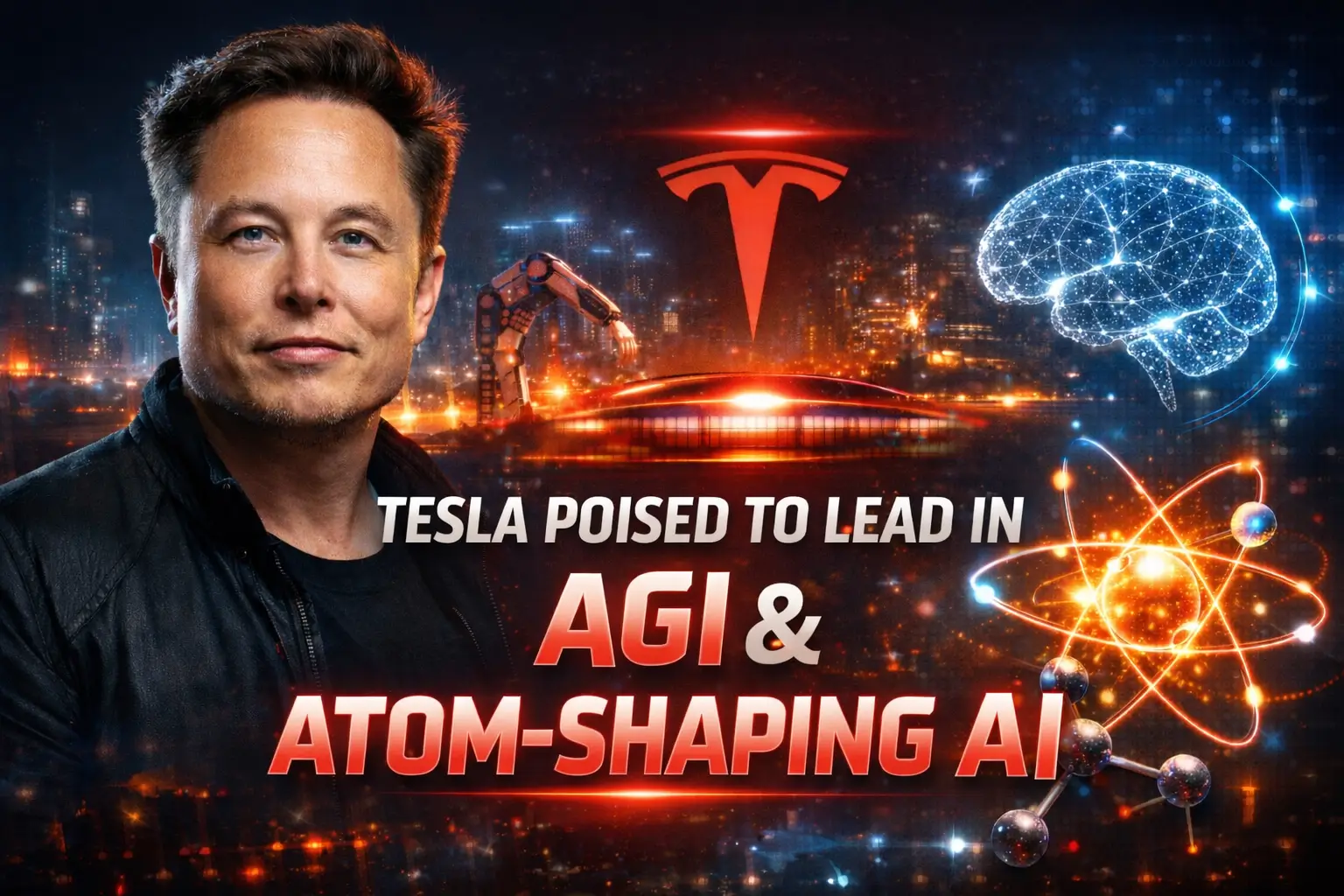
Elon Musk is no longer content with winning the software AI race. In his latest round of claims posted to X, the Tesla and xAI CEO declared that his electric vehicle company will be among the first to achieve Artificial General Intelligence — and, critically, the first to do so in "humanoid/atom-shaping form." It is a statement that, if taken at face value, positions Tesla not as a car company with AI ambitions but as a full-spectrum intelligence company building minds and bodies for machines.
The timing is deliberate. As OpenAI, Google DeepMind, and Anthropic compete to scale digital reasoning, Musk is staking out different ground entirely: AI that doesn't just think, but physically acts on the world at a fundamental level.
Decoding the 'Atom-Shaping AI' Concept
Strip away the branding and Musk's concept refers to artificial intelligence capable of simulating and eventually manipulating matter at the atomic scale. Today's most advanced AI systems excel at pattern recognition, language, and code generation — all confined to digital outputs. Atom-shaping AI, as Musk describes it, would extend that capability into physical manipulation: organizing raw materials, assembling structures, and potentially engineering matter with atomic precision.
The practical infrastructure Musk points to is twofold. Tesla's Optimus humanoid robot serves as the physical platform — the "muscles." The computational backbone comes from Tesla's next-generation AI training systems, including its Dojo supercomputer and what Musk has referenced as "AI5" architectures. The thesis is that pairing general-purpose reasoning with a dexterous physical body creates something no purely digital AI lab can replicate.
Musk has gone further, calling Optimus a future "Von Neumann machine" — a self-replicating system theoretically capable of bootstrapping civilization on another planet without human oversight.
Digital AGI vs. Physical AGI — The Core Divide
Digital AGI operates within software environments: generating text, images, code, and strategic plans. Physical AGI, as Musk frames it, operates in unstructured, real-world environments where variables are unpredictable and consequences are material. The gap between the two is enormous. Controlling atoms requires breakthroughs in robotics, materials science, and real-time sensory processing that no lab has yet demonstrated at scale.
Why This Matters for the Industry
Musk's framing creates a strategic wedge. If the next phase of AI competition shifts from benchmark performance to real-world physical capability, companies without robotics divisions face a structural disadvantage. Google DeepMind has robotics research. OpenAI largely does not. Anthropic does not. Tesla, by contrast, already manufactures millions of physical machines annually.
For end users, the implications stretch well beyond autonomous driving. A general-purpose humanoid robot with genuine cognitive flexibility could reshape manufacturing, logistics, elder care, construction, and agriculture. Musk's prediction of a shift from "sustainable abundance" to what he calls outright abundance hinges on machines that can do physical labor at marginal cost approaching zero.
That said, Tesla has not publicly demonstrated anything close to atomic-level manipulation, and the gap between Musk's rhetoric and Tesla's current Optimus prototypes — which still struggle with basic household tasks in uncontrolled demos — remains vast.
The Risk Side of the Equation
Musk's own language raises red flags. Describing humans as a "biological bootloader for digital superintelligence" frames human civilization as a transitional phase rather than an end in itself. That philosophy, applied to product development, raises urgent questions about labor displacement at a scale no prior automation wave has approached. A self-replicating machine with general intelligence is, by definition, a dual-use technology with profound military and surveillance implications.
There is also a credibility question. Musk has repeatedly missed self-imposed timelines on full self-driving, Optimus deployment, and Dojo capabilities. Bold claims without peer-reviewed milestones warrant measured skepticism.
Looking Ahead: The Next 12 Months
Expect Tesla to push Optimus toward limited commercial pilot programs in its own factories by late 2026, using controlled environments to demonstrate physical AI competence. The real test will be whether Optimus can perform novel tasks it was not explicitly trained on — the minimum threshold for any credible AGI claim. Meanwhile, watch for xAI's Grok models to be more tightly integrated into Tesla's robotics stack, narrowing the gap between Musk's digital and physical AI efforts.
No company is within striking distance of true atom-scale manipulation. But the race to build embodied AGI — intelligence that lives in the real world — is now officially on.
Key Takeaways
Musk claims Tesla will achieve AGI in physical, "atom-shaping" form before any competitor.
The strategy pairs Optimus hardware with next-generation AI training infrastructure.
No working demonstration of atomic-level manipulation exists; the gap between vision and execution remains significant.
Labor displacement and dual-use risks demand serious regulatory attention.
The next 12 months will test whether Tesla can move Optimus beyond controlled factory settings.