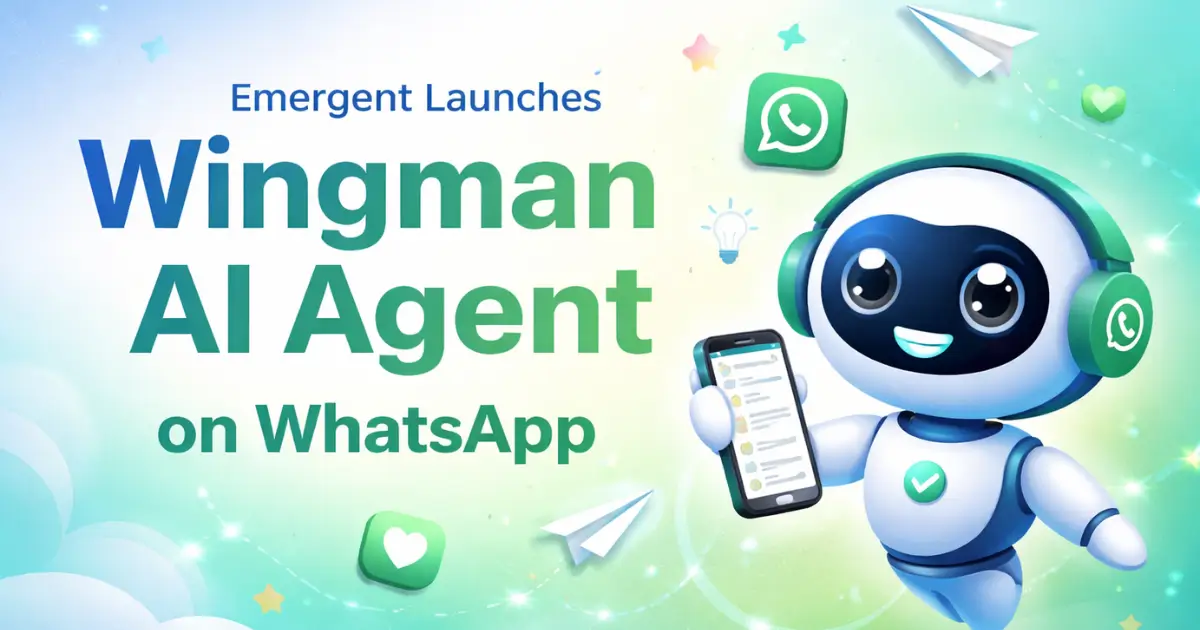
Indian startup Emergent, already well known for its vibe-coding platform that lets non-technical users build full-stack applications through natural language, is now making a bold move into the autonomous AI agent space. The Bengaluru-based company has launched "Wingman" — a messaging-first AI agent that lives inside platforms like WhatsApp, Telegram, and iMessage, completing tasks in the background while users go about their day.
The launch positions Emergent alongside some of the biggest names in AI, entering a rapidly growing category dominated by tools like OpenClaw and Anthropic's Claude-based agent systems. But Emergent's approach is different. Instead of asking users to learn a new interface, Wingman meets them where they already spend most of their time — inside their messaging apps.
From Building Software to Running It
Emergent first gained traction with its vibe-coding platform, which competes with tools like Cursor and Replit. The platform allows people with no coding background to create and deploy working software applications simply by describing what they want in plain language. According to the company, more than eight million builders have used the platform so far, with over 1.5 million monthly active users.
But co-founder and CEO Mukund Jha saw a natural next step. Helping users build software was only half the equation — the other half was helping them actually operate through it.
Jha explained that the transition from creation to execution was inevitable. Once people could build their own tools, the logical progression was giving them an AI that could also handle the routine work those tools were designed to support. Wingman is the result of that thinking: an agent that does not just assist with building software but actively helps run day-to-day operations.
How Wingman Works
Wingman operates through familiar messaging platforms. Users can assign tasks, provide context, and monitor progress through regular chat conversations on WhatsApp, Telegram, or iMessage. Behind the scenes, the agent connects to tools like email, calendars, and workplace software to carry out assigned actions.
The system includes what Emergent calls "trust boundaries." For routine, low-risk tasks, Wingman acts autonomously without needing permission. For more consequential actions — things that could have a significant impact if done incorrectly — the agent pauses and asks the user for approval before proceeding. This layered approach is designed to address one of the biggest concerns around fully autonomous AI systems: the risk of an agent making a costly mistake without human oversight.
Jha told reporters that the decision to embed Wingman inside messaging apps was driven by observation of how people actually work. Much of real work, he noted, already happens through chat, voice, and email — asking for things, following up, sharing context, making decisions. He believes messaging platforms will increasingly become the primary way people interact with AI agents, rather than dedicated dashboards or standalone apps.
The Competitive Landscape
Wingman enters a fiercely competitive and fast-moving market. The autonomous AI agent space has exploded over the past year, with projects like OpenClaw gaining significant traction among early adopters. Meanwhile, major players are pouring resources into the category. Anthropic has been developing agent-based systems around Claude, and Microsoft is reportedly working on its own OpenClaw-like agent product.
What Emergent hopes will set Wingman apart is its messaging-native design and its roots in the vibe-coding ecosystem. Users who have already built applications on the Emergent platform can seamlessly extend those tools with Wingman's capabilities, creating a tighter loop between software creation and software operation.
Limitations and What Comes Next
Jha was candid about Wingman's current limitations. The system still struggles with highly ambiguous situations, messy edge cases, unclear goals, and workflows that require significant human judgment. These are challenges shared by virtually every autonomous agent on the market today, and solving them remains one of the central problems in AI development.
Wingman is launching with a limited free trial, after which access will move to a paid model. Existing Emergent users can access the agent through their current accounts.
Why It Matters
Emergent's expansion from vibe-coding into autonomous agents reflects a broader trend in the AI industry. The companies that helped people build software are now trying to help them run entire workflows. If Wingman can deliver on its promise of handling routine tasks reliably through a simple chat interface, it could lower the barrier to AI agent adoption for millions of users — especially in markets like India and South Asia, where WhatsApp is the dominant communication platform and smartphone-first workflows are the norm.
The race to build the definitive AI agent is far from over, but Emergent just made sure it has a seat at the table.