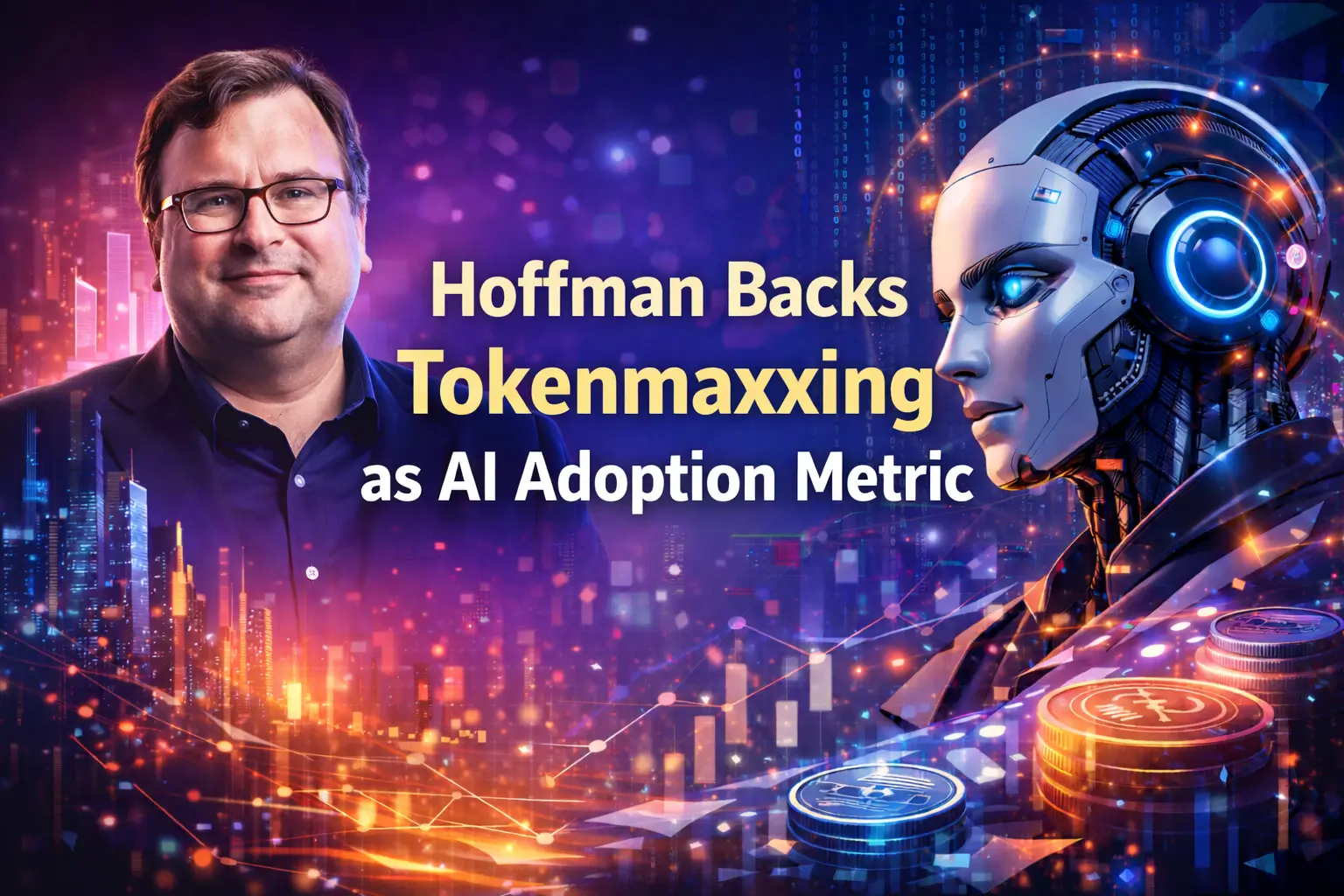
A new workplace trend is dividing Silicon Valley, and one of tech's most influential voices just picked a side. LinkedIn co-founder and veteran venture capitalist Reid Hoffman has publicly endorsed the concept of "tokenmaxxing" — the practice of tracking how many AI tokens employees consume as a way to gauge their engagement with artificial intelligence tools.
His comments, delivered at Semafor's World Economy summit this week, come just days after Meta was forced to shut down an internal AI usage leaderboard that had been ranking employees by their token consumption. The dashboard was taken offline after details about the system leaked to the press, sparking a fierce debate about whether tracking AI token usage is a smart management strategy or a fundamentally flawed metric.
What Is Tokenmaxxing?
For those unfamiliar with the term, an AI token is a small unit of data that a language model processes when interpreting a prompt and generating a response. Tokens are also the standard unit used to measure AI usage and calculate costs for AI services.
As companies race to integrate AI across their operations, many have started internally tracking which employees use the most tokens. The practice has been dubbed "tokenmaxxing" — borrowing the Gen Z suffix "maxxing," which means aggressively optimizing something. The term follows the same linguistic pattern as "looksmaxxing" and "sleepmaxxing," concepts that have gained traction in online culture.
In simple terms, companies are creating leaderboards that celebrate employees who consume the most AI resources, treating high token usage as a signal that someone is actively embracing and experimenting with AI tools.
The Controversy
Not everyone thinks this is a good idea. Engineers and developers at several tech companies have pushed back against the metric, arguing that it essentially rewards spending over substance. Critics compare it to ranking employees based on who spends the most money — a measure that says nothing about the quality or impact of what was purchased.
The debate intensified after Meta's internal leaderboard became public. Reports revealed that employees at the company had been competing for what was informally called "AI token legend" status. When the story broke, Meta quickly pulled the plug on the dashboard, but the conversation it ignited has only grown louder.
Industry commentators have noted that the leaderboard may actually reveal more about Meta's broader AI strategy than about individual employee productivity. Some analysts suggest it points toward the company's push for deeper vertical integration of AI across its products and workflows.
Hoffman's Take
At the Semafor summit, Hoffman offered a more nuanced endorsement of token tracking. He argued that companies should be encouraging employees across all functions to actively engage with and experiment with AI tools, and that monitoring token usage is one useful way to measure whether that is actually happening.
However, he was careful to acknowledge the metric's limitations. Token usage alone does not equal productivity, he noted. Some employees may be consuming large volumes of tokens through random or exploratory usage rather than focused, productive work. That is why, Hoffman explained, tracking token consumption should be paired with an understanding of what people are actually using those tokens to accomplish.
He also emphasized that experimentation, including experiments that fail, is a natural and healthy part of the adoption process. The goal is to have a wide variety of people across the organization using AI tools collectively and simultaneously, learning from each other in the process.
A Broader AI Strategy
Beyond tokenmaxxing, Hoffman shared additional advice for companies navigating their AI strategies. He recommended embedding AI across the entire organization rather than isolating it within specific teams or departments. He also advocated for regular weekly check-ins where employees share what they tried, what worked, and what they learned from using AI for personal, team, and company-level productivity.
The idea, Hoffman suggested, is to create a continuous feedback loop where insights from individual experimentation are shared broadly, allowing the entire organization to benefit from collective learning.
What It Means Going Forward
The tokenmaxxing debate reflects a larger challenge facing every company in the AI era: how do you measure whether your workforce is truly adopting AI in meaningful ways? Simple usage metrics are tempting because they are easy to track, but they risk incentivizing volume over value.
Hoffman's endorsement lends credibility to the practice, but his caveats are equally important. Token usage without context is just a number. The companies that get AI adoption right will be the ones that track not just how much AI their employees are using, but what they are achieving with it.
The race to figure out that balance has only just begun.