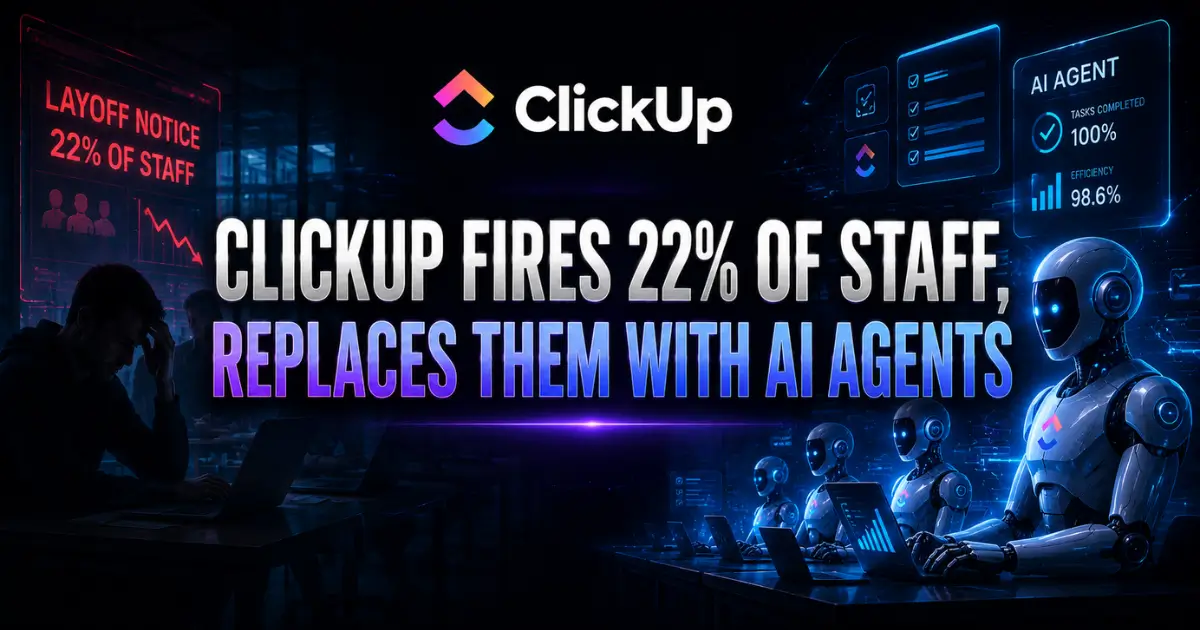
Collaboration software startup ClickUp has laid off 22 percent of its workforce and replaced hundreds of employees with roughly 3,000 internal AI agents. But CEO Zeb Evans is not calling it a cost-cutting move. He is calling it a radical bet on AI — one that he claims will turn ClickUp into what he describes as a "100x org." For the employees who survived the cuts, the reward is striking: million-dollar salary bands for those who create outsized impact using AI.
The announcement, made on X last Thursday, is one of the clearest statements yet of where AI-driven employment is heading. And it is forcing an uncomfortable question across the entire tech industry: when a company can replace people with agents and pay the survivors more, what happens to everyone in the middle?
What ClickUp Actually Did
ClickUp, last valued at $4 billion in 2021, deployed approximately 3,000 internal AI agents to handle a wide range of complex tasks across the company. Instead of performing the work themselves, the remaining employees are now expected to direct these agents and review their output to ensure it meets company standards.
Evans framed the restructuring in unusually direct terms. Most of the savings from the layoffs, he said, will flow directly back to the people who stay. The company is introducing million-dollar salary bands, and employees who generate exceptional impact using AI will be paid outside traditional compensation structures. The goal, in his words, is to turn ClickUp into a "100x org" — a company that produces 100 times the output per employee.
The logic is simple and brutal. AI agents handle the routine work. A smaller group of highly paid humans orchestrates those agents. And the people whose jobs the agents now perform are gone.
The Productivity Promise Versus the Data
ClickUp insists it is genuinely seeing productivity gains. Evans told TechCrunch the company is measuring those efficiencies internally and is preparing to build them into a forthcoming product for its customers. Rather than tracking how much AI employees consume, ClickUp says it measures value created and time saved.
That distinction matters because the broader data is far less flattering. According to a recent Gartner survey, about 80 percent of companies using autonomous technology have cut jobs — but those workforce reductions are not necessarily translating into meaningful financial returns. In other words, many companies appear to be using unproven AI as an excuse to downsize, then discovering the promised gains never materialize.
ClickUp maintains it is not one of those companies. Whether that claim holds up will become clear only when the productivity gains show up in revenue rather than headcount reduction. The pattern of cutting first and proving value later has become common enough that skepticism is warranted.
A Pattern Across the Industry
ClickUp is not an outlier. It is the latest and most aggressive example of a trend that has accelerated throughout 2026. Cloudflare recently admitted that AI made 1,100 jobs obsolete even as it posted record quarterly revenue. Cisco cut 4,000 jobs to redirect budget toward AI infrastructure. And Match Group, the owner of Tinder, froze hiring to fund its rising AI spending.
The common thread is that these are not struggling companies. They are profitable, growing businesses choosing to replace human labor with AI because the economics now favor it. That is precisely what makes the trend so significant. When healthy companies cut workers despite strong performance, the displacement is structural, not cyclical.
The data backs up the anxiety. Goldman Sachs has warned that AI could eliminate 25 million US jobs over the coming years. Even as Nvidia CEO Jensen Huang argues that AI creates more jobs than it destroys, the monthly numbers tell a more complicated story — and the people losing their roles are not finding comparable replacements.
The Disappearing Middle
The most important detail in ClickUp's announcement is the bifurcation it creates. On one side, a small group of highly paid, AI-augmented employees earning million-dollar salaries. On the other, the hundreds of workers who were let go entirely. The middle — the average employee doing average work at an average salary — simply disappears.
This is the dynamic that recently made AI the most dreaded topic at 2026 graduation ceremonies, where graduates booed speakers who framed AI as pure opportunity while entry-level job offers evaporated. ClickUp's model gives that fear a concrete shape. The promise of million-dollar salaries is real — but only for the few who can prove they amplify AI rather than compete with it.
The agentic capability behind this shift is improving rapidly. Enterprise platforms like Sierra's AI agents, now valued at $15 billion, and Notion's AI agent hub are making it easier for any company to deploy thousands of agents the way ClickUp did. As the tooling matures, more companies will be able to follow ClickUp's playbook — and many will.
The One-Person Company
If ClickUp represents the near-term future, a startup called Polsia hints at the extreme version. The one-year-old company, which claims to handle all software operations for solopreneurs, is run by exactly one person — founder and CEO Ben Broca. That radical efficiency is apparently paying off. Polsia recently raised $30 million at a $250 million valuation.
A $250 million company run by a single human would have been unthinkable a few years ago. Today it is a glimpse of where maximally-automated businesses are heading. When AI agents can handle operations, support, engineering, and content, the number of humans a company actually needs collapses — and the value each remaining human captures rises dramatically.
What It Actually Means
ClickUp's restructuring is a preview of a workforce model that more companies will adopt. The questions it raises extend well beyond one startup. If automating your own job is the only way to keep it — as Evans suggested — then the workers best positioned to survive are those who treat AI as a force multiplier rather than a threat. But not everyone can become an orchestrator of agents. And the math of a "100x org" implies that, over time, ClickUp will need fewer and fewer people regardless of how well they adapt.
The deeper tension is the one that even OpenAI acknowledged in its policy paper on AI risk, which proposed robot taxes and a four-day work week to cushion the coming disruption. The productivity gains AI delivers are real. So is the human cost. ClickUp has chosen to lean fully into the first and accept the second. Whether that produces the 100x company Evans envisions — or simply a smaller company with a bigger AI bill — will be one of the defining business experiments of the year.
What is already clear is that the future of work is not humans versus AI. It is a small group of highly paid humans directing armies of AI agents, and a much larger group left searching for a seat at a table that keeps getting smaller.