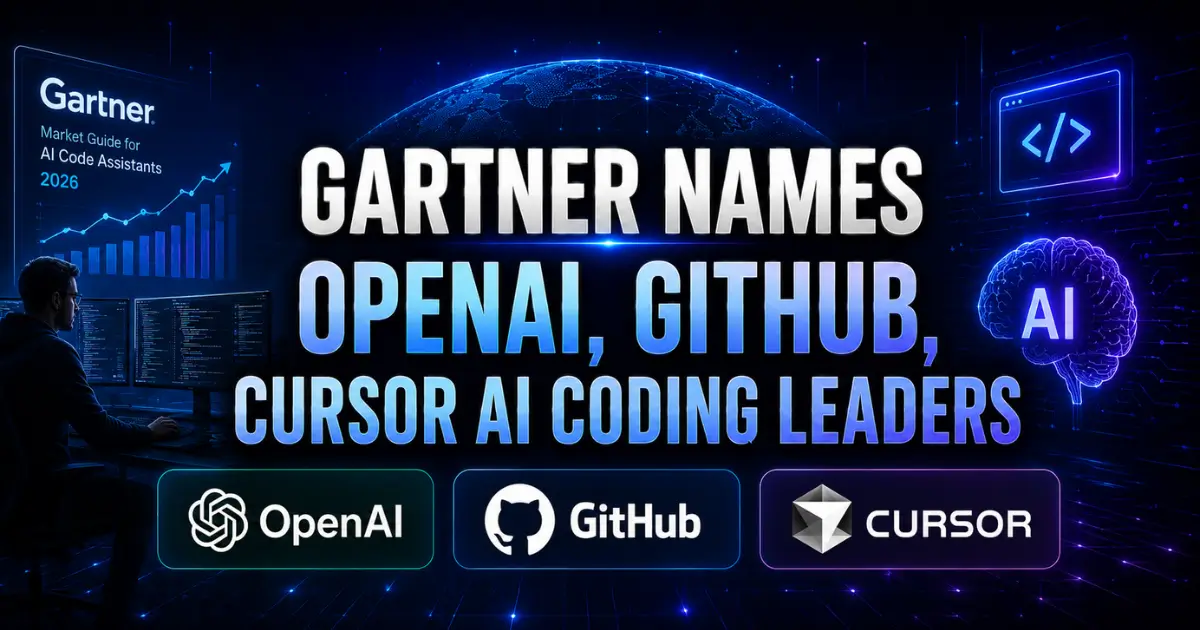
Gartner has published its inaugural Magic Quadrant for Enterprise AI Coding Agents — and the results map neatly onto the competitive dynamics that have defined the AI coding market throughout 2026. OpenAI, GitHub, and Cursor were all named Leaders. The report evaluated 12 vendors on their ability to execute and completeness of vision, marking the moment AI coding tools moved from experimental add-ons to enterprise infrastructure.
The Leaders
OpenAI earned the Leader designation for Codex. Gartner recognized its strengths in agentic software development, enterprise governance, sandboxing, and flexible deployment options. Codex now has over 4 million weekly users. Enterprise customers include Nvidia, Cisco, Datadog, Dell, and Virgin Atlantic. OpenAI has been rapidly improving Codex alongside GPT-5.5 with stronger tool use, faster performance, and deeper support for enterprise workflows.
GitHub Copilot was named a Leader for the third consecutive year. The report highlighted Copilot's multi-model approach — integrating models from multiple providers including Anthropic's Claude — and its presence across code editors, CLIs, IDEs, and GitHub's web and mobile apps. Microsoft's broader Copilot ecosystem, with 20 million paid enterprise users, gives GitHub Copilot unique distribution advantages.
Cursor earned the furthest position for Completeness of Vision — a notable distinction for a startup that was valued at just $2.5 billion in January 2025 and is now targeted by SpaceX for a $60 billion acquisition. Gartner recognized Cursor as a complete platform for agentic software development enabling complex organizations to transform their entire software delivery lifecycle.
Tabnine was named a Visionary. The company's enterprise focus on organizational context intelligence and trusted AI coding across the full delivery lifecycle earned recognition for both execution ability and vision.
What Is Notably Absent
The most striking aspect of the Magic Quadrant is what it does not include. Anthropic — whose Claude Code has been the dominant AI coding tool among enterprise developers throughout 2026 — does not appear to have been named in the Leaders quadrant alongside OpenAI, GitHub, and Cursor.
This is surprising given the data. Ramp spending data shows Anthropic has more business customers than OpenAI. Claude Code generates over $3 billion in annualized revenue. Replit's CEO ranked Anthropic first among AI labs. And even Elon Musk ranked Anthropic as the top AI company under oath.
The discrepancy may reflect Gartner's evaluation methodology. Magic Quadrants assess enterprise governance, deployment options, and vendor relationships — areas where OpenAI's Codex Labs partnerships with IT services firms and GitHub's three-year head start in enterprise adoption may score higher than Claude Code's developer-driven organic growth.
Why This Magic Quadrant Matters
Gartner Magic Quadrants influence billions in enterprise spending. CIOs and IT procurement teams use them as shortlists. Being named a Leader generates inbound sales inquiries, simplifies vendor evaluation, and provides cover for executives making purchasing decisions.
For OpenAI, the recognition validates its enterprise push at a critical moment. The company has been losing ground to Anthropic in enterprise AI. A Gartner Leader designation for Codex provides ammunition for its sales team and partners like Infosys who are deploying Codex across Fortune 500 clients.
For Cursor, the Leader designation alongside OpenAI and GitHub is remarkable for a startup. It positions the company as an equal to the industry's largest players — and makes the SpaceX acquisition option look less like a premium and more like fair value.
The Bigger Picture
Gartner's first Magic Quadrant for Enterprise AI Coding Agents confirms that AI coding has matured from experiment to enterprise requirement. The 12 vendors evaluated represent an ecosystem that did not exist three years ago. The Leaders — OpenAI, GitHub, Cursor — are collectively reshaping how software gets built at the world's largest organizations.
The question going forward is whether the Magic Quadrant captures what is actually happening in the market. If developers are choosing Claude Code over Codex in practice — as multiple data sources suggest — then the analyst rankings and the market reality may be telling different stories. And in enterprise AI, the market usually wins.