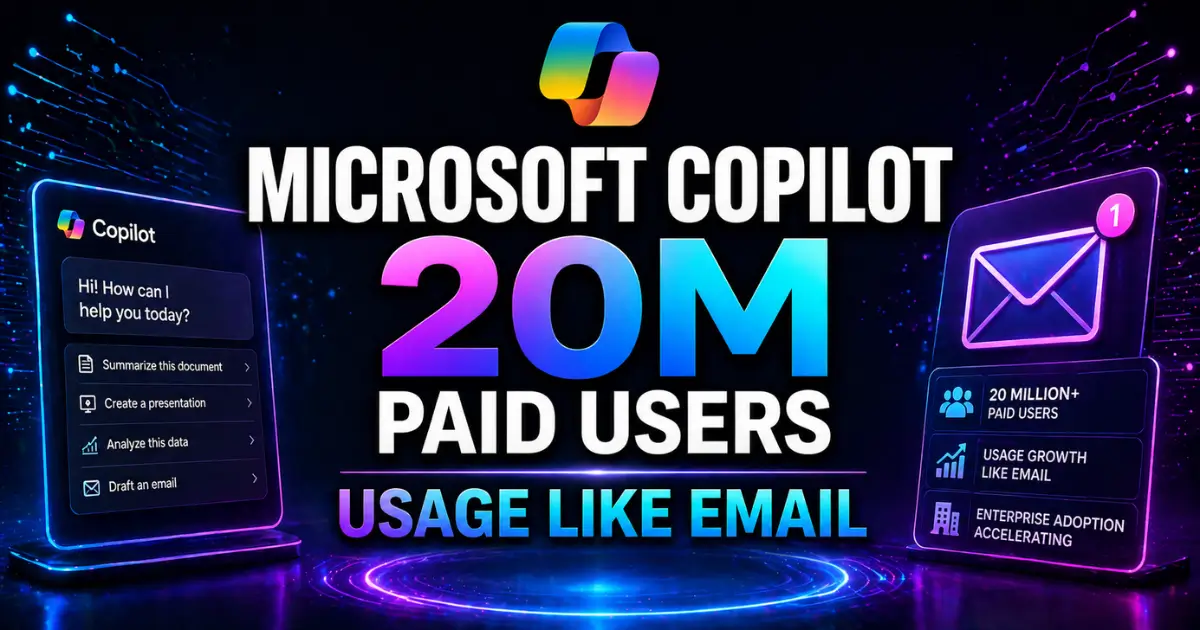
Microsoft Copilot now has 20 million paid enterprise users. CEO Satya Nadella said weekly engagement has reached the same level as Outlook email — making AI assistance a daily habit for millions of office workers. The numbers are far ahead of analyst expectations and challenge the lingering perception that enterprise AI tools are purchased but rarely used.
The Engagement Numbers
Copilot queries per user grew nearly 20 percent quarter-over-quarter. Nadella compared the usage intensity to Outlook, calling it a daily habit of intense use. For a product that launched less than two years ago, matching the engagement of the most essential business communication tool in the world is a significant milestone.
The company quadrupled the number of enterprises paying for over 50,000 Copilot seats. Bayer, Johnson & Johnson, Mercedes, and Roche each have more than 90,000 seats. And this week, Accenture signed up for over 740,000 seats — Microsoft's largest Copilot deal to date.
Morgan Stanley analyst Keith Weiss called the numbers "super impressive and way ahead of most people's expectations."
Agent Mode Changes Everything
The biggest driver of recent growth is Agent Mode, which Microsoft made the default experience across Word, Excel, and PowerPoint last week. Agent Mode allows Copilot to take multi-step actions directly inside documents — not just suggest edits or generate text, but autonomously execute complex tasks across multiple steps.
This shifts Copilot from an assistant you ask questions to into an AI agent that does work for you. The difference matters. An assistant answers when prompted. An agent acts autonomously. Making that capability the default in the world's most widely used office suite puts agentic AI directly into the daily workflow of millions of workers.
Multi-Model, Not Just OpenAI
Nadella emphasized that Copilot is no longer dependent on any single AI model. The system now uses multiple models by default, with intelligent auto-routing that selects the best model for each task. Microsoft 365 supports Anthropic's Claude alongside OpenAI's models, giving enterprise users access to the best available AI regardless of provider.
The multi-model approach reflects Microsoft's broader hedging strategy. The company recently renegotiated its OpenAI partnership, ending Azure exclusivity. It has built relationships with Anthropic through its OpenClaw initiative. And it continues to develop its own AI capabilities independently.
For enterprise customers, multi-model support means Copilot can route a coding task to one model, a writing task to another, and a data analysis task to a third — automatically selecting the best tool for each job without user intervention.
The Enterprise AI Race
Microsoft's Copilot numbers put pressure on every competitor in the enterprise AI space. Google's Workspace Intelligence launched with similar ambitions but does not yet have comparable user numbers. Anthropic's Claude Code dominates the developer market but does not compete directly in office productivity. And standalone AI tools struggle to match the distribution advantage of being built into Word and Excel.
Microsoft's edge is distribution. With over 400 million Microsoft 365 users worldwide, Copilot does not need to acquire customers — it needs to convert existing ones. The 20 million paid seat milestone represents roughly 5 percent conversion. If engagement continues growing at current rates, that percentage could climb rapidly.
The Revenue Impact
Microsoft reported $70.1 billion in total revenue for the quarter, up 13 percent year-over-year. Azure and other cloud services revenue grew 33 percent. The company did not break out Copilot revenue specifically, but at roughly $30 per user per month, 20 million paid seats represent approximately $7.2 billion in annualized Copilot revenue alone.
That figure would make Copilot one of the fastest-growing enterprise software products in history. It also validates the AI monetization model that many analysts questioned when Microsoft first launched the $30 add-on — a price that some enterprise buyers initially resisted.
The Bigger Picture
Microsoft's Copilot milestone answers one of the most important questions in enterprise AI: are people actually using these tools? The answer, based on engagement data matching Outlook, appears to be yes. The era of AI shelfware — products purchased but ignored — may be ending, at least for tools embedded deeply enough into existing workflows.
For the AI industry, the implication is clear. The winners in enterprise AI will not be the companies with the best standalone chatbot. They will be the companies that embed AI into the tools people already use every day. Microsoft built Word, Excel, and Outlook. Now it is making sure AI lives inside all of them.