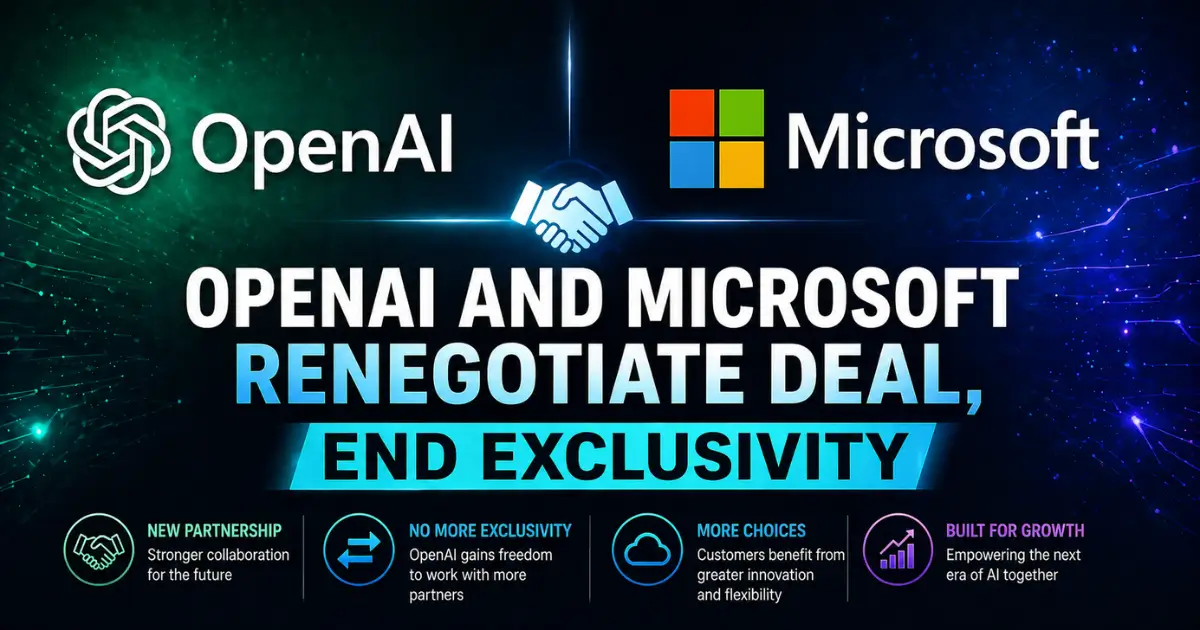
Microsoft and OpenAI have renegotiated their partnership again — this time replacing Microsoft's exclusive rights with a non-exclusive license that runs through 2032. The new deal eliminates the legal threat hanging over OpenAI's $50 billion Amazon investment by allowing OpenAI to serve all its products across any cloud provider, while Microsoft retains its 27 percent stake and continues to collect revenue share through 2030.
What Changed
The most consequential change is the end of Microsoft's exclusivity. Under the previous agreement, Microsoft had exclusive access to all of OpenAI's models and products accessed through APIs — a restriction that directly conflicted with OpenAI's February deal with Amazon, in which AWS was promised exclusive rights to host OpenAI's new agent-making tool Frontier.
Microsoft had publicly pushed back on the Amazon deal the same day it was announced, emphasizing that Azure remained the exclusive cloud provider for OpenAI's APIs. The Financial Times subsequently reported that Microsoft was considering legal action to enforce those terms.
The new agreement resolves the conflict. OpenAI products will ship first on Azure, but OpenAI can now serve all its products to customers across any cloud provider. Amazon CEO Andy Jassy celebrated the deal on social media, confirming that OpenAI's models will become available on AWS Bedrock in the coming weeks.
The Financial Terms
The renegotiation produced a clean financial trade. Microsoft no longer has to pay revenue share to OpenAI — a significant cost saving given that Microsoft reported $7.5 billion in a single quarter from its OpenAI investment. In exchange, OpenAI will continue paying revenue share to Microsoft through 2030, subject to a cap.
Microsoft also retains its approximately 27 percent ownership stake in OpenAI's for-profit entity. That means Microsoft continues to benefit financially from OpenAI's growth — even when that growth comes from sales made on AWS rather than Azure.
The deal gives the partnership a definitive calendar end date of 2032, replacing the previous arrangement that was tied to the undefined milestone of OpenAI achieving AGI. For both companies, a fixed timeline provides clearer planning and removes the ambiguity of an open-ended commitment.
Why OpenAI Needed This
The Amazon deal was worth up to $50 billion — comprising a $15 billion initial investment and another $35 billion contingent on certain conditions. In exchange, OpenAI agreed to co-develop stateful runtime technology on AWS Bedrock, the infrastructure that supports AI agents by allowing them to remember tasks and contexts over long periods.
But OpenAI could not deliver on those promises without violating its Microsoft contract. The new agreement resolves that contradiction, allowing OpenAI to fulfill its commitments to Amazon while maintaining its relationship with Microsoft as its primary cloud partner.
For OpenAI, the ability to operate across multiple clouds is strategically critical. The company is simultaneously competing with Anthropic for enterprise customers, rolling out GPT-5.5, building its superapp vision, and preparing to defend itself in the Musk trial. Being locked into a single cloud provider limited its flexibility at exactly the wrong moment.
A Timeline of Escalation
The renegotiation caps months of escalating tension between Microsoft and OpenAI:
In October 2025, the two companies signed an agreement giving OpenAI the ability to run non-API products on other clouds. In November, OpenAI signed a $38 billion AWS cloud contract. In February, Amazon announced its $50 billion investment, and Microsoft publicly refuted the exclusivity terms that same day. In March, the Financial Times reported Microsoft was considering legal action. And in April, the new deal was announced — eliminating Microsoft's exclusive rights entirely.
Microsoft's Consolation Prize
Despite losing exclusivity, Microsoft emerges with meaningful advantages. It no longer pays revenue share to OpenAI. It keeps its ownership stake. And it remains OpenAI's primary cloud partner with products shipping on Azure first.
Microsoft has also hedged its AI bets by building a relationship with Anthropic, using Claude to power agentic products through its OpenClaw initiative. Just as OpenAI has diversified its cloud providers, Microsoft has diversified its AI model partners — reducing its dependence on any single lab.
What It Means
The biggest winners are enterprise customers, who now get to choose both their AI models and their cloud providers without being forced into a single vendor's ecosystem. The biggest losers are the exclusivity arrangements that defined the early AI era — deals that looked powerful on paper but proved unsustainable as the market evolved.
For the AI industry, the renegotiation confirms that the cloud giants and the AI labs are locked in a complex dance where no single partnership can contain the ambitions of either side. OpenAI needs multiple clouds. Microsoft needs multiple models. And the era of exclusive AI deals appears to be ending as quickly as it began.