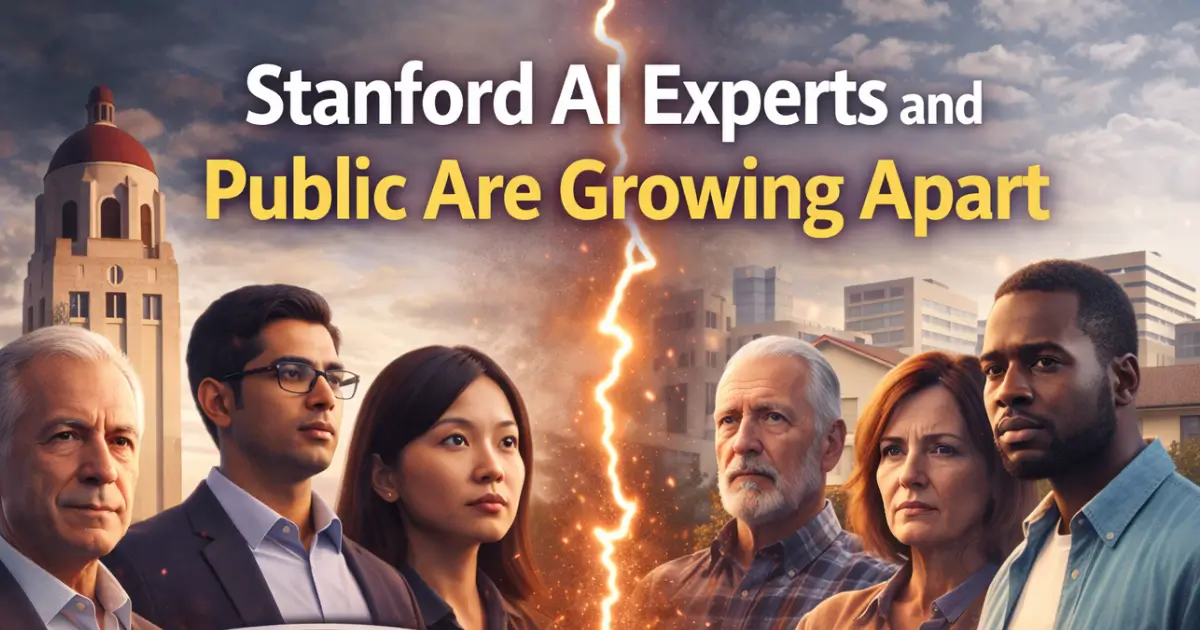
Artificial intelligence is advancing at an unprecedented pace but depending on who you ask, it's either humanity's greatest opportunity or its most serious threat. A major new report from Stanford University makes clear that these two camps are not just different in opinion they are living in entirely different realities.
AI experts and the public's opinions on the technology are increasingly diverging, according to Stanford University's annual report on the AI industry, released Monday. In particular, the report noted a growing trend of anxiety around AI and, in the U.S., concerns about how the technology will impact key societal areas such as jobs, medical care, and the economy.
The Numbers Tell a Stark Story
The gap between expert optimism and public fear is not subtle it is vast, and measurable across nearly every category Stanford examined.
A Pew Research report published last month found that only 10% of Americans said they were more excited than concerned about the increased use of AI in daily life. Meanwhile, 56% of AI experts said they believed AI would have a positive impact on the U.S. over the next 20 years.
The divergence is even sharper on specific issues. 84% of experts said AI would have a largely positive impact on medical care over the next 20 years, but only 44% of the U.S. general public said the same. A majority of experts 73% felt positive about AI's impact on how people do their jobs, compared with just 23% of the public. And 69% of experts felt AI would have a positive impact on the economy, while only 21% of the public felt similarly.
Those are not minor differences. They represent a fundamental disagreement about the technology's trajectory.
Jobs Are the Core Anxiety
The sharpest point of public fear centers on employment. Nearly two-thirds of Americans 64% said they think AI will lead to fewer jobs over the next 20 years, while AI experts were considerably less pessimistic on AI's impact on the job market.
This fear is not irrational. High-profile layoffs at major companies, the rapid rise of AI coding tools, and widespread media coverage of automation have all contributed to a public that sees AI as a threat to their livelihoods not a productivity booster.
Gen Z Is Leading the Backlash
The report's findings follow growing negative sentiment about AI, with Gen Z reportedly leading the way according to a recent Gallup poll. The study found that young people were growing less hopeful and more angry about the technology, even though around half of the demographic was using AI either daily or weekly.
The paradox is striking Gen Z is using AI extensively while simultaneously growing more resentful of it. Heavy usage and negative sentiment are not mutually exclusive when the technology feels imposed rather than chosen, and when its consequences like job competition feel personal.
AI Insiders Are Out of Touch
For some working in tech, the AI backlash has come as a surprise. AI leaders have focused on managing the possibility of Artificial General Intelligence a theoretical form of AI superintelligence but everyday people are more concerned about AI's impact on their paycheck and whether their power bills will go up as energy-hungry data centers are built.
The disconnect has been on full public display in the reaction to recent attacks on OpenAI CEO Sam Altman's home, where some social media commenters expressed sympathy toward the attacker a sentiment that genuinely shocked many in the tech community but reflected a deeper undercurrent of public anger at AI's perceived winners.
Americans Don't Trust Their Government to Regulate AI
Compounding public anxiety is a deep mistrust of the institutions meant to provide oversight. The U.S. reported the lowest trust in its government to regulate AI responsibly compared with other nations, at just 31%. Singapore ranked highest at 81%.
On the regulatory question, 41% of U.S. respondents said federal AI regulation will not go far enough, while only 27% said it would go "too far." Americans, in other words, are not anti-regulation they're skeptical that regulation will actually protect them.
One Silver Lining
Not everything in the data points downward. Globally, those who feel AI products and services offer more benefits than drawbacks slightly rose from 55% in 2024 to 59% in 2025. But at the same time, those who said AI makes them "nervous" grew from 50% to 52% during the same period.
People can acknowledge AI's benefits and still feel deeply uneasy about it. That tension benefit and anxiety coexisting may be the defining public mood of the AI era.