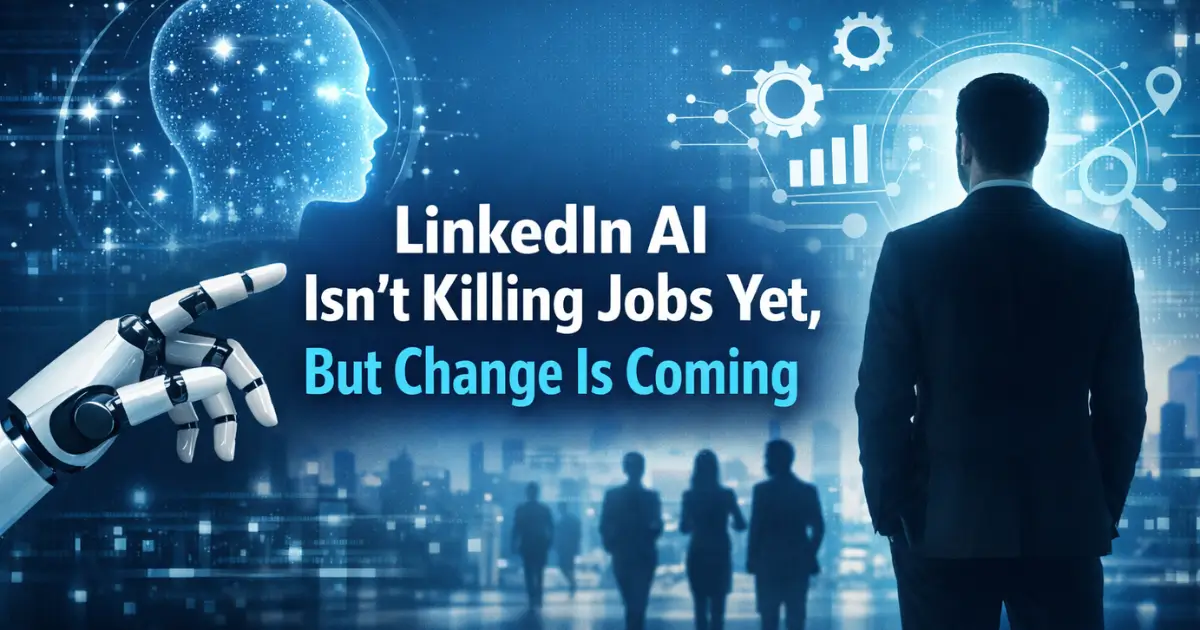
One of the most persistent fears surrounding the rise of artificial intelligence is that it will destroy jobs on a massive scale. But according to LinkedIn's own data, drawn from over a billion members on the world's largest professional network, that scenario has not materialized — at least not yet.
Speaking at the Semafor World Economy summit this week, LinkedIn's chief global affairs and legal officer Blake Lawit confirmed that hiring across the platform has declined by roughly 20 percent since 2022. However, he was clear that AI is not the driving force behind that drop. The real culprit, he suggested, is rising interest rates, which have slowed economic activity and made companies more cautious about expanding their workforces.
The Data Tells a Different Story
LinkedIn occupies a unique position in the global labor market. With its "economic graph" spanning more than a billion members, millions of companies, and detailed data on jobs and skills, the platform has one of the most comprehensive real-time views of employment trends anywhere in the world. And when LinkedIn's analysts looked specifically at whether AI was displacing workers, the answer was surprisingly straightforward: they could not find evidence of it.
Lawit pointed out that the sectors most commonly expected to be disrupted by AI — customer support, administrative roles, and marketing — have not experienced hiring declines that are disproportionately larger than other industries. Hiring is down broadly, but not down more in the areas where AI adoption is highest or where automation fears are strongest.
He also addressed concerns about younger workers, particularly college-aged adults entering the job market for the first time. There has been widespread anxiety that AI could hit entry-level positions hardest, eliminating the kinds of tasks that have traditionally served as on-ramps for new graduates. But LinkedIn's data does not support that fear either. The hiring decline among young adults is not significantly worse than the decline among mid-career or senior professionals.
A Warning About What Comes Next
While the current data may be reassuring, Lawit was careful not to dismiss the longer-term implications of AI for the labor market. He acknowledged that things could change and that the absence of impact today does not guarantee stability tomorrow.
His most striking warning came in the form of a statistic about skills. Over the past several years, LinkedIn has observed that the skills required to perform the average job have already changed by 25 percent. With AI accelerating the transformation of work, the company expects that figure to reach 70 percent by 2030.
That means even workers who keep their current jobs will find those jobs looking very different within a few years. The tasks, tools, and competencies required to succeed will shift dramatically, and workers who do not adapt risk falling behind even if their positions are never formally eliminated.
What This Means for Workers
The distinction Lawit draws is an important one. The popular narrative around AI and employment tends to focus on outright job loss — robots replacing humans, entire departments being automated away. But the more immediate and perhaps more insidious risk is job transformation. Workers may keep their titles and their desks, but the work they do and the skills they need will change so fundamentally that staying relevant will require continuous learning and adaptation.
This is already visible in industries that have adopted AI tools aggressively. Marketing teams now use AI for content generation, data analysis, and campaign optimization. Customer support departments are deploying chatbots and AI-powered assistants. Software development teams are writing code with AI copilots. In each case, the jobs still exist, but the people doing them need very different capabilities than they did three years ago.
The Bigger Picture
LinkedIn's findings offer a moment of relief in an otherwise anxious conversation about AI and work. Jobs are not disappearing because of AI — not yet. But the relief comes with a clear caveat: the nature of work is changing at an unprecedented pace, and the gap between workers who embrace that change and those who resist it will only widen.
For job seekers, the message is clear. Learning to work alongside AI tools is no longer optional — it is becoming a baseline expectation. For employers, the challenge is equally pressing: investing in reskilling and upskilling programs is not just a nice-to-have but a strategic necessity.
AI may not be taking jobs today. But it is already reshaping every job it touches. And by 2030, according to LinkedIn's own projections, very few jobs will remain untouched.