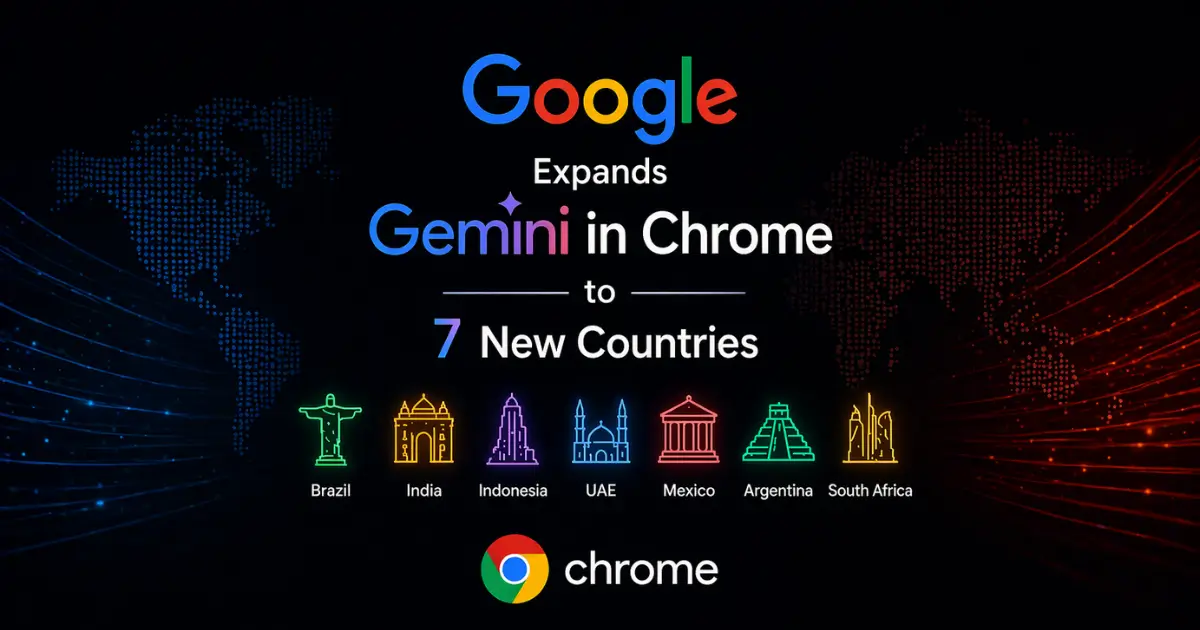
Google announced Monday that its Gemini in Chrome feature is now available in seven new markets: Australia, Indonesia, Japan, the Philippines, Singapore, South Korea, and Vietnam. The expansion brings Google's AI-powered browser assistant to some of the fastest-growing internet markets in the Asia-Pacific region.
What Users Get
Gemini in Chrome works through a sidebar-based assistant that lets users ask questions across their open tabs, get personalized answers using connected Google services, and perform actions without leaving the browser. Users can schedule meetings through Calendar, check locations with Maps, draft and send emails through Gmail, and connect to services like Google Photos for personalized responses.
The feature also supports image transformation on web pages using Nano Banana 2 in the sidebar a tool that lets users modify images directly within the browsing experience.
The rollout covers both desktop and iOS in all seven new countries except Japan, where availability may be limited initially. Google has not specified when Android support will follow in these markets.
Rapid Global Expansion
The expansion follows an aggressive rollout timeline. Gemini in Chrome first launched in the US in January. Google expanded it to India, Canada, and New Zealand in March. With this latest wave, the feature is now available in at least 11 countries with more expected to follow.
The pace of the rollout reflects Google's broader strategy of embedding AI deeply into Chrome before competitors can establish alternative browsing paradigms. OpenAI's Atlas browser, Perplexity's Comet, and The Browser Company's Dia are all positioning themselves as AI-first alternatives to Chrome.
Skills and Side-by-Side Browsing
The country expansion comes alongside a series of other Chrome AI updates Google has announced in recent weeks. The company launched AI Skills, which let users save and reuse favorite AI prompts across any webpage. It also introduced side-by-side browsing in AI Mode, allowing users to explore websites alongside the AI conversation without losing context.
Together, these features are transforming Chrome from a traditional browser into something closer to an AI workspace a platform where users research, compare, and take actions with AI assistance built into every interaction.
The Agentic Feature Is Still US-Only
One notable limitation: Google's most advanced agentic feature for Chrome, which can autonomously control the browser window to complete tasks on a user's behalf, remains in testing and is only available to US users on paid AI Pro and AI Ultra plans. This is the feature that would make Chrome a true AI agent rather than just an assistant but Google appears to be rolling it out cautiously.
Why Asia-Pacific Matters
The choice of expansion markets is strategic. Southeast Asia and the Asia-Pacific region represent some of the world's fastest-growing internet populations, with high smartphone penetration and rapidly increasing digital adoption. Indonesia alone has over 200 million internet users. Getting Gemini in Chrome into these markets early gives Google a significant head start in shaping how hundreds of millions of new users experience AI-assisted browsing.
For Google, Chrome is not just a browser it is the distribution channel for its entire AI strategy. With over two billion users worldwide, every feature Google adds to Chrome reaches a scale that no standalone AI product can match.