Companies are racing to roll out artificial intelligence tools across their workforces, but a major new poll suggests that many employees simply aren't interested. New Gallup polling finds that while more employees are using AI frequently in their work, there's been an uptick in alarm that new technologies will replace their jobs. Many workers who are not using AI say they prefer to work without it, have ethical oppositions to the technology, or worry about data privacy.
The findings reveal a growing split in how American workers are experiencing the AI revolution one that corporate adoption strategies and boardroom enthusiasm are failing to bridge.
By the Numbers: What the Poll Found
Gallup's most recent survey of 23,717 employed U.S. adults was conducted February 4–19, 2026, with a margin of sampling error of plus or minus 0.9 percentage points. The scale of the study makes its findings hard to ignore.
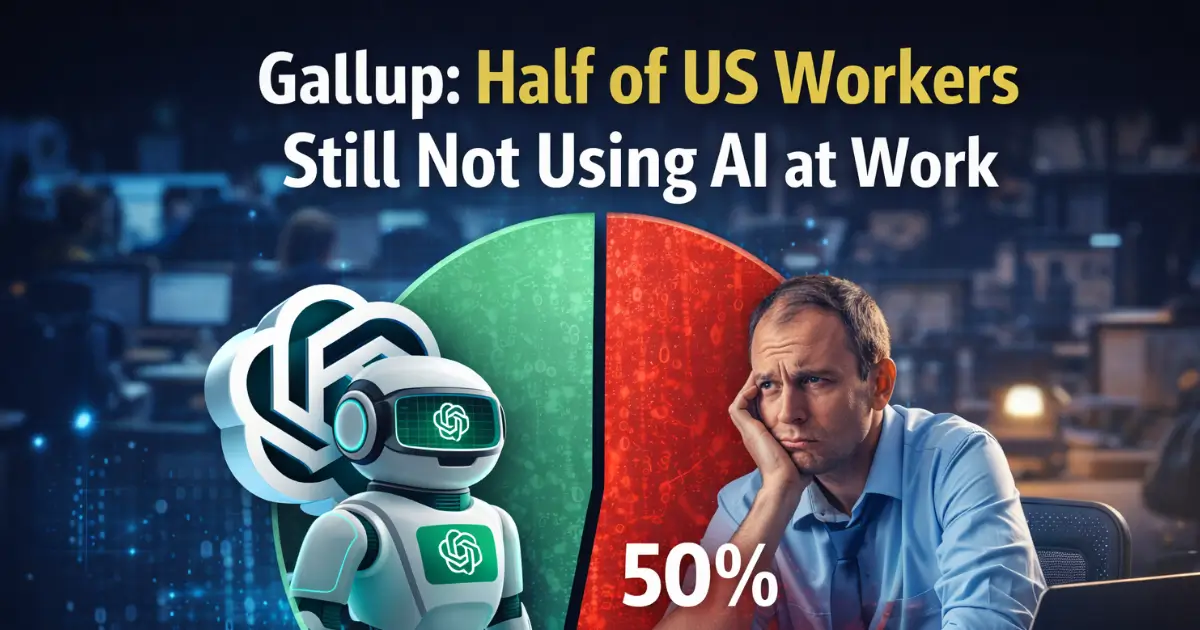
About 4 in 10 workers say their organization has adopted AI tools or technology to improve organizational practices. Yet even within that group, adoption is far from universal. About half of U.S. employees use AI only once a year or not at all, according to the Gallup study.
That means the technology is physically present in millions of workplaces and being actively ignored by a significant portion of the workforce.
When It Works, It Really Works
For those who do embrace AI, the productivity gains are notable. About two-thirds of workers who use AI say it has had an "extremely" or "somewhat" positive impact on their individual productivity and efficiency at work.
The benefits are especially pronounced among those in leadership positions. About 7 in 10 leaders using AI at least a few times a year say AI has made them more efficient at work, compared with just over half of individual contributors.
The gap between managers and frontline workers in AI enthusiasm is telling and may reflect differences in the types of tasks each group handles, as well as varying levels of digital confidence.
Why Non-Users Are Saying No
The reasons employees give for skipping AI at work are varied but preference is the biggest factor. Among workers who have AI tools available at their company and don't use them, 46% say it's because they prefer to keep doing their work the way they do it now. About 4 in 10 non-users who have AI available report that they are ethically opposed to AI, are concerned about data privacy, or don't believe AI can be helpful for the work they do.
These aren't trivial objections. Privacy concerns are well-founded many enterprise AI tools process sensitive business data, and employees may be right to be cautious about what they feed into these systems. Ethical objections, meanwhile, reflect a growing public conversation about AI's broader societal impacts.
The Hallucination Problem Is Real
For some workers, skepticism about AI isn't abstract it's grounded in direct experience. Labor and employment attorney Elizabeth Bloch said she has tried using AI for legal research but found it unreliable. Bloch said she finds AI prone to hallucinations generating false information even when using AI tools custom-built for legal work. She's concerned that lawyers who were already poor at finding and citing relevant case law will struggle with AI, potentially leading judges to sanction them for false citations.
Her concerns highlight a core challenge: AI tools can be transformative in the right hands, but genuinely risky when used by people who lack the expertise to verify the outputs.
The Job Displacement Fear Is Growing
Beyond individual workflow concerns, a deeper anxiety is spreading through the workforce. About 18% of U.S. workers say it is "very" or "somewhat" likely that their current job will be eliminated within the next five years because of new technology, automation, robots, or AI up from 15% in 2025. People working at companies that have adopted AI are even more likely to be concerned, with 23% saying job elimination is at least "somewhat" likely.
Broader public opinion reflects similar anxieties. A Fox News poll conducted in March found that about 6 in 10 registered voters believe AI will eliminate more jobs than it creates over the next five years, with only about 1 in 10 expecting it will create more positions.
The Bottom Line
The Gallup poll paints a picture of a workforce that is divided, cautious, and in many cases deliberately choosing to opt out of AI not because they can't access it, but because they don't trust it, don't need it, or simply don't want it. For companies betting their productivity gains on AI adoption, that's a serious challenge. Deploying the tools is the easy part. Getting people to actually use them is something else entirely.