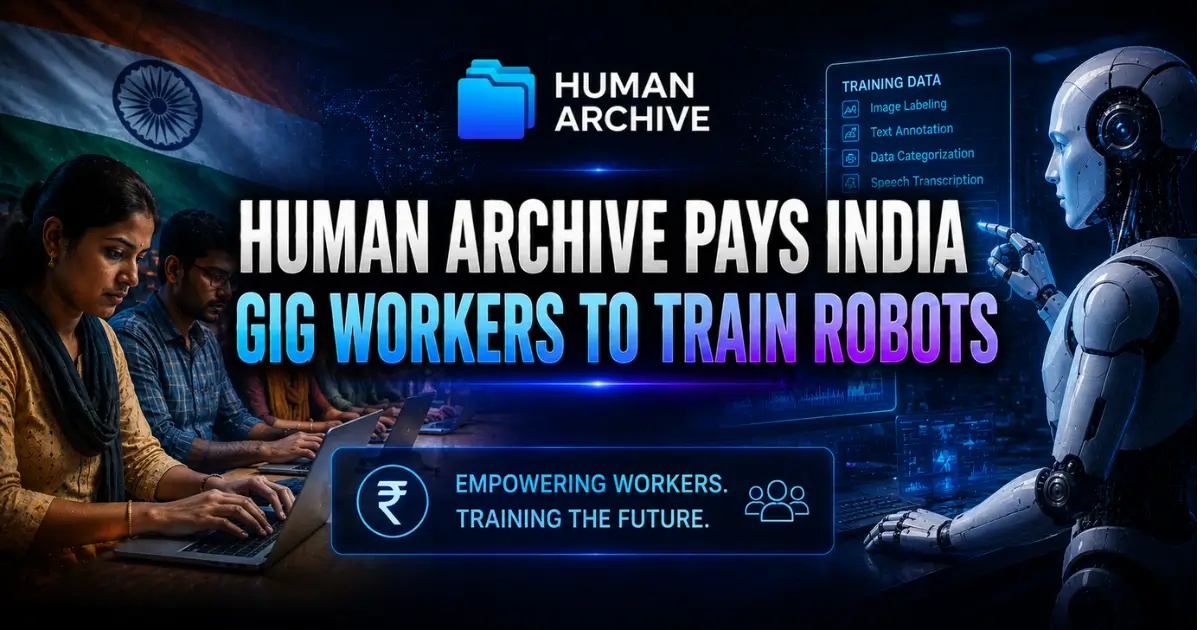
Silicon Valley startup Human Archive has a provocative bet: the millions of workers staffing India's booming gig economy can train the world's robots. The company is paying gig workers in India roughly $1 an hour to wear camera-equipped caps and sensor devices that capture first-person video of everyday physical tasks — the exact data that robotics labs and frontier AI companies are racing to acquire. On Tuesday, Human Archive announced it has raised $8.2 million to scale the effort.
The funding came from Wing Venture Capital, NVP Capital, Y Combinator, and a roster of angels from OpenAI, Nvidia, Google, Meta, Mercor, and AfterQuery. The startup was founded by three UC Berkeley students and one from Stanford — Samay Maini, Rushil Agarwal, Shloke Patel, and Raj Patel, who serves as CEO. All four have research backgrounds spanning robotics, hardware, and tactile data.
The Data Bottleneck Behind Physical AI
Human Archive's founding is a direct bet on where the AI industry is heading. As robotics labs and frontier AI companies race to build machines that can perform physical tasks in the real world, they face a critical bottleneck — a shortage of high-quality, real-world training data showing humans doing everyday work. Text and images are abundant on the internet. Footage of a human cleaning a kitchen counter, folding laundry, or plating food from a first-person perspective is not.
That gap is exactly what the company is trying to fill. The startup is working with companies in the home services, hotel, and restaurant sectors to collect egocentric data — first-person point-of-view video — and says it already has more than 1,000 active headsets deployed across multiple locations. The same physical AI thesis is driving deals across the industry, including the moment when Meta acquired robotics startup ARI for humanoid AI, and the symbolic milestone when humanoid robots beat humans at a Beijing marathon. Machines are moving off screens and into the physical world — and they need to learn from people first.
Why India
India is the center of Human Archive's strategy for a reason. The country's online food delivery market has grown dramatically, with Zomato and Swiggy both going public. On-demand home services platforms like Urban Company, Snabbit, and Pronto have gained enormous popularity. That creates a vast, organized workforce performing exactly the kinds of physical tasks robots need to learn — and a population eager to participate in the AI economy.
The traction mirrors a broader pattern. India has become one of the fastest-growing markets for AI products globally, as shown when ChatGPT Images 2.0 became a hit in India with millions of downloads in a single week, riding the same wave as India's booming app market. India is also producing the talent building these systems — including the Pakistani co-founder of Cursor and the South Asian engineers staffing Silicon Valley's leading labs. Human Archive is betting the region can supply both the data and the workforce that physical AI demands.
What Makes the Data Different
To differentiate itself from rivals collecting similar footage, Human Archive is building custom hardware that captures far more than video. The company uses tactile gloves, a full-body motion capture suit, and wrist cameras to record motion and tactile force, synchronously aligned with RGB-D — color imagery paired in real time with depth information. The startup believes video alone is not enough. Pairing it with synchronized sensor data, the company argues, makes the dataset dramatically more valuable to AI labs.
The company started with iPhones and makeshift rigs, then built its own custom caps and devices. It now has more than seven different hardware products it uses interchangeably across different data types, with more than 50 devices deployed in the field. Zach DeWitt, a partner at Wing VC, said no one else in the world has been able to synchronize and collect headset RGB-D, force feedback, full-body motion capture, and chest and wrist camera data at scale — and that major labs and universities are eager to run experiments on the dataset.
The Public Spat With Indian Startups
Human Archive's expansion has not been smooth. The startup said it was rejected by many Indian home services companies, including Pronto and Urban Company. The rejections became public last weekend when Indian outlet Entrackr reported that Pronto was independently seeking data partnerships and that Snabbit had held early talks with Human Archive before the project fell apart.
The exchange turned combative. Urban Company CEO Abhiraj Singh Bhal said publicly that his company would not engage in such arrangements, prompting CEO Raj Patel to fire back that Urban Company would soon be forced to reconsider or risk losing relevance. Co-founder Rushil Agarwal went further, claiming a Pronto founder had laughed at him and called the idea "stupid." Pronto acknowledged the conversations but said it chose not to move forward, and denied the insult. The public friction underscores how contested — and how valuable — this data has suddenly become.
The Privacy Problem
The model raises serious privacy questions. Human Archive partners with smaller startups to offer discounted services. When a worker arrives at a home, the customer is offered a choice through the app: pay a reduced price in exchange for consenting to data collection, or pay full price for an unrecorded visit. Patel said customers have often chosen the discount, in part because video recordings can help resolve disputes about service quality.
But it is not fully clear what workers are told about how their footage is used. The company says its contracts comply with India's Digital Personal Data Protection Act, that it displays consent notices, and that all data is anonymized with faces blurred. Even so, India's Ministry of Electronics and Information Technology is reportedly examining the consent mechanisms and data-collection practices of startups gathering egocentric data through home service workers. The concerns echo the broader unease around ambient recording devices — the same tension raised when Amazon's Bee AI wearable records conversations throughout the day. When AI's appetite for real-world data meets people's homes, consent becomes the hardest problem to solve.
The Economics of the Bargain
The compensation sits at the center of the ethical debate. Human Archive pays workers a base rate of $1 per hour for participating in data collection. By comparison, the Economic Times reports that other firms pay roughly $2.63 to $4.20 per hour. Patel acknowledged that competitors pay more, but said the company's on-the-ground presence in India lets it keep compensation lower.
DeWitt framed the arrangement as a bridge that funds immediate livelihoods while building infrastructure for a more productive future. Critics will see a familiar pattern — workers in the Global South paid a fraction of Western wages to generate the raw material that powers trillion-dollar AI ambitions. It is the same dynamic visible across the industry as the AI economy hits hard physical limits and companies search for any edge in cost, data, or compute.
What It Means
Human Archive is one of several well-funded startups racing to solve physical AI's data problem, and its approach is still unproven at scale. Whether it succeeds will hinge on the partnerships it can strike and the uniqueness and volume of the data it collects. The company is already expanding into Southeast Asia and the United States, and is building a platform that would let anyone, anywhere, participate in data collection and earn money.
The bigger story is what Human Archive represents. The race to build robots that work in the real world has created demand for a new kind of labor — humans wearing sensors, performing ordinary tasks, teaching machines to eventually replace them. India's gig economy, vast and organized, has become the training ground. Whether that is an opportunity or an exploitation may depend entirely on who you ask — the labs buying the data, the startups selling it, or the workers earning a dollar an hour to record their own work.