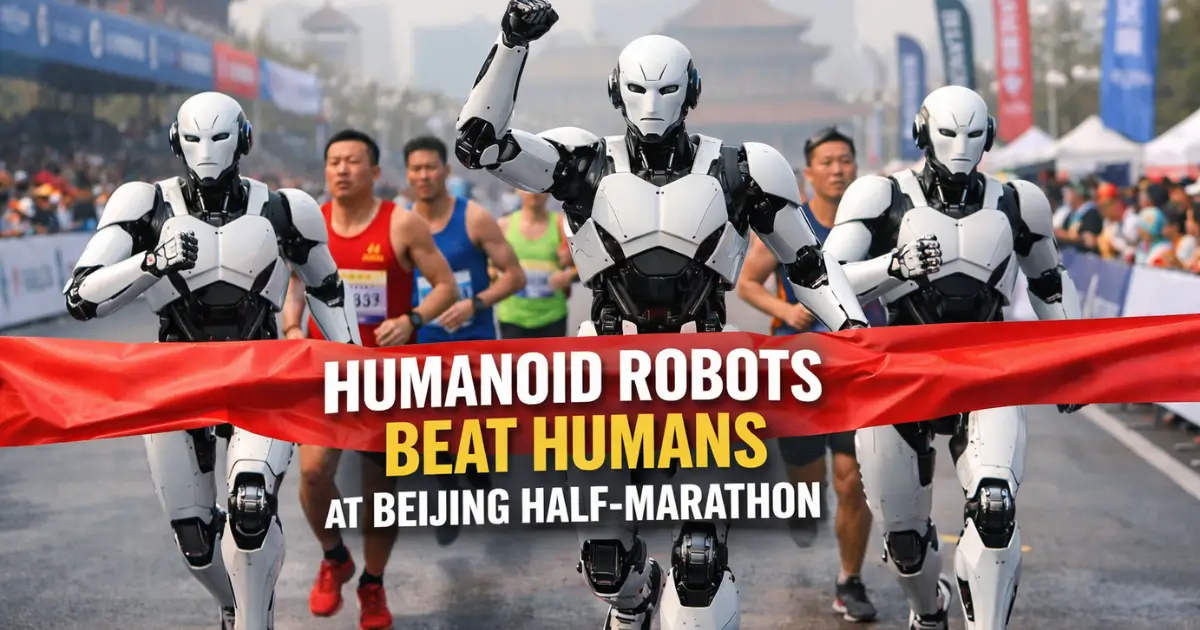
A humanoid robot has broken the world record at a Beijing half-marathon, completing the 21-kilometer course in 50 minutes and 26 seconds — faster than any human has ever run the distance. The winning robot, built by Chinese smartphone maker Honor and equipped with autonomous navigation, averaged roughly 25 kilometers per hour, beating the current men's world record of 57 minutes and 20 seconds held by Ugandan runner Jacob Kiplimo.
The race, held Sunday in the Yizhuang development zone in southern Beijing, was the second edition of the Beijing E-Town Humanoid Robot Half-Marathon. Last year's event was riddled with mishaps — most robots could not even finish, and the champion recorded a time of 2 hours and 40 minutes. This year, the transformation was dramatic.
From 20 Robots to Over 100
The number of humanoid entries jumped from around 20 last year to more than 100 this year, according to organizers — a clear sign of how rapidly the sector is advancing. The robots and human runners raced in separate lanes to avoid collisions. Some machines moved with striking agility, mimicking the running style of athletes like Usain Bolt, while others demonstrated more basic capabilities.
Around 40 percent of teams relied on fully autonomous navigation, a significant technical challenge that adds complexity beyond raw speed. New awards were introduced this year, including prizes for endurance and simply finishing the race — a goal that proved beyond most robots just twelve months ago.
China's Robotics Ambitions
The half-marathon is more than a spectacle. It serves as a real-world stress test for durability, mobility, and autonomous navigation — capabilities that matter for future applications in manufacturing, hazardous operations, and even military use.
China is investing heavily in this space. Investment in robotics and embodied AI reached 73.5 billion yuan — roughly $10.8 billion — in China in 2025, according to a government agency study. The country has enacted subsidies, infrastructure projects, and industrial policies designed to make it a global powerhouse in humanoid robotics.
Earlier this year, China's most-watched TV show, the annual CCTV Spring Festival Gala, featured over a dozen Unitree humanoid robots performing sophisticated martial arts routines alongside human performers — a demonstration of both technical precision and growing public acceptance.
The Gap Between Running and Working
Despite the impressive racing performance, experts caution that the skills on display do not translate directly to widespread commercial use. Chinese robotics firms are still struggling to develop the AI software that would enable humanoids to match human factory workers in tasks requiring manual dexterity, real-world perception, and complex decision-making.
Running fast in a straight line on a closed course is a fundamentally different challenge from assembling products on a factory floor or navigating unpredictable environments. The half-marathon showcases physical prowess, but industrial readiness remains in early stages.
That said, engineers see the race as a meaningful stepping stone. One participant noted that running faster enables technology transfer into structural reliability, cooling systems, and eventually industrial applications — even if the connection is not immediately obvious.
Public Reaction: Excitement and Anxiety
Spectators along the course reflected the same mix of excitement and unease that surveys have documented globally. Han Chenyu, a 25-year-old student, barely had time to photograph the leading robot as it whizzed past. She called the event pretty cool but admitted that as someone who works for a living, the speed of technological advancement sometimes worries her — especially with AI growing increasingly sophisticated.
Another spectator, Xie Lei, said robots could become part of daily life within several years, potentially handling housework, elderly care, and other routine tasks. But he also expressed a bittersweet feeling: for thousands of years, humans have been at the top on planet Earth. Now, at least in this specific event, robots are starting to surpass us.
The Bigger Picture
The Beijing half-marathon illustrates a broader trend in the AI industry. While much of the Western conversation about AI focuses on software coding tools, enterprise agents, and language models — China is simultaneously pushing hard on physical AI. The combination of advanced robotics hardware with improving AI software represents a different but equally significant frontier.
Elon Musk has identified China as Tesla's most formidable competitor in humanoid robotics, citing the country's strengths in large-scale manufacturing and rapidly advancing AI capabilities. If Chinese firms can close the gap between athletic demonstrations and industrial applications, the implications for global manufacturing, labor markets, and military balance could be profound.
For now, the robots are running faster than any human alive. What they do when they stop running is the question that matters most.