Sam Altman's identity verification project World is scaling aggressively. The company behind World, Tools for Humanity, announced Friday that it will integrate its verification technology into dating apps, concert ticketing, business video calls, document signing, and the emerging world of AI agents. The first major consumer integration: Tinder.
Proving You Are Human in an AI World
At a packed event near the San Francisco pier, Altman framed the need for human verification as increasingly urgent. He pointed out that the world is heading toward a future where more content is generated by AI than by humans, and that distinguishing between the two is becoming a fundamental challenge.
World, formerly known as Worldcoin, uses a spherical device called the Orb to scan users' irises and convert them into unique, anonymous cryptographic identifiers called verified World IDs. The system uses zero-knowledge proof-based authentication, which means it can confirm that a real human is behind a digital interaction without revealing that person's identity.
The company calls this concept "proof of human" a mechanism designed for a world increasingly populated by AI agents and bots.
Tinder Gets Verified Humans
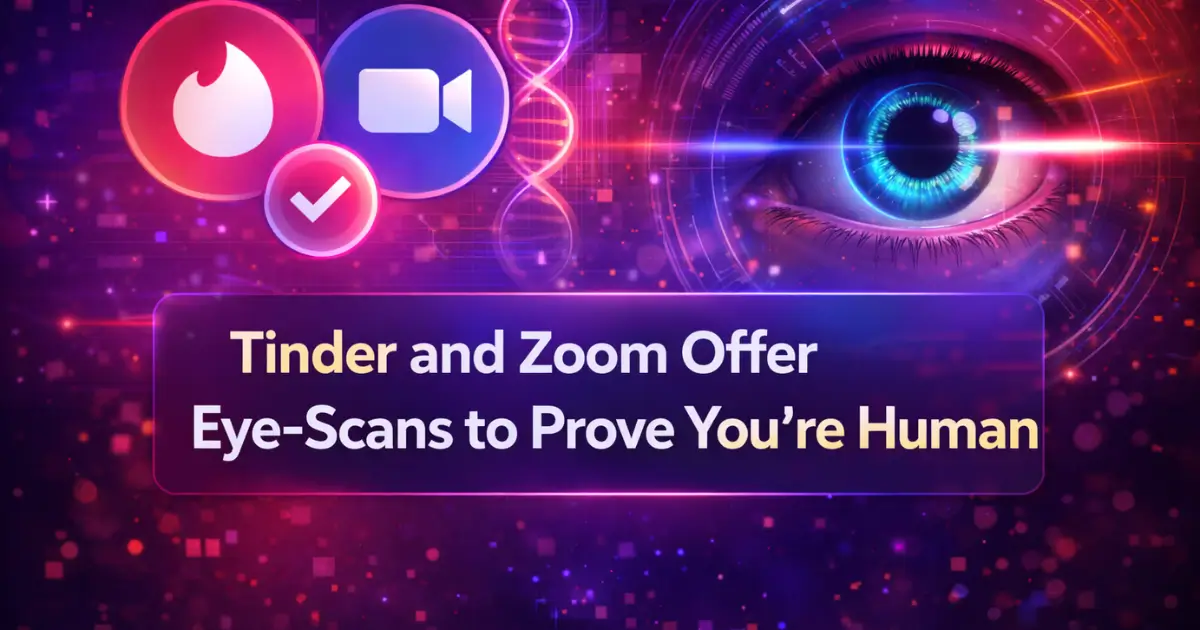
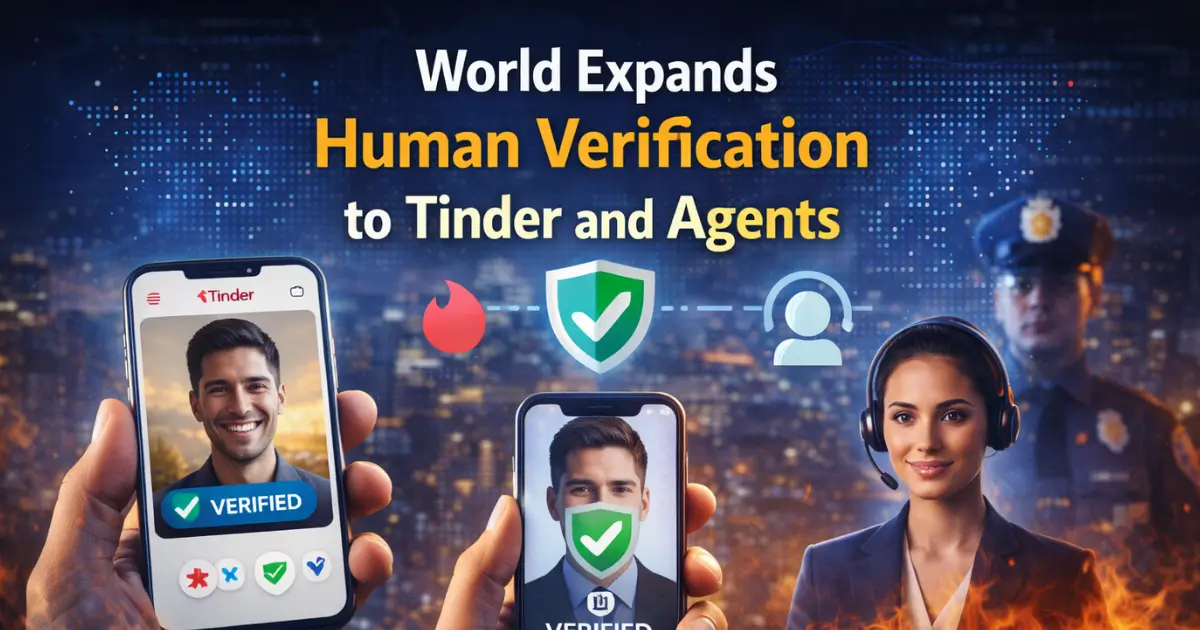
The headline integration is with Tinder. Following a successful pilot program in Japan last year, World announced that Tinder will roll out its verification integration in global markets, including the United States. Verified users will receive a World ID emblem on their profiles, authenticating them as real people.
For a dating platform plagued by fake profiles and bot accounts, the integration addresses a genuine user pain point. Whether mainstream users will be comfortable scanning their eyes to prove they are human on a dating app remains to be seen but the demand for authenticity on these platforms is real.
Concert Tickets, Zoom Calls, and Docusign
World also unveiled Concert Kit, a feature that lets musical artists reserve a portion of concert tickets exclusively for World ID-verified humans. The tool is compatible with Ticketmaster and Eventbrite and is being promoted through partnerships with 30 Seconds to Mars and Bruno Mars for their upcoming tours. The goal is to prevent automated bots from buying up tickets before real fans can access them.
On the enterprise side, World announced a Zoom integration designed to verify that participants in video calls are real humans a response to growing concerns about deepfakes in business communications. A Docusign partnership ensures that digital signatures come from authenticated users.
Preparing for the Agentic Web
Perhaps the most forward-looking announcement was a feature called agent delegation. Users will be able to delegate their World ID to an AI agent that carries out online activities on their behalf. Through a partnership with authentication firm Okta, the system ties a World ID to a specific agent so that websites can verify a real person is behind the agent's actions.
This positions World as infrastructure for the emerging agentic internet a future where autonomous AI systems interact with websites, make purchases, and handle tasks without direct human involvement. In that world, proving human authorization behind every agent action could become as essential as passwords are today.
The Scaling Problem
Despite its ambitious vision, World has struggled to scale. For much of its history, getting fully verified required visiting a physical location and having your eyes scanned by an Orb a process that is both inconvenient and, for many people, unsettling.
The company has been working to lower that barrier. Orbs have been deployed in major retail chains, and World now offers to bring an Orb directly to users' locations. The company is also expanding its Orb presence in New York, Los Angeles, and San Francisco.
To further ease adoption, World introduced tiered verification levels. The highest tier requires an Orb scan. A mid-level tier uses an anonymized scan of a government ID via NFC chip. And a new low-level tier called Selfie Check requires only a selfie though the company acknowledges this method has obvious security limitations.
The Bigger Picture
World's expansion reflects a growing consensus that as AI becomes more powerful and more pervasive, the ability to verify human identity online will become critical infrastructure. The challenge is public trust convincing hundreds of millions of people to scan their eyes or share biometric data with a company co-founded by one of tech's most polarizing figures.
If World succeeds, it could become the identity layer of the AI-powered internet. If it fails to scale past early adopters, it risks becoming an interesting experiment that never achieved mass adoption. The Tinder integration may be the most telling test yet because nothing motivates people to verify their identity quite like the promise of meeting someone real.