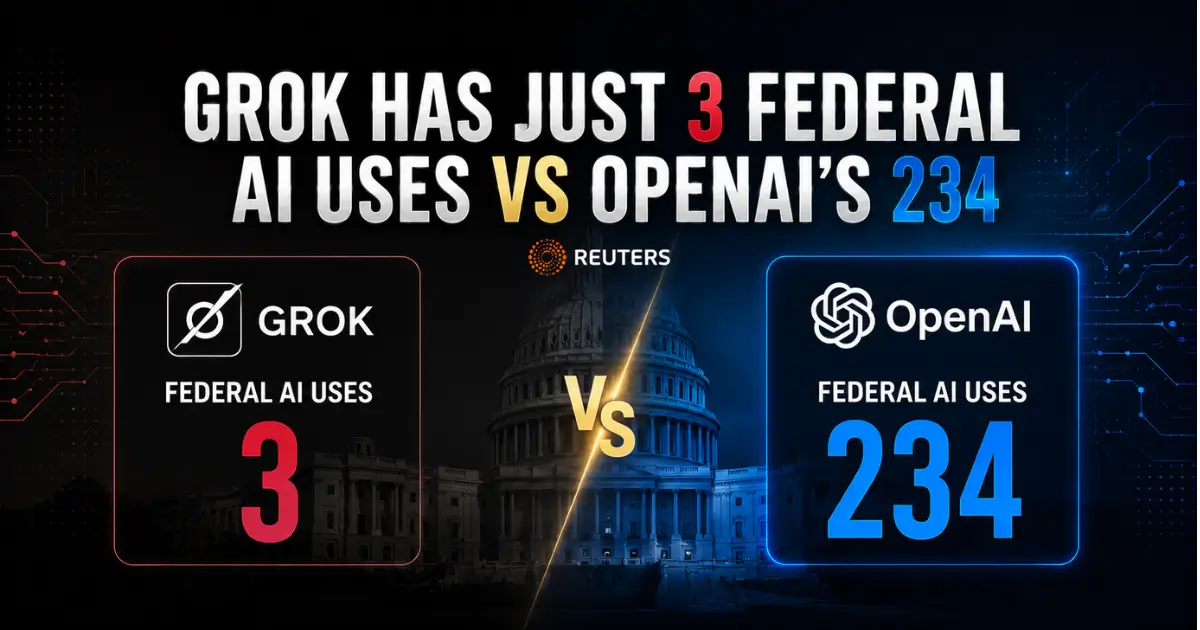
Elon Musk's xAI has positioned Grok as a cornerstone of SpaceX's $1.75 trillion IPO story. But federal government data tells a devastating story. Out of more than 400 publicly identified AI use cases across US agencies, only three involve Grok. OpenAI's models appear in 234. Google's Gemini in 33. Anthropic's Claude in 26. Grok is essentially invisible in Washington — the market Musk personally lobbied to win.
The Numbers Are Brutal
Reuters reviewed the 2025 consolidated AI inventory records from federal agencies. The data shows how government agencies are actually using AI in practice. The results are one-sided.
OpenAI dominates with 234 identified use cases including ChatGPT, Codex, and Microsoft Copilot. Google's Gemini and other Alphabet products account for 33 use cases. Anthropic's Claude — which has since been designated a supply-chain risk by the Pentagon — still managed 26. Grok has three.
The gap is not just about adoption numbers. It reveals that despite Musk's political connections, personal lobbying, and DOGE's attempts to push Grok into agencies, federal employees and contracting officers overwhelmingly chose competitors.
Enterprise Usage Is Falling Too
The government data mirrors the private sector. Web traffic monitoring firm Netskope reported that Grok enterprise usage has fallen to 2 out of every 1,000 users — down from a peak of 5 per 1,000. The decline is happening while the broader AI market is growing explosively. Every other major platform is gaining users. Grok is losing them.
Musk acknowledged under oath during the OpenAI trial that xAI ranks behind Anthropic, OpenAI, Google, and Chinese models. The Reuters data confirms that ranking extends to the market's most important customer: the US government.
DOGE Pushed Grok — Nobody Listened
Musk's Department of Government Efficiency actively promoted Grok across federal agencies. DOGE told Department of Homeland Security officials to use Grok even though it had not been approved for use at the agency. The push did not work. Federal employees continued using the tools they trusted — overwhelmingly OpenAI and Microsoft products.
One security analyst told Reuters the data suggests Grok lacks the security rigor required at the federal level. Without government validation, he warned, SpaceX's $1.75 trillion IPO valuation looks less like a floor and more like a high ceiling.
The concern is not theoretical. SpaceX's IPO filing positioned xAI's AI business as the company's growth engine — projecting a multi-trillion dollar addressable market. If xAI cannot win even basic adoption from the US government despite having the president's most prominent supporter personally lobbying for it, the growth story weakens considerably.
Why Government Adoption Matters
Federal AI adoption is one of the most closely watched indicators of enterprise readiness. Government agencies have rigorous security requirements, compliance standards, and procurement processes. An AI model that passes federal scrutiny gains credibility with corporate buyers who use government approval as a proxy for trust.
OpenAI's 234 federal use cases signal that its models meet those standards. Grok's three use cases signal the opposite. For enterprise sales teams pitching Grok to Fortune 500 companies, the federal adoption gap is a significant obstacle.
The irony is that Google and OpenAI both signed Pentagon deals specifically to capitalize on Anthropic's refusal to provide unrestricted military access. xAI deployed on Defense Department classified networks in May. But deploying and being adopted are different things. Having access does not mean anyone is using it.
The IPO Risk
The Reuters investigation creates a specific risk for SpaceX's IPO. If xAI's AI revenue story depends on capturing a meaningful share of the multi-trillion dollar AI market, and its flagship product has negligible adoption in the world's largest customer, institutional investors may discount the AI portion of SpaceX's valuation.
xAI burned $6.4 billion in 2025 on just $340 million in revenue. It has been selling compute to Anthropic and partnering with Cursor rather than growing Grok's user base. The federal adoption data adds another data point to a pattern suggesting xAI's value lies in its infrastructure — not its AI model.
The Bigger Picture
The Reuters data paints the clearest picture yet of the AI industry's competitive landscape in government. OpenAI dominates. Google and Anthropic compete for second. And Grok — despite its owner's unprecedented political access — barely registers.
For Musk, the federal failure is particularly stinging. He spent months using DOGE to promote Grok. He personally lobbied the president. He deployed on classified networks. And after all of that effort, three out of 400 use cases is the result. The AI market rewards models that work, not connections that open doors.