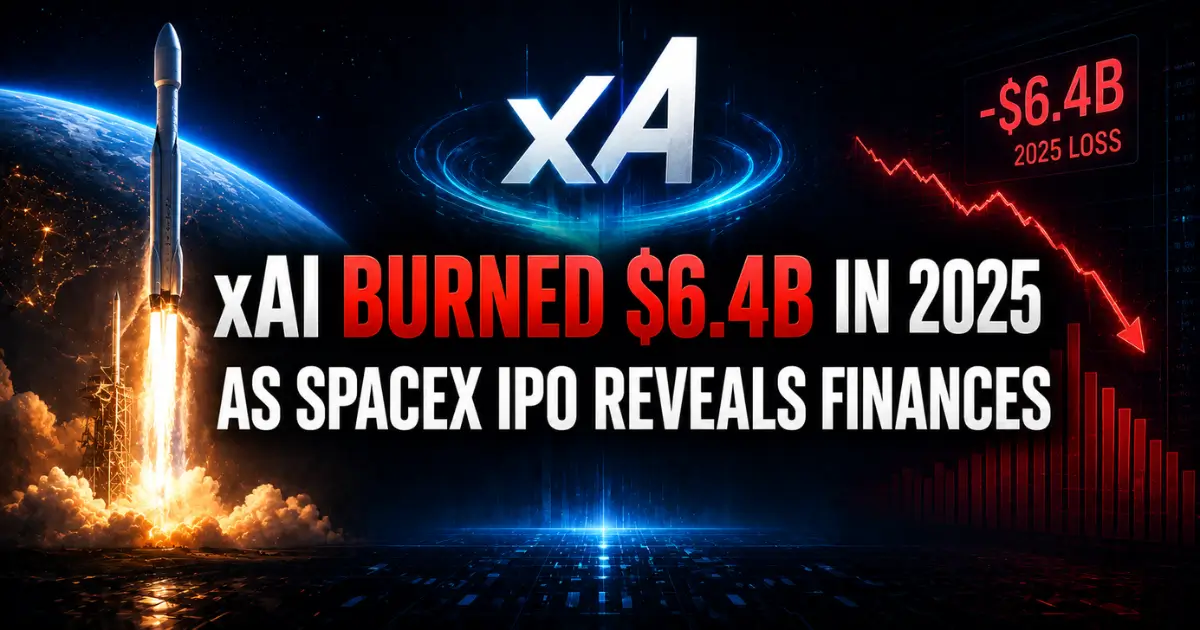
SpaceX's highly anticipated IPO filing has pulled back the curtain on xAI's finances for the first time. Elon Musk's AI company burned through $6.4 billion in 2025 — a staggering figure that makes it one of the most expensive AI ventures in history. The filing also reveals that xAI generated just $340 million in revenue during the same period, producing a net loss of over $6 billion. The numbers explain why xAI has been selling data center capacity to Anthropic and partnering with Cursor rather than competing head-on with frontier AI labs.
What the Filing Shows
SpaceX merged with xAI last year, making xAI's financials visible for the first time through the IPO prospectus. The numbers are sobering.
Revenue: $340 million. Operating expenses: $6.7 billion. Net loss: approximately $6.4 billion. The majority of spending went to infrastructure — building and operating the Colossus data centers that Musk has positioned as xAI's competitive advantage.
For comparison, Anthropic's annualized revenue is approaching $40 billion. OpenAI reported $24-25 billion. Even Cursor — a coding startup — projects $6 billion in annualized revenue by year end. xAI's $340 million makes it a fraction of the size of every major competitor despite spending more than most of them.
Why xAI Is Pivoting to Infrastructure
The financial picture explains xAI's recent strategic moves. Selling Colossus 1's entire capacity to Anthropic generates immediate revenue from infrastructure that was sitting underutilized. The Cursor partnership provides another revenue stream from compute rental. And the SpaceX merger gives xAI access to IPO capital without needing to justify its AI model business on a standalone basis.
Musk himself acknowledged the competitive reality during the OpenAI trial, ranking xAI behind Anthropic, OpenAI, Google, and Chinese open-source models. Grok's user numbers have been declining. The company admitted under oath to training Grok by distilling OpenAI's models. And its data center operations in Memphis are running 50 gas turbines without air quality permits.
The pattern is clear. xAI's AI model business is not competitive with the frontier labs. Its infrastructure business — selling compute to companies that are competitive — may be where the real value lies.
The IPO Context
SpaceX is expected to price its IPO at a valuation exceeding $350 billion, making it the largest tech IPO ever. xAI's financials are embedded within that filing. Investors evaluating SpaceX must decide how to value xAI's contribution — a division that burns billions while generating hundreds of millions.
The bull case for xAI within SpaceX is infrastructure. Data centers are physical assets that generate recurring revenue. If xAI transitions from a money-losing AI lab into a profitable compute provider — selling capacity to Anthropic, Cursor, and eventually others — the business model starts to resemble a neocloud provider like CoreWeave rather than an AI research lab.
The bear case is that $6.4 billion in losses and $340 million in revenue is unsustainable regardless of framing. If Grok cannot compete with Claude and GPT, and the infrastructure business depends on selling capacity to competitors, xAI is essentially subsidizing its rivals' success.
What It Means for the AI Industry
xAI's financials are a reminder of how expensive frontier AI is. Building competitive AI models requires billions in compute, talent, and infrastructure. Google and Amazon can absorb those costs through their cloud businesses. Anthropic and OpenAI fund them through massive fundraises. xAI funded them through SpaceX and Musk's personal wealth.
But $6.4 billion in a single year — with minimal revenue to show for it — raises the question of how many companies can sustain frontier AI development. The answer appears to be fewer than the market assumed. Even with Musk's resources, xAI could not build a competitive model business. The path from compute to revenue is longer and harder than any CEO — even the world's richest person — expected.
For the broader AI industry, xAI's IPO filing is both a cautionary tale and a validation. It confirms that the AI infrastructure buildout is extraordinarily expensive. It confirms that model competition is consolidating around a handful of winners. And it confirms that even companies willing to burn billions cannot buy their way to the frontier without the models, talent, and distribution to match.