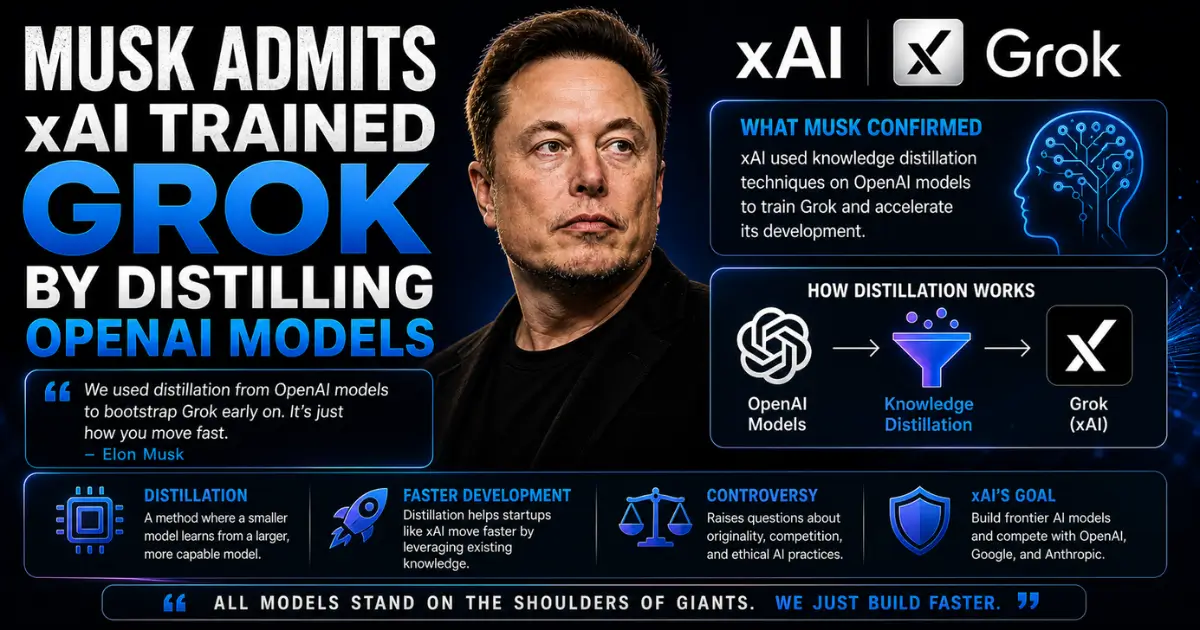
Elon Musk admitted under oath on Thursday that xAI used distillation techniques on OpenAI's models to help train Grok. When asked directly whether xAI had distilled OpenAI's models, Musk called it a general practice among AI companies. When pressed on whether that meant yes, he said "partly." The admission came during the Musk vs Altman trial in Oakland — the same trial where Musk is accusing OpenAI of betraying its charitable mission.
What Distillation Means
Distillation is a technique where one AI company systematically queries a competitor's model to extract its knowledge and use it to train a cheaper, faster alternative. The process involves sending thousands or millions of prompts to a model's API or chatbot, collecting the responses, and using that data to teach a new model.
The practice threatens frontier AI labs because it undermines the advantage they have built through billions of dollars in compute investment. A company that spent $100 billion training a model can have its capabilities partially replicated by a competitor spending a fraction of that amount.
The debate around distillation has focused primarily on Chinese firms. Both OpenAI and Anthropic have accused DeepSeek and other Chinese labs of systematically mining their models. The three largest US AI labs — OpenAI, Anthropic, and Google — reportedly launched a joint initiative through the Frontier Model Forum to combat distillation from China.
Musk's admission reveals that the practice is not limited to foreign competitors. American AI companies are doing it to each other.
The Irony Is Hard to Miss
The admission is loaded with irony. Musk is suing OpenAI for allegedly betraying its nonprofit mission. Yet his own company used OpenAI's work — built partly with Musk's own early donations — to train a competing commercial product. xAI launched Grok as a for-profit venture from day one, with no nonprofit constraints of the kind Musk argues OpenAI should have maintained.
There is also a broader irony. Frontier AI labs have aggressively scraped the open internet — including copyrighted content from publishers, authors, and artists — to train their models. Now those same labs are outraged when others scrape their outputs through distillation. The practice of taking others' work to build commercial AI products is one the industry pioneered.
It is not clear that distillation is illegal. It likely violates the terms of service that AI companies set for their products. But terms of service violations are a civil matter, not a criminal one. And enforcement has been inconsistent at best.
Musk Ranks the AI Industry
Later in his testimony, Musk was asked about a claim he made last summer that xAI would soon be far beyond any company besides Google. His response under oath was more humble. He ranked the world's leading AI providers with Anthropic in the top spot, followed by OpenAI, Google, and Chinese open-source models. He described xAI as a much smaller company with just a few hundred employees.
The ranking contradicts Musk's public positioning of xAI as a frontier competitor. It also validates what enterprise users have been saying for months — that Anthropic's Claude has become the dominant AI platform among developers and businesses, while xAI's Grok remains a niche product primarily distributed through X.
What It Means for the Trial
The distillation admission complicates Musk's case. His core argument is that OpenAI's founders betrayed the public interest by converting a nonprofit into a for-profit enterprise. But if Musk's own company used OpenAI's publicly available technology to build a competing commercial product, the moral high ground becomes harder to maintain.
OpenAI's lawyers had already damaged Musk's credibility the previous day by confronting him with contradictory tweets and inflated investment claims. The distillation admission adds another layer. Musk is accusing OpenAI of betrayal while simultaneously benefiting from the very technology he says was wrongfully commercialized.
The trial continues with testimony expected from Greg Brockman, Sam Altman, Satya Nadella, Mira Murati, and Ilya Sutskever. The $134 billion in potential damages and the possible unwinding of OpenAI's corporate structure remain at stake.
The Bigger Picture
Musk's admission that xAI distilled OpenAI's models is the first public confirmation from a major US AI company that the practice happens domestically — not just from Chinese competitors. It adds fuel to the growing debate about intellectual property in the AI industry and raises questions about whether any company's AI output can truly be protected.
If distillation is a general practice — as Musk characterized it — then every frontier model is simultaneously a product and a training dataset for its competitors. The billions spent on compute, data, and research can be partially captured by anyone willing to query the API and learn from the answers. That dynamic has profound implications for the economics of building AI — and for the companies spending hundreds of billions to stay ahead.