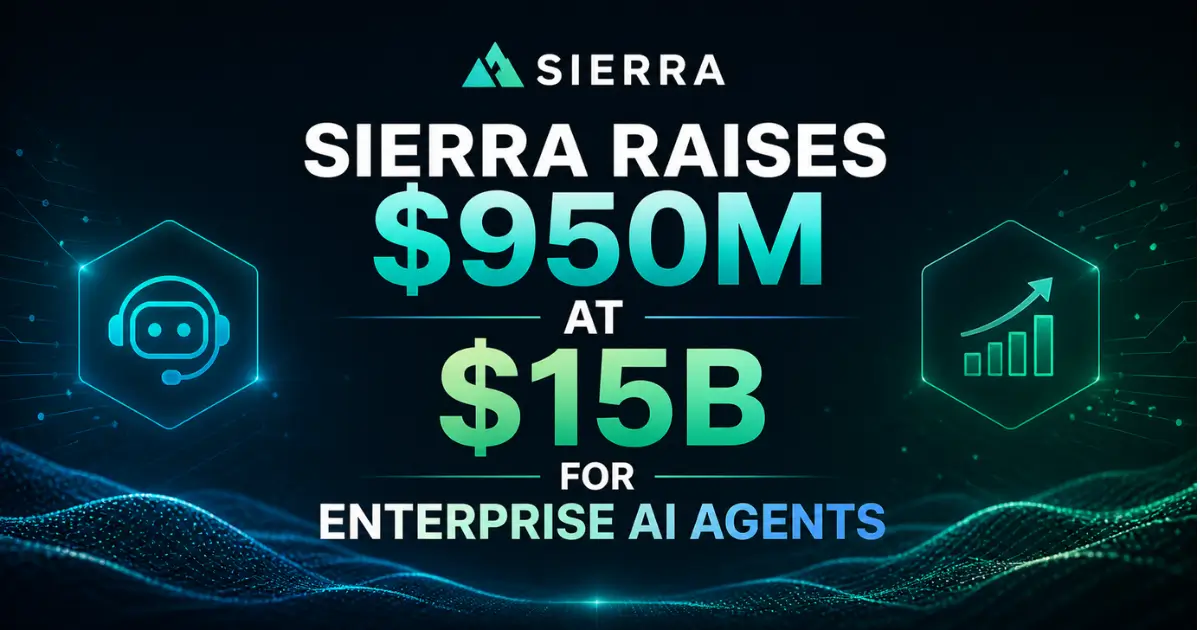
Bret Taylor's AI startup Sierra has raised $950 million led by Tiger Global and GV, pushing its valuation above $15 billion. The company, which builds AI agents for enterprise customer experiences, now has over $1 billion in capital to pursue what Taylor calls the global standard for AI-powered customer interactions. Sierra claims more than 40 percent of the Fortune 50 as customers.
From 4 Partners to Fortune 50
Sierra started with just four design partners two years ago. Today its agents handle billions of interactions — from refinancing mortgages and processing insurance claims to managing returns and powering nonprofit fundraising campaigns.
Revenue growth has been rapid. Sierra hit $100 million in annual recurring revenue in November 2025. By February 2026 it reached $150 million. That pace reflects both the urgency enterprises feel about deploying AI and the costs that come with the ramp-up phase.
Taylor, who also serves as chairman of OpenAI and was formerly co-CEO of Salesforce, has been blunt about the economics. Enterprise AI promises lower costs and higher revenue for clients. But before those returns materialize, the deployment phase is expensive.
Uber's AI Budget Blowout
The cost dynamic showed up in a revealing conversation at TechCrunch's StrictlyVC event. Uber CTO Praveen Neppalli Naga said the company blew through its AI budget soon after opening the door to agentic AI tools late last year.
But results are starting to appear. About 10 percent of all code produced at Uber is now generated autonomously across a staff of 8,000 engineers. As a proof-of-concept, one team built a new hotel-booking integration using only agentic workflows. Work that would normally take a year was done in six months.
The Uber example illustrates the enterprise AI value proposition at scale. The upfront cost is real. But a 50 percent reduction in development time — replicated across an entire engineering organization produces returns that dwarf the investment.
Ghostwriter: Agents That Build Agents
Sierra also launched Ghostwriter in April — an agent-as-a-service tool that builds other agents. Users describe what they need in natural language. Ghostwriter autonomously creates and deploys a specialized AI agent to handle it.
The meta-agent concept — an AI that builds and deploys other AIs — connects to the broader agentic shift happening across the industry. NeoCognition is building self-learning agents. Anthropic and OpenAI just launched enterprise joint ventures with embedded engineering teams. And Microsoft Copilot recently made Agent Mode the default across Office.
Sierra's Ghostwriter adds another layer: instead of deploying agents one at a time, enterprises can describe what they need and have the platform build the agent for them. It is the difference between hiring an employee and hiring a manager who hires employees.
Taylor's Vision: Software Nobody Uses
Taylor's broader thesis is provocative. He argues that most enterprise software is barely used. Employees log into tools like Workday when they onboard and again at open enrollment. That is about it. The rest of the time, the software sits idle — expensive infrastructure that nobody wants to interact with.
AI agents change that equation. Instead of forcing employees and customers to navigate complex systems, agents handle the interactions on their behalf. The software still exists. Humans just never have to touch it.
If that vision materializes, it threatens the entire traditional enterprise software model — including the company Taylor used to lead. Salesforce, SAP, Oracle, and Workday all depend on humans interacting with their interfaces. An AI layer that eliminates that interaction could make the interface irrelevant while keeping the data and workflows underneath.
The Competition
Sierra is not alone in pursuing enterprise AI agents. The competition is fierce and well-funded. Anthropic's enterprise revenue is approaching $40 billion annualized. OpenAI launched Codex Labs with major IT services firms. Google Cloud just posted $20 billion in quarterly revenue. And AWS reported its fastest growth in 15 quarters.
Sierra's advantage is focus. While the frontier labs compete across consumer, enterprise, and infrastructure markets simultaneously, Sierra is building exclusively for enterprise customer experiences. That specialization — combined with Taylor's relationships and $1 billion in capital — gives the company a credible shot at becoming the default platform for AI-powered customer interactions.
At $15 billion, Sierra is still a fraction of the size of the frontier labs. But in a market growing as fast as enterprise AI, being focused and well-funded may be worth more than being the biggest.