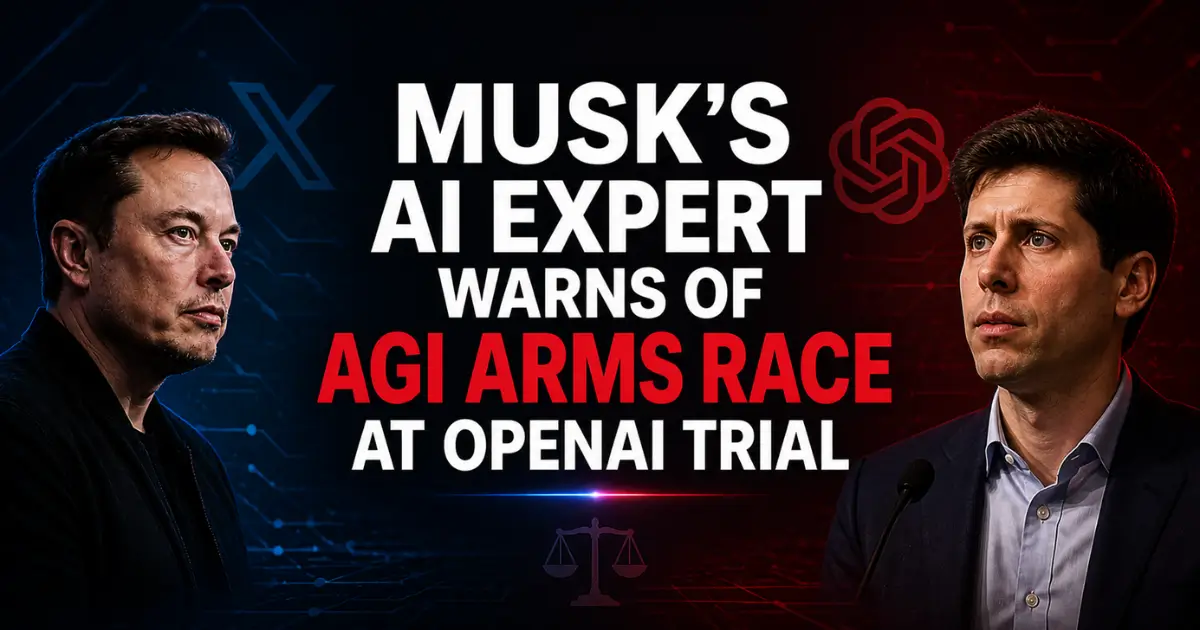
Berkeley professor Stuart Russell, the only AI expert witness called by Elon Musk's legal team, testified Sunday that the world is heading toward a dangerous AGI arms race. Russell argued that OpenAI's conversion from nonprofit to for-profit accelerated that race by prioritizing speed over safety. His testimony attempted to shift the jury's attention back to the existential risks of AI after a week dominated by Musk's contradictory tweets, distillation admission, and threatening texts.
What Russell Argued
Russell is one of the most respected AI researchers in the world. He co-authored the most widely used AI textbook. He has spent years warning that the pursuit of artificial general intelligence without adequate safety measures could pose existential risks to humanity.
On the stand, Russell argued that OpenAI's original nonprofit mission was designed to serve as a counterweight to the commercial pressures driving unsafe AI development. By converting to a for-profit structure, he said, OpenAI removed that counterweight — joining the race rather than governing it.
He described a scenario where AI companies compete to build increasingly powerful systems as quickly as possible, with safety taking a backseat to speed and market share. The result, in his view, is an arms race that no single company can opt out of once it begins.
The Anthropic Comparison
Russell's testimony connected directly to the debate over how AI companies should engage with government and military applications. Anthropic's refusal to give the Pentagon unrestricted access to its models — and the resulting supply-chain risk designation — was cited as an example of what principled AI governance looks like.
The contrast with OpenAI was implicit. OpenAI signed a Pentagon deal. Google and xAI followed. Even OpenAI itself recently restricted its own cybersecurity tool after discovering the same dangers Anthropic warned about. Russell's argument was that these ad hoc decisions are no substitute for the structural safety commitment that OpenAI's nonprofit status was supposed to provide.
OpenAI's Response
OpenAI's lawyers challenged Russell's framing. They argued that the for-profit conversion enabled OpenAI to raise the hundreds of billions needed to compete at the frontier resources that a nonprofit could never have secured. Without that capital, OpenAI would have fallen behind competitors who had no safety constraints at all.
The defense also pointed out that Musk's own company, xAI, was founded as a for-profit from day one with no nonprofit mission. If the for-profit model is inherently dangerous, OpenAI's lawyers argued, then Musk is guilty of the same thing he accuses Altman of doing.
Russell acknowledged that all AI companies face the same competitive pressures. But he maintained that OpenAI's unique origin as a nonprofit created obligations that a for-profit conversion violated.
Why It Matters for the Trial
Russell's testimony is important because he is the only witness who can speak with scientific authority about the risks of AGI. Musk's personal credibility has been damaged by contradictions and admissions. His motives have been questioned after the threatening texts to Brockman. Russell provides the intellectual foundation for the argument that OpenAI's structural change was genuinely harmful — not just a personal grievance.
Whether the jury finds that argument compelling especially after a week of evidence suggesting Musk's lawsuit may be driven by competitive rather than altruistic motives remains the central question.
The Bigger Picture
The Musk vs Altman trial is the first time the AGI arms race debate has been presented to a jury. Russell's testimony forces ordinary citizens to grapple with questions that have until now been confined to academic conferences and congressional hearings. Is the pursuit of AGI dangerous? Should it be governed by nonprofits? And does the conversion of a safety-focused charity into an $852 billion for-profit enterprise make the world more or less safe?
The AI industry is watching closely. If Russell's argument resonates with the jury, it could create legal precedent that affects how every AI company structures its governance. If it falls flat, it will confirm that the market not the courtroom will determine how AGI is built and who controls it.