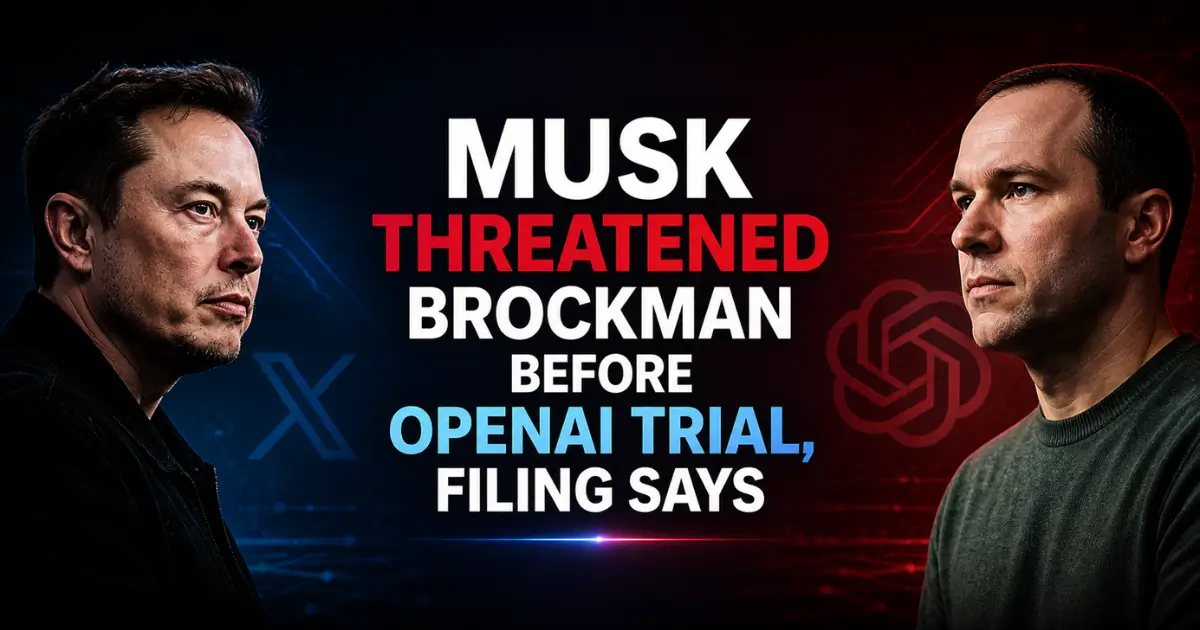
Two days before the Musk vs Altman trial began, Elon Musk texted OpenAI president Greg Brockman with a settlement demand. When Brockman suggested both sides drop their suits instead, Musk replied with a threat: by the end of this week, you and Sam will be the most hated men in America. If you insist, so it will be.
OpenAI's lawyers revealed the exchange in a court filing on Sunday. The judge ruled it inadmissible but the damage was already done in the court of public opinion.
What the Filing Shows
OpenAI submitted a filing that described the text exchange but did not include copies of the actual messages. The filing's primary purpose was to convince Judge Gonzalez Rogers to admit the texts as evidence. She declined.
The sequence was straightforward. Musk contacted Brockman. He suggested OpenAI settle the lawsuit. Brockman counteroffered both sides drop all suits. Musk escalated with his threat about hatred and public consequences. The exchange ended there.
OpenAI's lawyers argued the texts reveal Musk's true motivation. His lawsuit claims to protect AI safety and the public interest. The texts suggest a different agenda: either pay me or I will destroy your reputation.
The Settlement-or-Else Pattern
The text exchange fits a pattern that has emerged throughout the trial. On the stand, Musk was trapped by his own tweets contradicting claims he made on X about Tesla pursuing AGI and inflating his OpenAI investment from $38 million to $100 million. He admitted that xAI trained Grok by distilling OpenAI's models. And he ranked Anthropic above his own company in AI capabilities.
Each revelation has chipped away at the narrative that Musk is suing out of genuine concern for humanity. The text to Brockman threatening to make him and Altman the most hated men in America unless they settle is the most direct evidence yet that the lawsuit may be about money and competitive leverage rather than charitable mission.
What OpenAI Claims
OpenAI's countersuit alleges exactly this. The company argues Musk is trying to use the legal system to kneecap a rival while extracting financial concessions from a company he helped found but no longer controls.
The lawsuit seeks to unwind OpenAI's for-profit structure, strip Microsoft's licensing agreement, make OpenAI's technology freely available, and compel the company to pay Musk compensatory and punitive damages plus legal fees. The combined ask could reach $134 billion.
If the jury or ultimately the judge views the case as a genuine dispute over charitable mission, Musk has a path to victory. If they view it as a billionaire trying to shake down a former partner, the case collapses.
The Trial Continues
The text exchange was ruled inadmissible, meaning the jury will not see it directly. But the filing is public. The media has reported it widely. And the implication that Musk tried to intimidate OpenAI's leaders before trial will hang over the remaining weeks of proceedings.
Still expected to testify are Altman, Microsoft CEO Satya Nadella, former OpenAI CTO Mira Murati, and co-founder Ilya Sutskever. Musk's only AI expert witness, Berkeley professor Stuart Russell, testified Sunday about the risks of an AGI arms race attempting to refocus the jury on AI safety concerns rather than personal grievances.
Whether the safety argument can survive the mounting evidence of personal motivation is the question that will define the trial's outcome.
What It Means
The Musk-Brockman text exchange is a small moment with large implications. Trials are won on evidence and credibility. Musk's credibility has taken hits every day he has been in court. The text threatening public destruction unless OpenAI settles may be inadmissible in the courtroom. But it is already shaping how the AI industry and the public understand what this trial is really about.