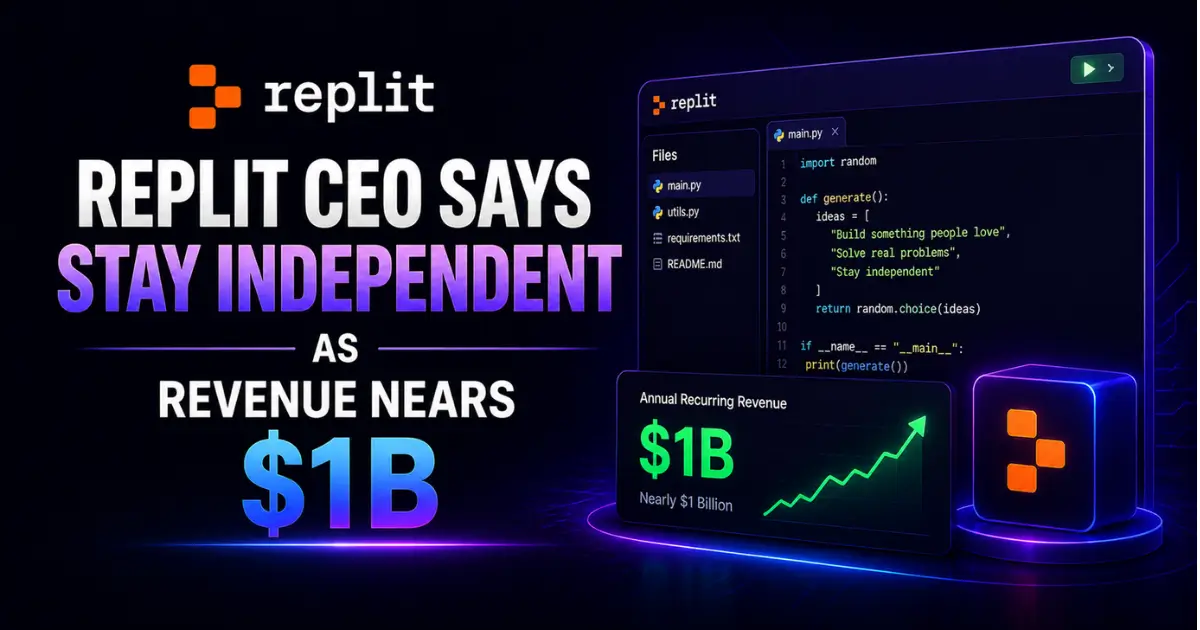
Replit CEO Amjad Masad says the AI coding company plans to stay independent — even as rival Cursor fields a $60 billion acquisition offer from SpaceX. Speaking at TechCrunch's StrictlyVC event in San Francisco, Masad revealed that Replit has gone from $2.8 million in annual revenue in 2024 to tracking toward $1 billion. He also accused Apple of lying about why it blocked Replit's iOS updates and said the company is willing to go to court.
Why Replit Won't Sell
Masad was direct about independence. Unlike Cursor, which reportedly operates at negative 23 percent gross margins, Replit has been gross margin positive for over a year. The difference is business model: Cursor targets professional developers and burns through expensive model inference. Replit targets non-technical users and provides a full-stack platform — from prompt to deployed app — with databases, security, and hosting built in.
That positioning gives Replit the economics to survive without being acquired. Masad said the company has been building for 10 years, and now that the dream of a billion software creators is finally possible, he would love for Replit to remain independent.
He did not rule out a sale entirely. But the tone was clear: Replit is not shopping for a buyer.
Revenue Growth Is Extraordinary
Replit's revenue trajectory is one of the steepest in the vibe coding category. Going from $2.8 million to a billion-dollar run rate in roughly 18 months puts it alongside the fastest-growing AI companies in history.
Net revenue retention reaches 300 percent in some cases. That means existing customers are tripling their spending. Churn is very low. Masad cited Bain & Company replacing Tableau and Power BI with Replit and Databricks as an example of how enterprises are deepening their commitment.
The company recently integrated with Stripe, and transactions flowing through Replit-built apps are growing triple digits month over month. Masad predicted that Replit's customers will soon generate more revenue than Replit itself.
The Apple Fight
Replit's iOS app has been blocked from updates for months. Apple cited policy violations around downloading new code to devices. Masad called that explanation a lie and said Replit can prove it in court.
His theory: Apple blocked Replit because the platform enables users to build and submit iOS apps to the App Store — something that threatens Apple's control over the app creation pipeline. Charts circulated showing how many apps were reaching the App Store through Replit after it launched iOS app creation in December.
The situation contrasts with Lovable, which got its vibe coding app approved by routing generated apps to web browsers rather than creating native iOS apps. Replit's full-stack approach — which includes native app output — puts it in direct conflict with Apple's security concerns and commercial interests.
Ranking the AI Labs
Asked to rank the frontier AI providers, Masad put Anthropic first. He said Claude remains undefeated on the core agentic loop — the best tool calling and the longest coherent agent sessions. GPT-5 is catching up quickly. Google's Flash models are winning on price-performance, beating open source on speed and cost.
He also flagged newer labs. Reflection AI is producing impressive open-source models. Chinese models like Kimi are only about three months behind Anthropic's latest — confirming the rapid pace at which the gap between US and Chinese AI is closing.
The Bigger Picture
Replit's story illustrates the diverging paths in the AI coding market. Cursor is the tool for professional developers. Replit is the platform for everyone else. Cursor may sell to SpaceX for $60 billion. Replit wants to stay independent and build a billion-dollar business on its own.
Both paths are viable. But Masad's bet is that democratizing app creation — letting non-technical users build and deploy real software — is a larger market than making professional developers faster. If he is right, staying independent could be worth far more than any acquisition offer.