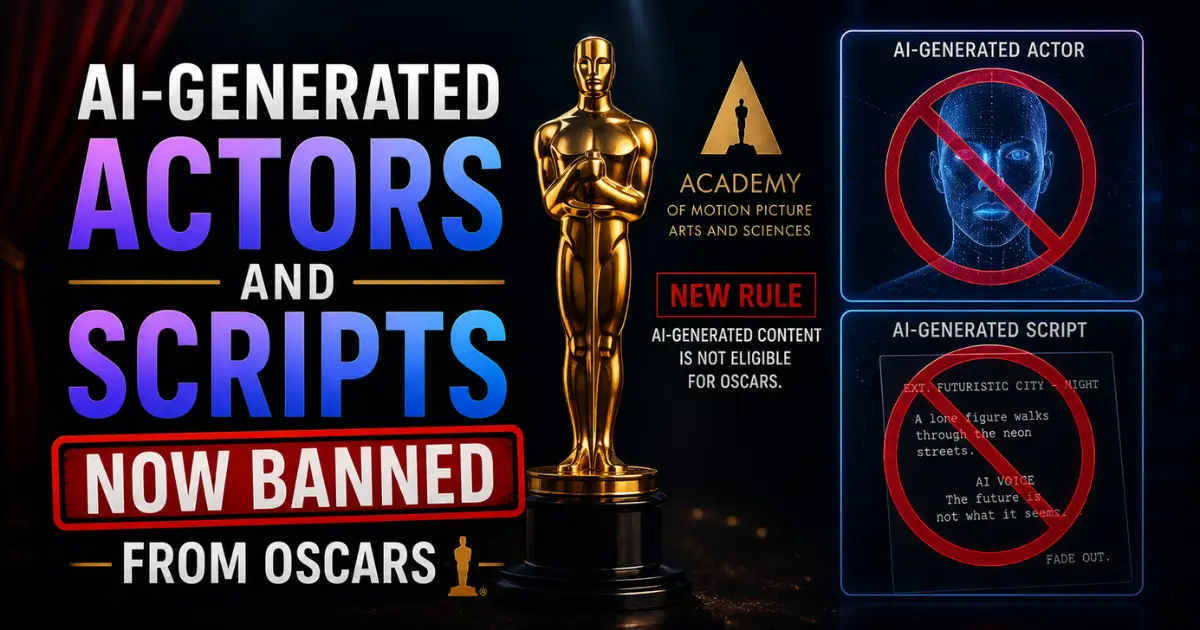
The Academy of Motion Picture Arts and Sciences has officially banned AI-generated performances and screenplays from Oscar eligibility. New rules released Friday state that only performances "credited in the film's legal billing and demonstrably performed by humans with their consent" can be nominated. Screenplays must be "human-authored." The Academy also reserved the right to request detailed information about any film's AI usage and human authorship.
Why the Academy Acted Now
The rules arrive amid a wave of AI incursions into Hollywood. An independent film is in development using an AI-generated version of actor Val Kilmer. AI "actress" Tilly Norwood — an entirely synthetic performer — continues generating headlines. And new video generation models from companies like Seedance are causing filmmakers to question the future of human-made cinema.
AI was one of the central issues in the 2023 actors' and writers' strikes. Those labor disputes produced contract language protecting performers and screenwriters from AI replacement. The Academy's new rules extend those protections to the industry's most prestigious awards — effectively declaring that AI-generated work, no matter how technically impressive, does not qualify as human creative achievement.
Beyond Hollywood
The Oscar ban reflects a broader trend across creative industries. At least one novel has been pulled by its publisher over apparent AI use. Science fiction writers' groups and Comic-Con have declared AI-generated work ineligible for literary awards. And the debate over what constitutes human authorship is intensifying across publishing, music, journalism, and visual arts.
The tension is familiar to the AI industry. The same technology that enables extraordinary creative possibilities also threatens the livelihoods and recognition of human creators. Platforms like ComfyUI are building tools that keep humans in creative control. But fully AI-generated content — where no human performs, writes, or directs — is a different category entirely.
The Enforcement Challenge
The Academy's rules raise immediate questions about enforcement. How do you prove a performance is "demonstrably performed by humans"? What about films that use AI for de-aging, voice synthesis, or background crowd generation? Where is the line between AI as a tool and AI as the creator?
The rules appear to target fully AI-generated content rather than AI-assisted filmmaking. A human actor enhanced with AI visual effects would presumably remain eligible. A synthetic performer generated entirely by AI would not. But the boundary between those categories is blurring rapidly as AI tools become more sophisticated.
The Academy said it can request additional information about AI usage — suggesting that enforcement will be case-by-case rather than automated. That approach gives the Academy flexibility but also introduces subjectivity into a process that filmmakers expect to be governed by clear rules.
The AI Content Flood
The Oscar decision connects to a broader anxiety about AI-generated content flooding creative markets. The same AI writing patterns that have quadrupled in corporate communications are showing up in screenplays, novels, and journalism. AI image generation has produced billions of synthetic images. And AI video tools are approaching the point where short films can be generated from text prompts alone.
For awards bodies, the question is existential. If AI can write a screenplay that moves audiences and generate a performance that wins empathy, does it deserve recognition? The Academy's answer is no. Human creativity — with all its imperfection, struggle, and intention — is what the Oscars are meant to celebrate. AI may assist. It cannot replace.
What It Means for AI Companies
The Oscar ban does not affect AI companies directly. But it sends a cultural signal that matters. Hollywood's most prestigious institution has declared that AI-generated creative work is fundamentally different from human-made art. That framing could influence policy debates about AI regulation, copyright, and labor protections far beyond the film industry.
For AI companies building creative tools from Luma's Wonder Project to OpenAI's video capabilities — the message is that the market for fully AI-generated entertainment may face institutional resistance even as the technology improves. The tools will get better. Whether audiences, awards bodies, and regulators accept what they produce is a separate question entirely.