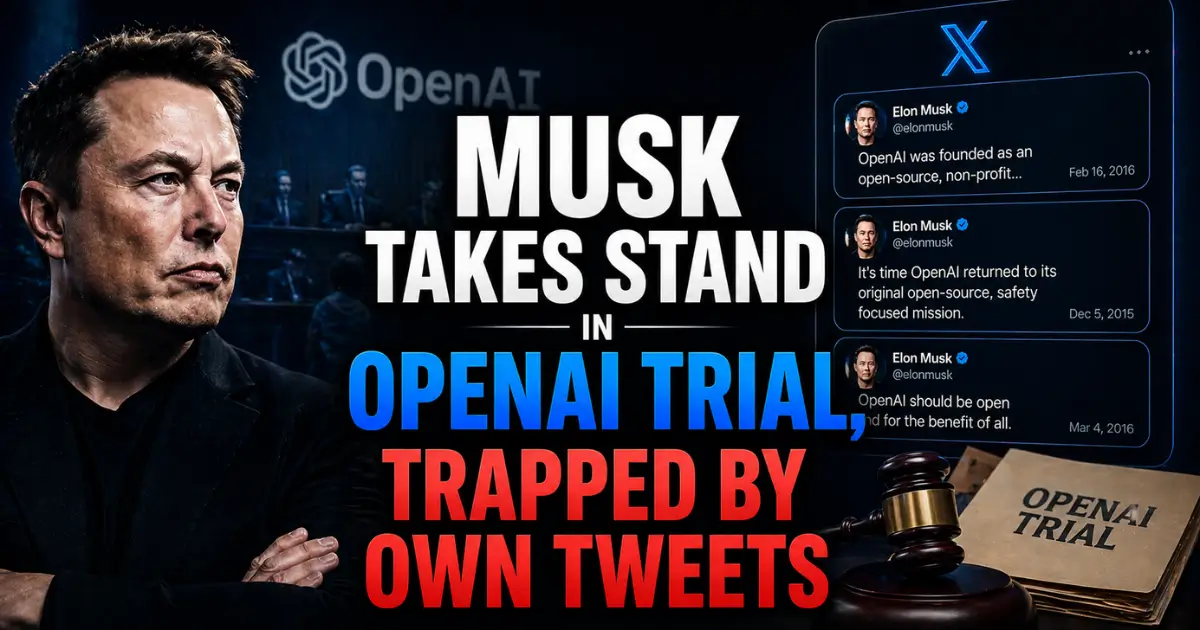
Elon Musk took the witness stand in the Musk vs Altman trial on Wednesday and spent hours arguing that Sam Altman and his co-founders "stole a charity." But under cross-examination, Musk repeatedly contradicted himself — most dramatically when he admitted under oath that Tesla is not currently pursuing artificial general intelligence, directly contradicting a tweet he posted just weeks earlier claiming Tesla would be one of the companies to make AGI.
What Musk Said
Musk's core argument is unchanged. He says he trusted Altman, Brockman, and Sutskever to build AI for humanity through a nonprofit structure. Over time, he grew suspicious of their motives. He concluded they were looting the nonprofit by converting it into an $852 billion for-profit enterprise and keeping the equity.
He testified that the key distinction is between investors whose profits are capped and those whose profits are unlimited. Early Microsoft investments in OpenAI included profit caps. Those caps were rolled back over the years. Musk says that change is what ultimately led him to sue.
How OpenAI's Lawyers Fought Back
OpenAI lawyer William Savitt used cross-examination to dismantle Musk's narrative piece by piece — largely using Musk's own words against him.
Savitt established that Musk had discussed converting OpenAI to a for-profit as early as 2016. In 2017, Musk explored creating a for-profit arm where he would hold majority equity and control the company. When those plans fell apart, he stopped making regular donations — though he continued paying for OpenAI's office space until 2020.
Savitt then confronted Musk with a post on X claiming he had invested $100 million in OpenAI. The actual figure was $38 million. Musk argued that his reputation and network made up for the gap.
The most damaging moment came over AGI. Musk had posted on X that Tesla would be one of the companies to make AGI. On the stand, he said Tesla is not pursuing AGI right now. The contradiction is significant because part of Musk's case rests on the argument that OpenAI's transition to for-profit status is dangerous to society. If his own company makes similar claims without similar safeguards, that argument weakens considerably.
The Employee Poaching Issue
Savitt also surfaced emails showing Musk had backed efforts by Tesla and Neuralink to poach employees from OpenAI while he was still on OpenAI's board. When he left the board in 2018, he tried to recruit senior OpenAI leaders including Andrej Karpathy, who left OpenAI to lead self-driving work at Tesla.
Shivon Zillis — Musk's longtime adviser and the mother of four of his children — was also a member of the OpenAI board when it approved some of the transactions Musk now challenges. Savitt tried to establish that Musk had been consulted about fundraising efforts through Zillis and did not object at the time.
The Safety Argument
The most consequential thread may have been about AI safety. Part of Musk's case is that OpenAI's for-profit conversion reduces its focus on safety. Savitt had Musk admit that all AI companies — including xAI — face the same risk.
Judge Gonzalez Rogers halted that line of questioning but signaled it would resume with limits. When Musk's lawyers raised ChatGPT's role in the Tumbler Ridge shooting, the judge said she did not want to hear about scandals caused by AI models. But she ruled that comparing xAI's and OpenAI's approaches to safety was fair game.
What Comes Next
Musk returns Thursday for more cross-examination. Also expected to testify are his family office manager Jared Birchall, AI safety expert Stuart Russell, and OpenAI president Greg Brockman.
The trial is scheduled to run four weeks. The witness list still includes Altman, Microsoft CEO Satya Nadella, former OpenAI CTO Mira Murati, and co-founder Ilya Sutskever. At stake is up to $134 billion in damages and potentially the unwinding of OpenAI's entire for-profit structure.
For the AI industry, Day One established that the trial will be driven less by legal arguments and more by the personal credibility of the two men at its center. Musk came to court to argue that Altman betrayed a charitable mission. He left having contradicted his own tweets, admitted to planning the same for-profit conversion he now condemns, and acknowledged that his own AI company faces the same safety risks he accuses OpenAI of ignoring.