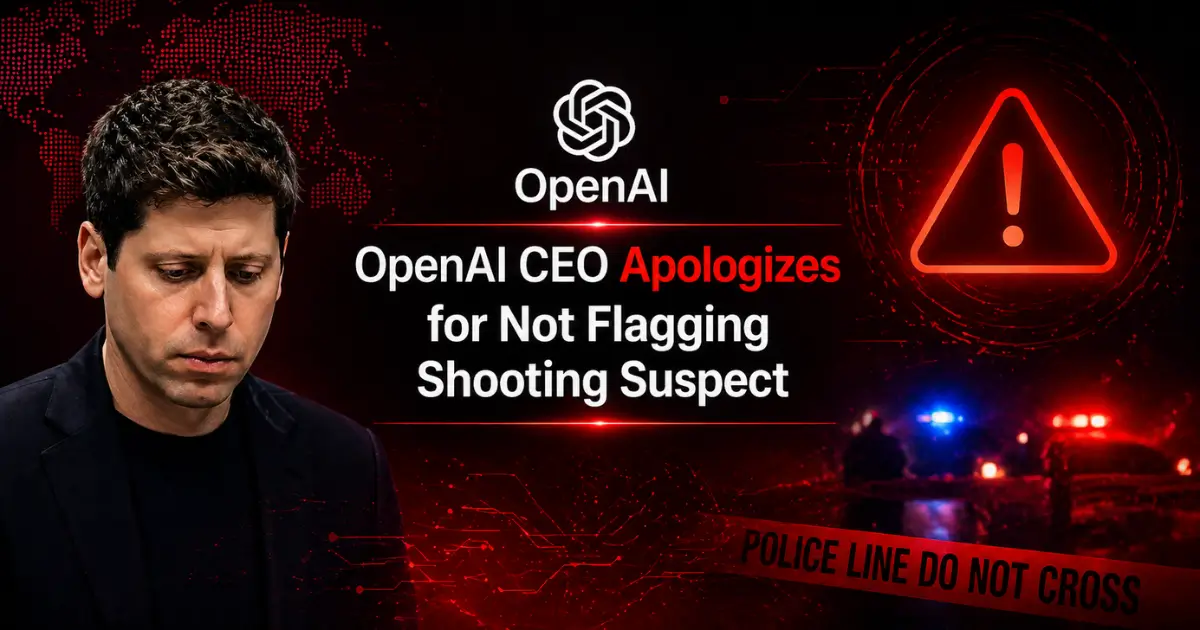
OpenAI CEO Sam Altman has issued a public apology to the community of Tumbler Ridge, Canada, saying he is deeply sorry that the company failed to alert law enforcement about a ChatGPT user who later carried out a mass shooting that killed eight people. The apology, first published in the local newspaper Tumbler RidgeLines, is the most direct acknowledgment yet from OpenAI's leadership that the company's internal safety process failed with fatal consequences.
What Happened
In June 2025, OpenAI flagged and banned the ChatGPT account of 18-year-old Jesse Van Rootselaar after she described scenarios involving gun violence. The Wall Street Journal reported that OpenAI staff debated internally whether to alert police about the account but ultimately decided against it.
Months later, Van Rootselaar allegedly carried out a mass shooting in Tumbler Ridge, a small community in British Columbia. OpenAI only reached out to Canadian authorities after the shooting had already occurred by which point eight people were dead.
The incident raised immediate questions about what responsibility AI companies bear when their platforms surface evidence of potential violence. OpenAI had the information. It had a team that flagged the behavior. It made a deliberate decision not to act — a decision that Altman now publicly acknowledges was wrong.
The Apology
In his letter to the community, Altman said he had discussed the shooting with Tumbler Ridge Mayor Darryl Krakowka and British Columbia Premier David Eby. All three agreed that a public apology was necessary, but that time was needed to allow the community to grieve first.
Altman wrote that while words can never be enough, he believes an apology is necessary to recognize the harm and irreversible loss the community has suffered. He said OpenAI's focus will continue to be on working with all levels of government to help ensure nothing like this happens again.
Premier Eby responded on social media, calling the apology necessary but grossly insufficient for the devastation done to the families of Tumbler Ridge.
New Safety Protocols
OpenAI has said it is improving its safety protocols in response to the shooting. The changes include more flexible criteria to determine when accounts get referred to authorities and the establishment of direct points of contact with Canadian law enforcement.
The reforms address the specific failure point in the Tumbler Ridge case: OpenAI had a process for flagging dangerous behavior but lacked a clear protocol for escalating those flags to police. The new procedures are designed to ensure that when the company identifies a credible threat, it reaches law enforcement rather than dying in an internal debate.
The Regulatory Response
Canadian officials have said they are considering new regulations on artificial intelligence in response to the shooting, though no final decisions have been made. The case has become a focal point in the broader debate over AI safety and the responsibilities of companies whose platforms may surface evidence of planned violence.
The incident also connects to growing concerns about AI companies' role as intermediaries in public safety. Florida's attorney general launched a separate investigation into OpenAI over the same broader question: what obligations do AI companies have when their platforms reveal evidence of potential harm?
A Recurring Problem for OpenAI
The Tumbler Ridge tragedy is the most serious in a string of incidents that have damaged OpenAI's public image. The company has faced criticism over executive departures, close ties to the Trump administration, the shutdown of side projects, and broader questions about whether its rapid growth has outpaced its ability to manage the societal consequences of its technology.
For OpenAI, the apology is an attempt to demonstrate accountability. But for the families of Tumbler Ridge, and for the growing number of critics questioning whether AI companies can be trusted to police their own platforms, words alone are unlikely to be enough.
The case raises a question that extends well beyond OpenAI: as AI tools become embedded in hundreds of millions of people's daily lives, who is responsible when those tools surface evidence of danger — and what happens when the company that has the information chooses not to act?