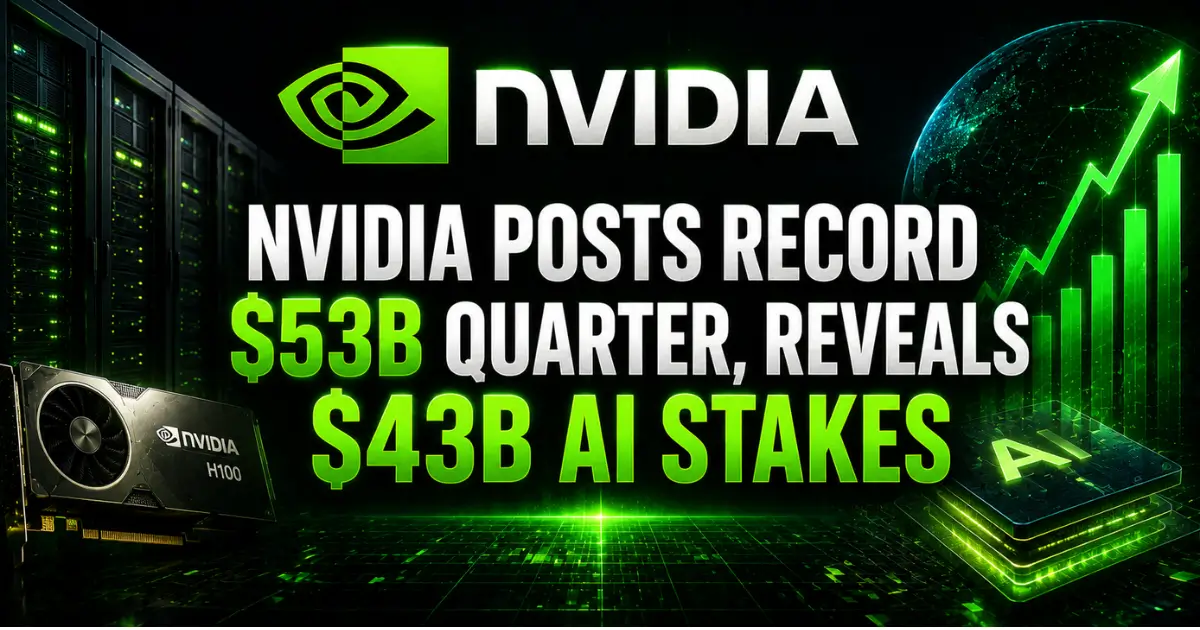
Nvidia reported another record quarter. Revenue hit $53 billion — up 60 percent year-over-year. Net income was $29.5 billion. And for the first time, the company disclosed the full scale of its AI investment portfolio: $43 billion in equity holdings across dozens of AI startups and public companies. Nvidia is not just selling the shovels in the AI gold rush. It is buying stakes in the miners too.
The Revenue Machine
Nvidia's data center revenue — the segment driven by AI chip sales — hit $47.5 billion, accounting for roughly 90 percent of total revenue. Gaming, automotive, and professional visualization contributed the remainder. The data center number alone exceeds the total quarterly revenue of most technology companies.
CEO Jensen Huang told investors that demand continues to exceed supply. Every hyperscaler — Google, Amazon, Microsoft — is buying Nvidia chips as fast as they can be manufactured. And custom chip alternatives from Google's TPUs and Amazon's Graviton are supplementing rather than replacing Nvidia hardware.
ASML's CEO said the chip supply shortage will last three to five years. As long as that constraint persists, Nvidia's pricing power remains intact. The company can charge premium prices because there simply are not enough alternatives.
The $43 Billion Portfolio
The most revealing disclosure was Nvidia's investment portfolio. The company holds $43 billion in equity across AI companies including its $30 billion stake in OpenAI, positions in Thinking Machines Lab, Ineffable Intelligence, Legora, Corning, IREN, and dozens of private startups.
The portfolio creates the circular investment pattern that critics have highlighted. Nvidia invests in AI companies. Those companies use the capital to buy Nvidia chips. Nvidia reports higher revenue. Its stock rises. It uses the gains to invest in more AI companies. The cycle repeats.
Huang dismissed the criticism. He argued the investments are strategic rather than financial. By funding AI companies early, Nvidia ensures they build on Nvidia hardware. The equity positions create alignment. The chip purchases create revenue. Both benefit Nvidia.
Blackwell and Beyond
Nvidia said its next-generation Blackwell chips are now in full production. The company is also preparing its Vera Rubin architecture — named after the astronomer whose work is driving GPU demand from the scientific community. Vera Rubin chips will be available on Google Cloud later this year.
The roadmap confirms that Nvidia intends to maintain its generational lead over competitors. Each new chip architecture offers performance gains that keep customers locked into the Nvidia ecosystem. By the time Google's TPUs or Amazon's Trainium catch up to current-generation Nvidia hardware, Nvidia has already moved to the next generation.
The AI Economy's Central Company
Nvidia's $53 billion quarter and $43 billion portfolio make it the central company of the AI economy. It sells the chips that power every frontier AI model. It invests in the companies that buy those chips. It profits from both sides of every transaction. And it is approaching a $5 trillion market cap.
No other company in the AI industry has this combination of hardware dominance, ecosystem investment, and financial performance. Anthropic is raising $50 billion at $900 billion. OpenAI raised $122 billion at $852 billion. Both are impressive. Neither generates $53 billion in a single quarter.
The Risk
The biggest risk to Nvidia is the same one that has been discussed for a decade: that custom chips eventually reduce demand for GPUs. Google's TPUs power Anthropic's models. Amazon's Graviton won Meta as a customer. And Cerebras is going public at $26.6 billion with wafer-scale chips designed as a direct alternative.
But so far, every prediction of Nvidia's decline has been wrong. Custom chips have grown. Nvidia has grown faster. The AI infrastructure buildout is large enough for multiple chip architectures. And Nvidia's $43 billion in ecosystem investments ensures that every major AI company has a financial relationship with the company that makes their hardware.
The Bigger Picture
Nvidia's earnings confirm what the AI industry already knows: the company selling the infrastructure is capturing more value than the companies building on it. Anthropic's $40 billion revenue run rate is extraordinary. But Nvidia's $53 billion quarter — with net margins above 55 percent — generates more profit in three months than most AI companies will earn in a year.
The AI gold rush continues. And Jensen Huang is selling the picks, the shovels, and taking equity in the mines.