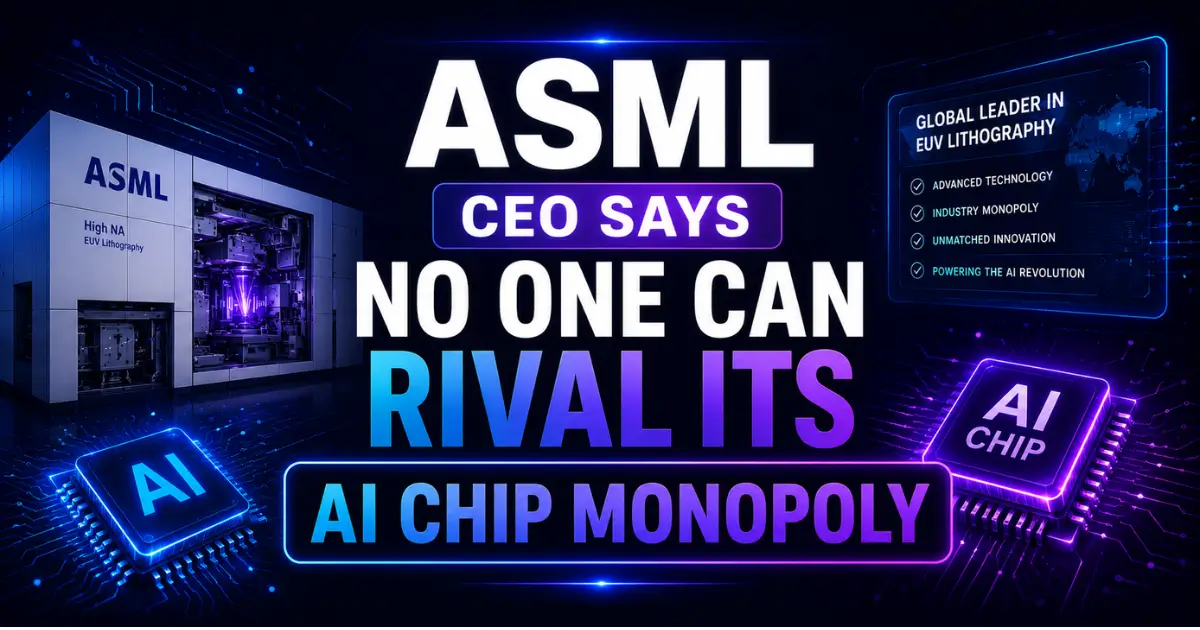
ASML CEO Christophe Fouquet says no one is coming for his company's monopoly. The Dutch company makes the only machines in the world capable of manufacturing the most advanced AI chips. Every GPU from Nvidia, every TPU from Google, every custom chip from Amazon and Apple — all require ASML's extreme ultraviolet lithography machines. Without ASML, the AI revolution stops.
Why ASML Matters for AI
Every AI model running today depends on chips made using ASML's EUV machines. The bus-sized systems cost $200 million to $400 million each. They take months to assemble. They involve hundreds of suppliers. And ASML is the only company that makes them.
That monopoly has made ASML the most valuable company in Europe, worth over $530 billion. With Microsoft, Meta, Amazon, and Google committing over $600 billion in AI infrastructure spending this year alone, demand for ASML's machines has surged. Fouquet told TechCrunch at the Milken Institute that the world will not have enough chips for years.
The chip shortage is already visible. Google Cloud said its $20 billion quarter would have been even larger if it could meet demand. AWS reported its fastest growth in 15 quarters. Every hyperscaler is capacity-constrained. And the bottleneck traces back to chip manufacturing — which traces back to ASML.
The Thiel-Backed Challenger
Substrate, a San Francisco startup backed by Peter Thiel, has raised over $100 million and been valued above $1 billion on claims it can build a competing lithography machine. Fouquet dismissed the threat.
He said wanting to have the technology and having it are very different things. Making an image is a starting point. Doing it at nanometer accuracy, high speed, and low cost across billions of chips is something else entirely. ASML had its first EUV picture 30 years ago and still needed 20 more years to turn it into a manufacturing system.
The response was confident but not arrogant. Fouquet acknowledged that ASML spends €4.5 billion annually on R&D. The company needed decades of accumulated knowledge to solve EUV lithography. Starting from scratch, he suggested, would take even longer.
China Cannot Copy It
Reports have claimed that former ASML engineers in China partly reverse-engineered the technology. Fouquet was direct. No EUV machine has ever been shipped to China. ASML knows where every machine is. The company created a complete separation between employees who can access EUV technology and those who cannot. Chinese staff sit on the other side of that line.
The export control debate around ASML is intense. China can buy ASML's older machines — technology first shipped in 2015. But the latest EUV and high-NA systems are blocked. Fouquet agreed with Nvidia CEO Jensen Huang's argument that companies should sell globally while maintaining a generational gap in what they export. Nvidia works with roughly an eight-generation gap. ASML currently operates with two or three.
Why the AI Industry Should Care
ASML is the invisible foundation of the AI economy. Every debate about custom chips versus Nvidia, every deal for millions of Amazon processors, every IPO of an AI chipmaker — all depend on ASML's machines existing and scaling fast enough.
If ASML cannot produce enough machines, the chip shortage persists. If the chip shortage persists, AI companies cannot build enough data centers. If they cannot build enough data centers, the entire AI infrastructure buildout slows down. The $462 billion backlog at Google Cloud, the $100 billion AWS commitments from Anthropic, the multi-billion dollar deals with Thinking Machines — all of it depends on a single Dutch company shipping enough bus-sized machines.
The Bigger Picture
Fouquet's confidence reflects a simple truth. ASML's monopoly is not based on patents or market position. It is based on complexity. The machines are so difficult to build, so dependent on decades of accumulated knowledge, and so reliant on a global network of specialized suppliers that replicating them from scratch would take years — possibly decades.
In an AI industry where billions change hands weekly and valuations approach $1 trillion, the most important company may be the one most people have never heard of. ASML does not build AI. It builds the machines that make AI possible. And according to its CEO, no one else can.