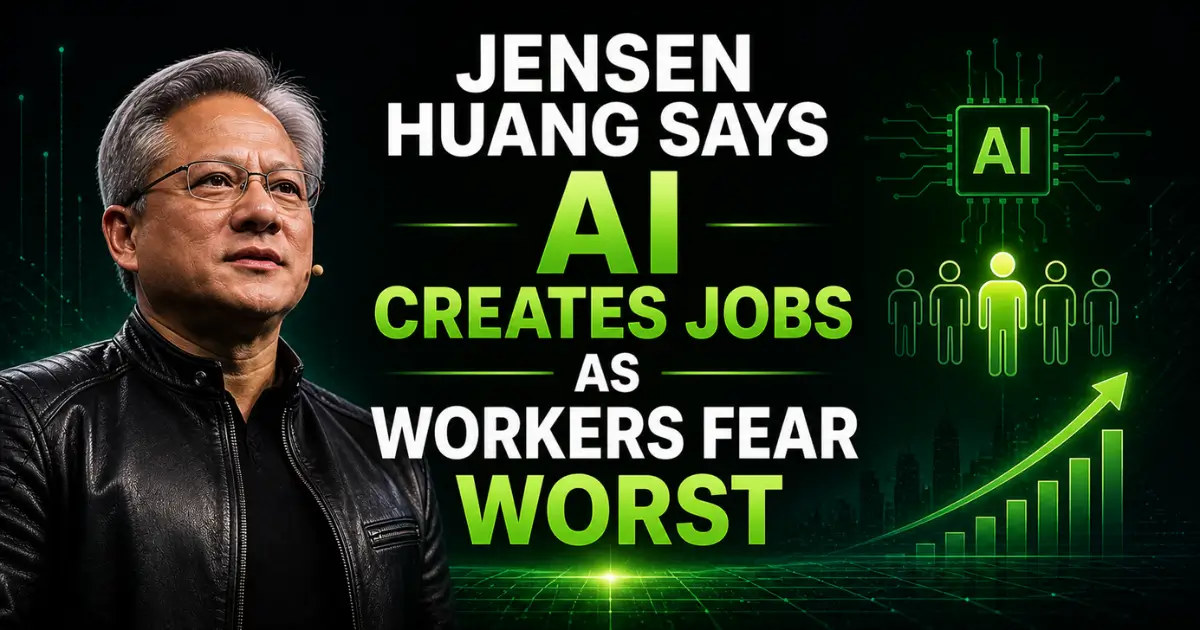
Nvidia CEO Jensen Huang pushed back hard against fears that AI will destroy jobs. Speaking at the Milken Institute on Monday, he called AI an industrial-scale job creator and said it represents America's best opportunity to re-industrialize. His optimism stands in stark contrast to Goldman Sachs data showing AI is already eliminating tens of thousands of jobs per month.
Huang's Argument
Huang made three core points. First, AI creates entirely new industries that need workers — from the factories building AI chips to the data centers running AI models to the companies deploying AI solutions. Nvidia itself has grown from a niche chipmaker to a nearly $5 trillion company, hiring thousands along the way.
Second, he argued that automating a task is not the same as eliminating a job. Just because AI handles one part of a role does not mean the entire position disappears. The purpose of a job and the tasks within it are related but not identical. A lawyer who uses AI to draft documents is still a lawyer. A doctor who uses AI for diagnosis is still a doctor. The job evolves. It does not vanish.
Third, Huang warned that the biggest risk is not AI destroying jobs. It is people being so afraid of AI that they refuse to engage with it. He said fear-driven narratives about AI dominance could make the technology unpopular enough that America fails to adopt it — handing the advantage to countries that embrace it without hesitation.
The Counter-Evidence
Huang's optimism is difficult to reconcile with the data. Goldman Sachs estimates AI is eliminating roughly 16,000 net jobs per month in the US. Anthropic CEO Dario Amodei has warned that AI could wipe out half of all entry-level white-collar jobs. Block laid off 40 percent of its workforce and explicitly cited AI. Amazon cut 30,000 corporate positions while spending billions on AI infrastructure.
Entry-level hiring at the top 15 tech companies dropped 25 percent between 2023 and 2024. The LinkedIn analysis showed that while AI is not killing jobs yet, the trajectory is unmistakable. Gen Z workers are feeling the impact first — losing the entry-level positions that AI tools now handle automatically.
BCG projects that as much as 15 percent of US jobs will be eliminated over the next several years as a result of AI. The World Economic Forum estimates 92 million jobs displaced globally by 2030 — offset by 170 million new ones, but with a massive skills gap in between.
The Conflict of Interest
Critics point to an obvious conflict. Huang runs the company that profits most from AI adoption. Nvidia sells the chips that power nearly every major AI system. Every new AI deployment, every expanded data center, every model training run generates revenue for Nvidia. His incentive to downplay AI's labor impact is as large as his company's market cap.
The irony is that much of the doom rhetoric Huang criticizes was generated by the AI industry itself. OpenAI, Anthropic, and other labs have spent years warning about existential risks and transformative capabilities. Those warnings drove public excitement, government attention, and enormous investment. Now that public anxiety about AI is rising, industry leaders want to walk back the very narratives they promoted.
The Middle Ground
The truth is probably somewhere between Huang's optimism and the doomers' worst fears. AI will create jobs. It will also destroy them. The question is timing, distribution, and scale. If new jobs emerge in the same communities and at the same skill levels as the ones being lost, the transition may be manageable. If the new jobs require skills that displaced workers do not have, the result is structural unemployment.
OpenAI's own policy paper acknowledged this gap, proposing robot taxes, public wealth funds, and a four-day work week to cushion the impact. Even the company building the technology recognizes that the transition will not be seamless.
What It Means
Huang's message at Milken was aimed at policymakers, investors, and the American workforce. Do not fear AI. Embrace it. The jobs will come. Whether that message proves prophetic or self-serving will depend on what the economy looks like in two years — when the first wave of AI displacement has fully arrived and the promised new jobs either exist or do not.
For now, Nvidia is selling the shovels. Whether the gold rush delivers prosperity or upheaval for the workers digging remains the most important economic question of the decade.