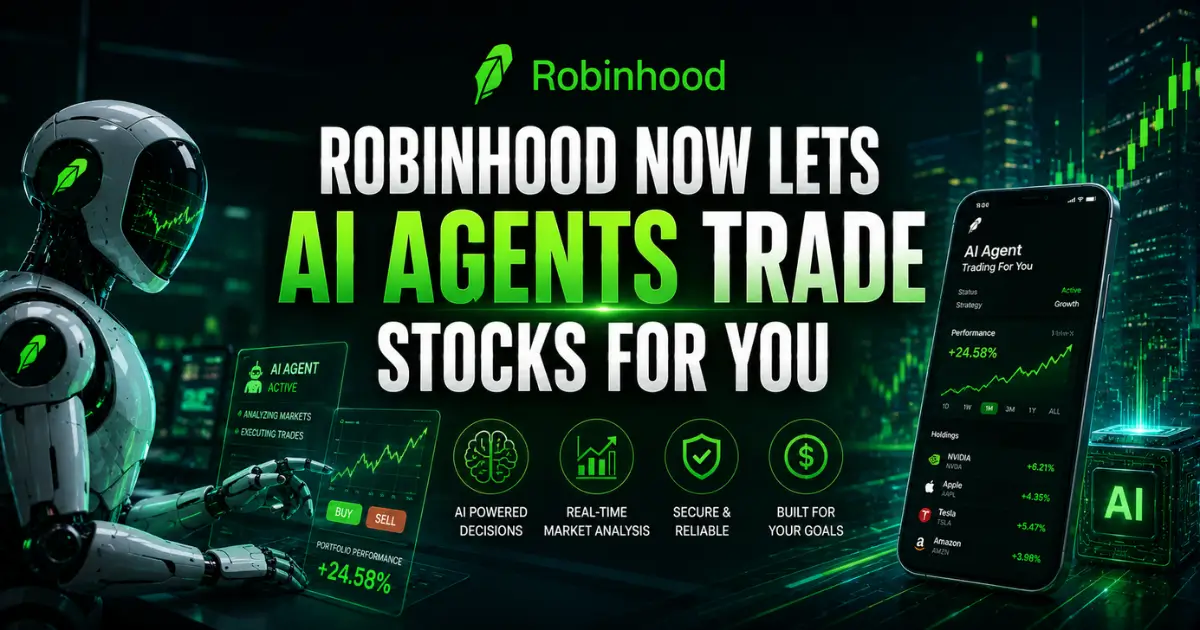
The era of AI agents managing your money has officially arrived. Stock trading app Robinhood announced on Wednesday that it is launching support for agentic trading — letting AI agents read your portfolio, devise strategies, and place trades on your behalf. Alongside it, the company unveiled a new agentic credit card that lets AI agents make payments. It is one of the most consequential moves yet in the rapidly expanding world of AI agents that can act with real financial stakes.
The launch marks a shift from AI that advises to AI that acts. For years, trading apps have offered AI-powered research and investment suggestions. Robinhood is now handing agents the keys to execute — within carefully designed guardrails meant to keep users in control of their money.
How Agentic Trading Works
Robinhood users can now create a separate account for their AI agents and connect it to a dedicated wallet. The agents can read and analyze a user's portfolio to develop trading strategies and suggest investments — but they can only access the pre-loaded balance in that dedicated wallet to place orders. That design choice is the core safety mechanism. An agent can only ever risk the money the user explicitly allocates to it, not the entire portfolio.
Users receive notifications of every trade their AI agent makes and can monitor all activity within the Robinhood app. For some trades, agents will show a preview that the user must approve before the order executes. Robinhood has also built in fraud detection — a dedicated team reviews suspicious trades and helps users resolve disputes. The feature is launching in beta and currently supports only stock trading, with options, crypto, event contracts, futures, and prediction markets planned soon.
The MCP Connection
At the technical core of Robinhood's launch is the Model Context Protocol, the emerging standard for connecting AI tools to external services. Users can connect their AI agents to Robinhood's MCP service to analyze concentration risk and sector exposure, execute trades, or comb through analyst notes to identify new investment opportunities across sectors.
The reliance on MCP is significant because it reflects how quickly the protocol has become the connective tissue of the agentic economy. The same standard powers platforms across the industry — from the way Notion turned its workspace into an AI agent hub to the infrastructure plays like when Anthropic acquired Stainless, the SDK tool that underpins how major AI APIs connect to developers. Robinhood is plugging finance directly into that ecosystem.
An Agentic Credit Card Too
Robinhood is not stopping at trading. The company is debuting a new virtual credit card designed specifically for AI agents. By connecting their agents to Robinhood's banking MCP server, users can let those agents make payments. The card is currently available only to Robinhood Gold Card holders, who can link their account to the new virtual card.
The controls mirror those on the trading side. Users can set monthly spending limits and choose whether their AI agent must seek approval for every payment. Robinhood said its Platinum Card will receive a similar agentic card feature when it launches later this year. The dual launch — trading plus payments — signals that Robinhood sees agentic finance as a complete category rather than a single feature.
Part of a Broader Agentic Wave
Robinhood is far from alone in giving AI agents the power to transact. Major players including Stripe, Amazon, and Google have all built products that let AI agents buy goods on users' behalf, alongside newer startups entering the space. The agentic economy is expanding from productivity into commerce and finance — the highest-stakes domains of all.
The momentum is visible everywhere. Sierra's enterprise AI agents, valued at $15 billion, handle billions of customer interactions. CopilotKit raised $27M to embed agents inside apps. Vapi was picked by Amazon Ring to handle over a billion calls. And even Google's own Gemini Spark now manages tasks proactively inside Gmail. Robinhood's move extends that wave into the one area where mistakes cost real money instantly.
The Risk Question
Handing AI agents the ability to trade stocks and make payments raises obvious concerns. Markets move fast. AI models can hallucinate, misread context, or behave unpredictably under conditions they were not trained for. A flawed trading strategy executed autonomously could drain a wallet before a user notices. Robinhood's guardrails — dedicated wallets, trade previews, approval requirements, spending limits, and fraud review — are designed to contain that risk. But the fundamental tension remains.
The timing is notable given that Google admitted it's figuring out AI security in real time, warning that agentic threats are outpacing defenses. An AI agent with access to a brokerage account and a credit card is exactly the kind of high-value target that security teams worry about. Robinhood is betting that its containment model — limiting agents to pre-loaded balances and requiring approvals — is enough to make agentic finance safe for mainstream users. As with any financial decision, the responsibility ultimately falls on users to understand the risks before delegating their money to an autonomous system.
What It Means
Robinhood's agentic trading launch is a milestone in the evolution of AI agents from helpful assistants to autonomous actors with real financial authority. The company is responding to genuine customer demand — VP of product Abhishek Fatehpuria said users have asked to bring their own tools, LLMs, and agents and connect them to Robinhood. That demand signals a future where managing investments may become something users supervise rather than do.
Whether that future is empowering or dangerous depends on execution. If the guardrails hold and the agents prove reliable, agentic trading could democratize sophisticated investment strategies that were once reserved for those who could afford professional managers. If they fail, the consequences land directly in users' wallets. Either way, Robinhood has fired one of the clearest shots yet in the race to let AI act on our behalf — and the rest of the financial industry is moving in the same direction.