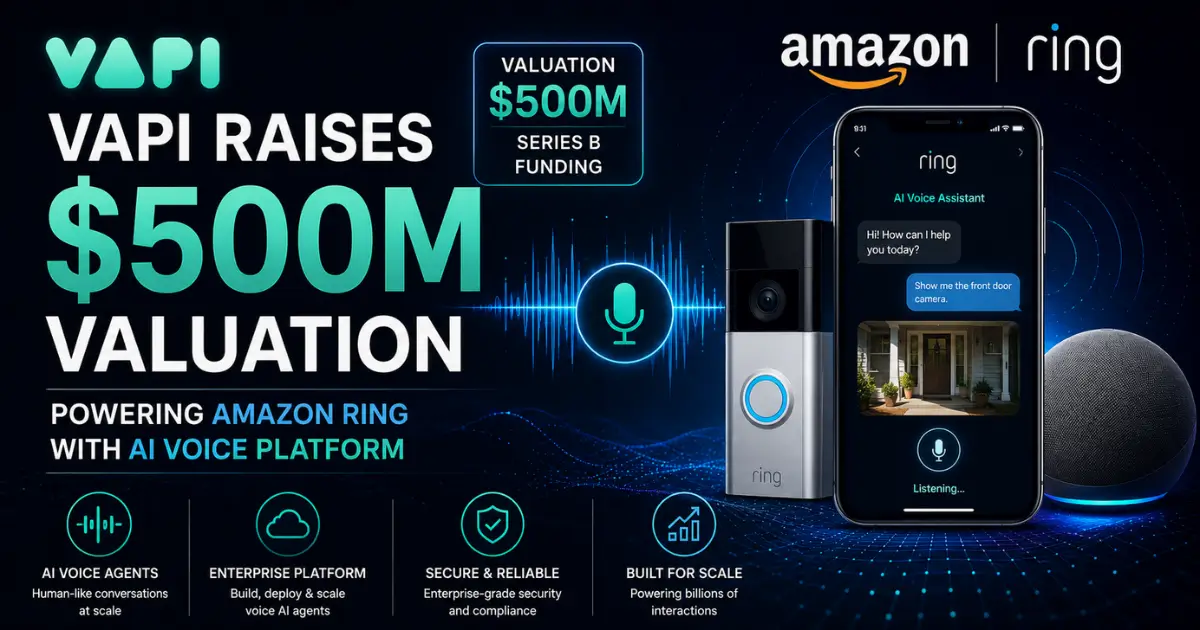
AI voice startup Vapi has raised $50 million in Series B funding at a $500 million valuation after Amazon Ring selected it over more than 40 competitors to handle 100 percent of its inbound customer calls. The platform has now processed over 1 billion calls. Enterprise business has grown 10x since early 2025. And the company is emerging as one of the most important infrastructure players in the voice AI market.
How Vapi Won Amazon Ring
During last year's holiday season, Ring faced a surge in customer support calls. The company evaluated over 40 AI voice vendors. It chose Vapi because the platform gave Ring's engineers granular control over how AI agents behaved during live customer conversations.
The results were immediate. Ring's customer satisfaction scores improved. Teams could tune the AI agent experience without depending on engineering. Today, 100 percent of Ring's inbound calls run through Vapi. Ring VP of software development Jason Mitura said most AI tools promise great outcomes — Vapi delivered on them.
The Amazon Ring win is significant beyond the revenue it generates. It validates that voice AI agents can handle customer interactions at scale for one of the world's most recognizable consumer brands. If Ring trusts Vapi with every inbound call, other enterprises take notice.
From AI Therapist to Billion-Call Platform
Vapi's origin story is unusual. Co-founder Jordan Dearsley built an AI therapist for conversations during his daily walks. Few people wanted the therapy product. But startups were interested in the low-latency voice infrastructure underneath it.
Dearsley and co-founder Nikhil Gupta, both University of Waterloo graduates who had gone through Y Combinator, pivoted to voice infrastructure. They launched Vapi publicly in 2024. The platform now processes between 1 million and 5 million calls per day.
Enterprise customers include Amazon Ring, Kavak, Instawork, New York Life, Intuit, and Cherry. The self-serve developer platform has been used by more than 1 million developers. The company has about 100 employees.
The Voice AI Market Is Exploding
Vapi enters a crowded and fast-growing market. Sierra raised $950 million at $15 billion for enterprise AI agents. OpenAI launched a voice intelligence API for enterprise phone AI. Thinking Machines Lab announced full-duplex interaction models that listen while they talk. And healthcare startup Basata raised $21 million for AI voice agents that schedule specialist appointments.
Competitors include Bland AI, Retell, PolyAI, Decagon, and ElevenLabs. Dearsley says Vapi differentiates by focusing on infrastructure and orchestration rather than pre-packaged applications. Enterprises that want control over reliability, compliance, and AI agent behavior choose Vapi over more opinionated solutions.
The distinction matters. Companies like Ring need to customize how the AI handles specific scenarios — returns, refunds, escalations, edge cases. A one-size-fits-all voice bot does not work at enterprise scale. Vapi provides the tools to build exactly the agent each customer needs.
The Funding
The $50 million Series B was led by Peak XV Partners. Microsoft's M12, Kleiner Perkins, and Bessemer Venture Partners also participated. Total funding is now $72 million. Annual recurring revenue is in the healthy eight figures, according to an investor.
The investor roster is notable. Microsoft's venture arm backing Vapi suggests the company's platform complements rather than competes with Microsoft Copilot. Copilot handles office productivity. Vapi handles phone calls. Different channels, same enterprise customers.
Why Voice AI Wins
Voice remains the dominant channel for customer interactions in most industries. Healthcare. Insurance. Financial services. Utilities. Government. These sectors process billions of phone calls annually. Most still rely on human agents or traditional interactive voice response systems that frustrate callers.
AI voice agents that can handle these calls naturally — understanding context, resolving issues, escalating when needed — represent one of the largest near-term opportunities in enterprise AI. The companies that cut hiring to fund AI spending are often redirecting those budgets toward exactly the kind of voice automation Vapi provides.
The Bigger Picture
Vapi's $500 million valuation and billion-call milestone mark a turning point for voice AI. The technology has moved from experimental to essential. Amazon Ring does not run 100 percent of its calls through an AI platform as a test. It does it because it works better than the alternative.
For the AI industry, Vapi's story illustrates a pattern that is repeating across sectors. The most valuable AI companies may not be the ones building frontier models. They may be the ones building the infrastructure that connects those models to the real world — one phone call at a time.