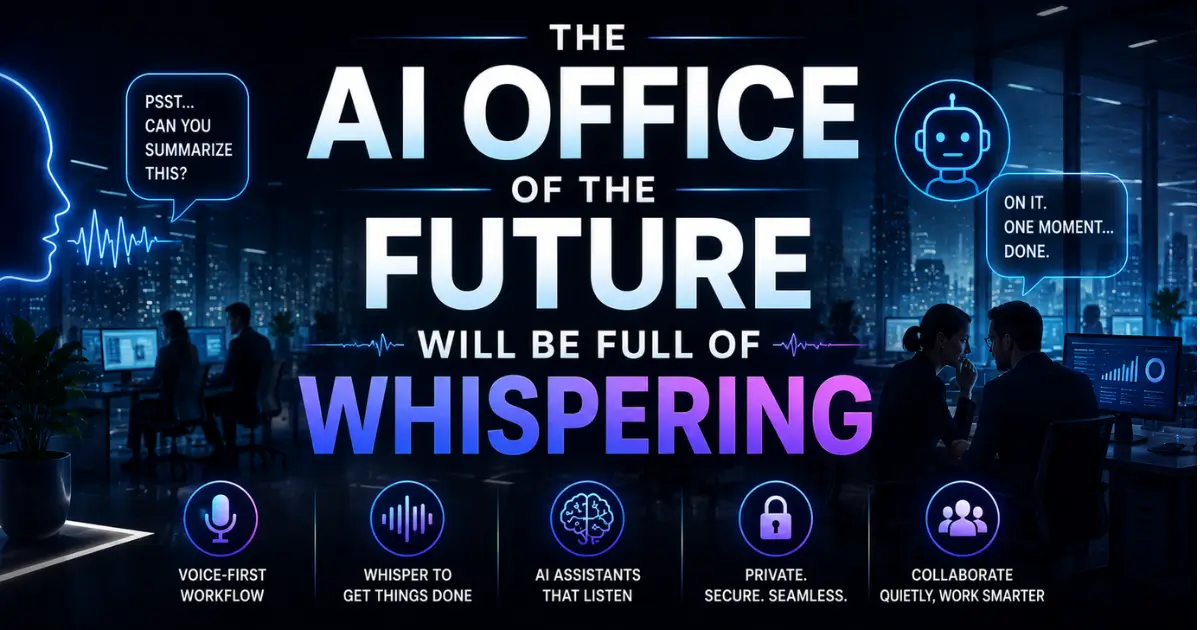
The open-plan office is about to get even stranger. As voice-based AI tools like Wispr Flow, Perplexity Computer, and OpenAI's voice API gain traction, a growing number of workers are discovering the fastest way to interact with AI is to talk to it. The problem: they are doing it in offices full of other people. The result is a new workplace phenomenon — rows of professionals whispering instructions to their laptops.
The Whisper Problem
Voice dictation and voice-based AI interaction are significantly faster than typing for many tasks. Wispr Flow claims users can compose messages and documents three to four times faster by speaking. Microsoft Copilot offers voice interaction across Office apps. And an expanding ecosystem of AI agents can be directed through natural speech.
But speaking to your computer in a shared office creates obvious social friction. Colleagues overhear your prompts. Confidential information travels across open floor plans. And the ambient noise of a dozen people simultaneously talking to their AI assistants creates an environment that is neither quiet enough for focused work nor structured enough for productive collaboration.
Several companies are already adapting. Some have designated voice AI zones. Others have issued noise-canceling headsets with built-in microphones. A few startups are developing whisper-optimized microphones that can capture low-volume speech while filtering out background noise.
The Hardware Response
The whisper office is driving demand for new hardware. Noise-canceling headsets with directional microphones. Desk-mounted privacy shields that block sound. And keyboard-integrated microphones that capture speech from inches away, letting users speak at a whisper without shouting across the room.
Apple's incoming CEO John Ternus is reportedly exploring AI-enhanced AirPods that could serve as always-on voice interfaces. AI hardware startups like Era are building wearable devices designed for ambient voice interaction. And brain-computer interface company Neurable is developing technology that could eventually bypass voice entirely — letting users interact with AI through neural signals.
Why Voice Is Winning Anyway
Despite the awkwardness, voice interaction with AI is growing because the productivity gains are real. Composing a detailed email by speaking takes 30 seconds. Typing takes three minutes. Directing an AI agent to research a topic, summarize findings, and draft a report is faster by voice than by keyboard.
The shift mirrors what happened with phone calls in offices decades ago. Initially, making a phone call at your desk felt disruptive to neighbors. Eventually, the practice became so universal that nobody noticed. Voice AI interaction may follow the same trajectory — awkward now, normal within a year.
Google's Gemini is already voice-native in cars and increasingly voice-capable across Chrome and Workspace. OpenAI's voice intelligence API enables enterprise phone agents and real-time transcription. The infrastructure for voice-based AI interaction is being built rapidly. The office culture just has not caught up yet.
The Remote Work Advantage
The whisper problem is one more argument for remote work. At home, you can talk to your AI assistant at full volume without disturbing anyone. You can dictate emails, direct agents, and conduct voice-based research without social friction.
For companies that have pushed return-to-office mandates, the voice AI trend creates an ironic tension. The most productive way to use AI requires talking out loud. The office environment makes talking out loud disruptive. Remote workers get to use AI more effectively than their in-office colleagues simply because they have privacy.
The Bigger Picture
The whisper-filled office is a small but telling sign of how deeply AI tools are changing the physical workspace. The open-plan office was designed for typing and screen-based work. Voice-based AI interaction requires a different kind of space — one that accommodates speech without sacrificing privacy or productivity.
Whether offices redesign for voice AI, workers adapt to whispering, or the technology develops to work silently through text and neural interfaces, one thing is clear. The way we interact with computers is changing. And the office will have to change with it.