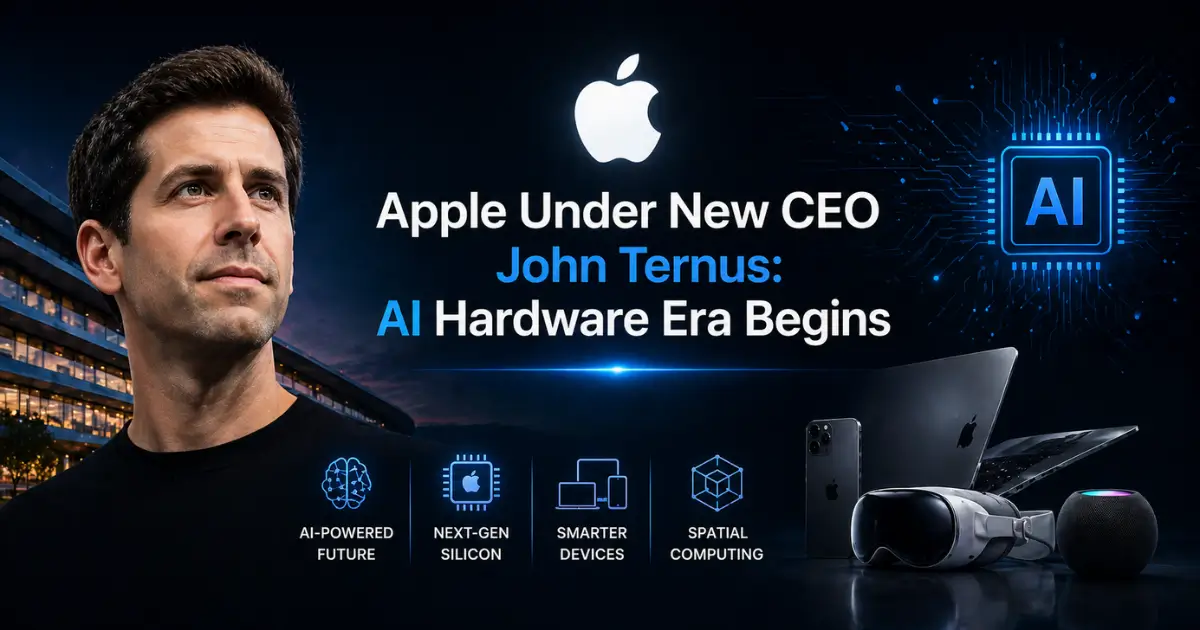
Tim Cook is stepping down. John Ternus, Apple's longtime hardware engineering chief, will take over as CEO later this year — and his appointment signals a renewed focus on hardware at the exact moment when AI is reshaping what devices can do. While Cook transformed Apple into a $4 trillion services powerhouse, Ternus is the builder who made AirPods, Apple Watch, and Vision Pro. His job now is to define what Apple builds next.
A Hardware Guy in an AI World
Rather than trying to compete head-on with companies building the largest AI models, Ternus is expected to push Apple deeper into AI-powered devices — the thing in your hand, the thing on your face, and the thing in your home.
Speculation about what Apple could launch next centers on three categories: smart glasses, a wearable pendant with a built-in camera, and AirPods with embedded AI capabilities. All of these products would reportedly connect to the iPhone, with Siri playing a central role as the AI interface.
The wearable AI category is rapidly heating up. Startups like Era are building the software layer for AI gadgets, and the market is searching for its first breakout consumer AI device beyond the smartphone. Apple's entry could define the category — or arrive too late to lead it.
The Foldable iPhone Is Coming
Ternus will oversee the launch of Apple's long-rumored foldable iPhone, which reports say is on track to arrive in September. Competitors like Samsung have been selling foldable devices for years. Apple took a slower approach, waiting until the technology met its standards — a classic Cook-era strategy that Ternus will now either continue or accelerate.
The foldable launch will be the first major product release of the Ternus era and will set the tone for how markets evaluate his leadership. Apple's hardware engineering team has been his domain for over two decades. If anyone at the company can deliver a foldable that justifies the wait, it should be him.
Robots in the Home
Apple has also been exploring robotics. One concept involves a tabletop device with a robotic arm attached to a display — a smart assistant that can physically move and turn toward you. Reports mention mobile robots that could follow you around, handle simple tasks, or act as a moving FaceTime screen. Some experiments even involve humanoid robots, though those are likely years away.
The robotics ambitions connect to a broader trend in the AI industry. China recently showcased humanoid robots at a Beijing half-marathon, and companies worldwide are racing to combine AI software with physical hardware. Ternus's personal background aligns with this direction — in college, he built a device that allowed quadriplegics to control a mechanical feeding arm using head movements.
The Mac Mini Problem
One immediate challenge Ternus inherits is the Mac Mini shortage. Apple's $599 desktop has sold out across configurations as AI users snap them up for running local models, with eBay prices surging past $900. The shortage reflects both the growing demand for on-device AI compute and an industry-wide memory chip crunch driven by AI infrastructure spending.
Whether Ternus responds with a refreshed Mac Mini designed specifically for AI workloads — perhaps with more memory and dedicated AI acceleration — could signal how seriously the new CEO intends to pursue the developer and AI enthusiast market alongside traditional consumers.
Tariffs, Supply Chains, and China
The leadership transition comes at a particularly challenging moment for Apple's global operations. Roughly 80 percent of iPhones were produced in China before recent tariff changes. The company has pivoted to India, which now accounts for about 25 percent of iPhone production — but ongoing tariff uncertainty under the Trump administration creates significant planning challenges.
Memory chip shortages add another layer of complexity. The same chips that go into iPhones and Macs also go into AI data centers, and when companies like Anthropic and Google are spending tens of billions on AI compute, consumer electronics inevitably feel the supply pressure.
What It Means for AI
Apple under Ternus will likely compete in the AI race differently from Google, OpenAI, or Anthropic. Instead of building the biggest models, Apple's strategy appears focused on building the best devices for experiencing AI — combining its silicon expertise, privacy-first approach, and massive install base to create hardware that makes AI feel personal rather than corporate.
The question is whether Apple can move fast enough. The AI industry is evolving at a pace measured in weeks, not years. Competitors are shipping new models monthly. Startups are raising billions. And the window for defining AI hardware is closing. Ternus has the engineering credentials. What he needs now is speed.