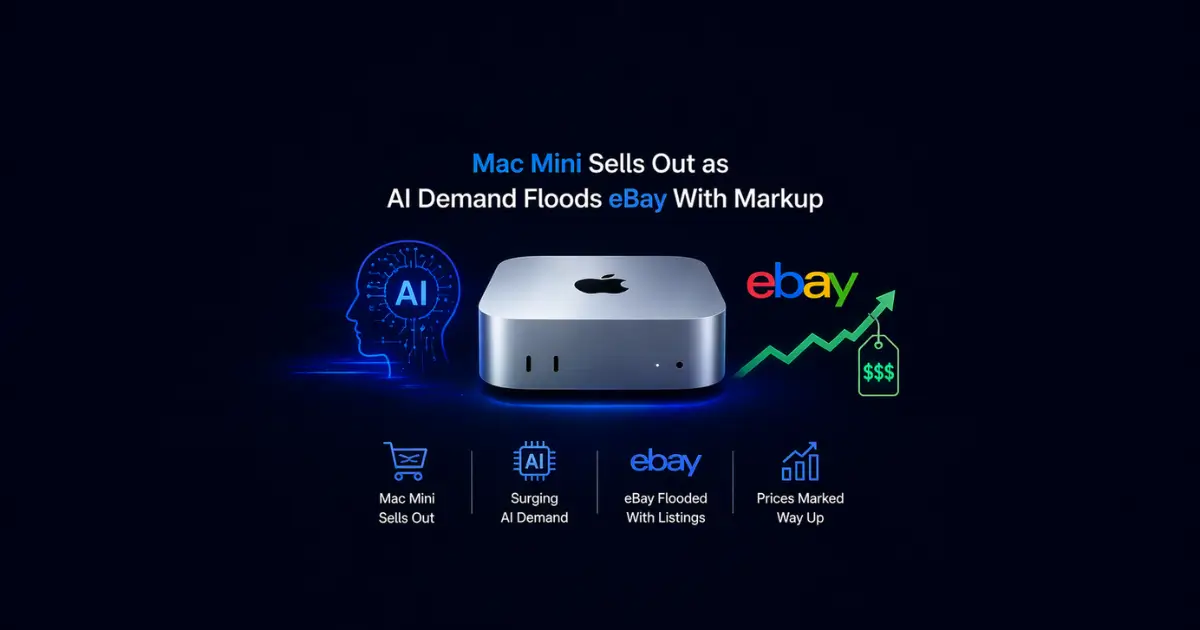
Apple's $599 Mac Mini is sold out, and scalpers on eBay are charging hundreds more for the tiny desktop computer that has become the unexpected hardware darling of the AI era. The shortages are being driven by surging demand from users running on-device AI models — a trend that is turning a consumer desktop into an AI development tool and creating a secondary market with inflated prices.
What Happened
The base M4 Mac Mini with 16GB RAM and 256GB storage is completely unavailable on Apple's retail website, with no options for delivery or in-store pickup. The shortage has extended across multiple configurations regardless of memory selected. Models with higher storage are not shipping until June at the earliest.
The Mac Studio has also sold out across several configurations, and even MacBook Pro delivery windows have stretched. Only the MacBook Neo, Apple's newest laptop, remains readily available — suggesting the real bottleneck is specific consumer demand for the Mac Mini form factor.
Apple has not commented on the shortages.
eBay Prices Tell the Story
With Apple unable to fulfill orders, eBay has become the secondary market for Mac Minis. The markup is significant: base models that retail for $599 are selling for $715 to $795 in open-box condition. Refurbished units in excellent condition are listed as high as $979. Even lightly used pre-owned models are going for around $700 — more than $100 above the price of a brand-new unit.
One listing for a brand-new base model was priced at $925 with a warning that it was the last one available. The pattern is reminiscent of GPU shortages during the cryptocurrency mining boom — except this time, the demand is driven by AI tools rather than mining rigs.
Why AI Users Want Mac Minis
Apple's Mac Mini has become a favored device for running local AI models because of its combination of power efficiency, quiet operation, and reliability for 24/7 use. The trend began with OpenClaw, Microsoft's open-source AI agent framework, but has since expanded to alternatives like ZeroClaw, tools from Anthropic and OpenAI, Perplexity Computer, and a growing ecosystem of specialized local models.
Running AI models locally — rather than through cloud APIs — gives users privacy, eliminates per-token costs, and provides always-available access without internet dependency. For developers experimenting with AI agents, hobbyists building personal assistants, and researchers testing models, the Mac Mini offers the cheapest entry point into Apple's silicon ecosystem, which has become one of the most efficient platforms for running language models locally.
The appeal is straightforward: a quiet, compact computer that can run sophisticated AI models continuously without the noise, heat, and power consumption of a traditional GPU workstation.
The Memory Crunch Connection
The Mac Mini shortage is compounded by an industry-wide memory crunch. AI's insatiable demand for high-bandwidth memory is squeezing supply across the entire electronics market. The same memory chips that go into Mac Minis also go into AI data center hardware, and when companies like Anthropic, OpenAI, and Google are buying compute capacity measured in billions of dollars, consumer products inevitably feel the squeeze.
Bloomberg has also reported plans for a Mac Mini refresh, which may be contributing to supply constraints as Apple transitions manufacturing. But product line refreshes have not caused sellouts before — reinforcing the view that AI-driven demand is the primary factor.
A New Kind of Hardware Shortage
The Mac Mini sellout represents something new in the AI industry. Previous hardware shortages have centered on enterprise equipment — Nvidia GPUs, server racks, data center components. This is the first time a consumer desktop computer has been driven out of stock by AI demand.
It signals that AI is moving beyond the cloud and into people's homes. The same technology that requires billions in infrastructure investment at the enterprise level is now running on a $599 desktop — and there are not enough of them to go around.
Whether Apple responds with a refreshed Mac Mini designed specifically for AI workloads, or whether the shortage resolves as supply chains catch up, the sellout is a vivid reminder that AI's impact extends far beyond Silicon Valley boardrooms. It is changing what people buy, what they are willing to pay, and what they expect a desktop computer to do.