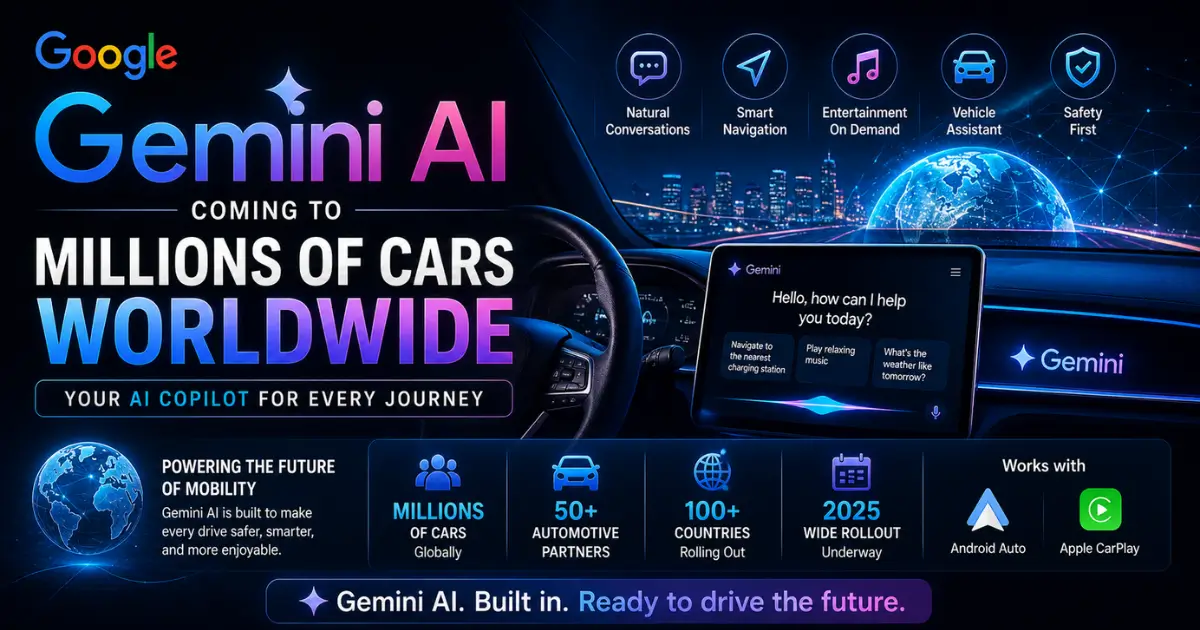
Google is bringing Gemini to the dashboard. The company announced that its AI assistant will be integrated into millions of vehicles through Google Built-In, the automotive platform that runs Android Automotive OS. Drivers will be able to have natural conversations with Gemini while on the road — asking questions, getting recommendations, and controlling vehicle functions using voice.
What Drivers Get
Gemini in the car works like a smart co-pilot. Drivers can ask open-ended questions about their route, nearby restaurants, weather conditions, or local attractions. The AI responds conversationally, drawing on Google's search, Maps, and knowledge graph to deliver relevant answers without requiring the driver to look at a screen.
The assistant also handles vehicle controls. Drivers can adjust climate settings, open the sunroof, change media, or switch drive modes using natural language. Instead of navigating menus or pressing buttons, a driver can simply say "I'm cold" and Gemini adjusts the temperature.
The experience builds on Google's existing automotive platform, which already powers infotainment systems in vehicles from Volvo, Polestar, Ford, Lincoln, Chevrolet, GMC, and other manufacturers. Adding Gemini transforms the system from a traditional voice assistant into a conversational AI interface that understands context and multi-step requests.
Part of Gemini Everywhere
The automotive push extends Google's strategy of embedding Gemini into every screen in a user's life. In the past weeks alone, Google has added Gemini to Chrome, Google Maps, Workspace, YouTube, Google TV, and even Google Photos. The car is the next logical step — and arguably one of the most important, given how much time people spend driving.
The integration also creates competitive pressure on Apple, whose CarPlay dominates the automotive infotainment market. Apple's incoming CEO John Ternus has signaled a renewed focus on AI-powered hardware, but Apple has not yet announced Siri upgrades comparable to what Google is delivering with Gemini in vehicles.
Safety Considerations
Putting a conversational AI assistant in the driver's seat raises immediate safety questions. Voice interfaces are inherently safer than touchscreens because they keep drivers' eyes on the road. But a highly engaging AI conversation could still be distracting. If Gemini starts telling a compelling story or diving deep into a topic, the cognitive load on the driver increases even without visual distraction.
Google says the automotive version of Gemini is designed for short, contextual interactions rather than extended conversations. The system prioritizes quick, relevant answers over lengthy responses. It also integrates with Google Maps to provide proactive alerts about traffic, weather, and road conditions without being asked.
The Data Opportunity
Cars generate enormous amounts of data — location, driving patterns, destinations, music preferences, climate settings, and passenger behavior. Adding an AI assistant that processes voice queries on top of that data creates an extraordinarily detailed profile of each driver's daily life.
Google says vehicle data is handled according to its automotive privacy policies. But the combination of location data, voice queries, and behavioral patterns makes the connected car one of the richest data environments any technology company can access. The same privacy tensions that affect Google's other AI products — from health advice to wardrobe recommendations — apply with equal force behind the steering wheel.
Why Automakers Want This
For car manufacturers, AI is becoming a differentiator. A vehicle with a smart, conversational assistant feels more premium than one with a basic voice command system. As cars become increasingly software-defined, the quality of the in-cabin AI experience influences purchase decisions — especially among younger buyers who expect the same intelligence from their car that they get from their phone.
Google's advantage is scale. Android Automotive OS already runs in millions of vehicles. Adding Gemini to that base gives automakers an AI upgrade without building their own systems. For manufacturers that lack the AI expertise of a Google or Apple, the partnership is a shortcut to a competitive feature set.
The Bigger Picture
Google Gemini in the car marks another milestone in the company's effort to make AI the connective layer across every device and surface. Your phone. Your laptop. Your TV. Your office tools. Your photos. And now your car. The AI industry is no longer just about building better models. It is about putting those models everywhere people already spend time.
For drivers, the promise is a car that understands you and helps you navigate both the road and your day. For Google, the promise is another screen, another data stream, and another surface where Gemini becomes indispensable.