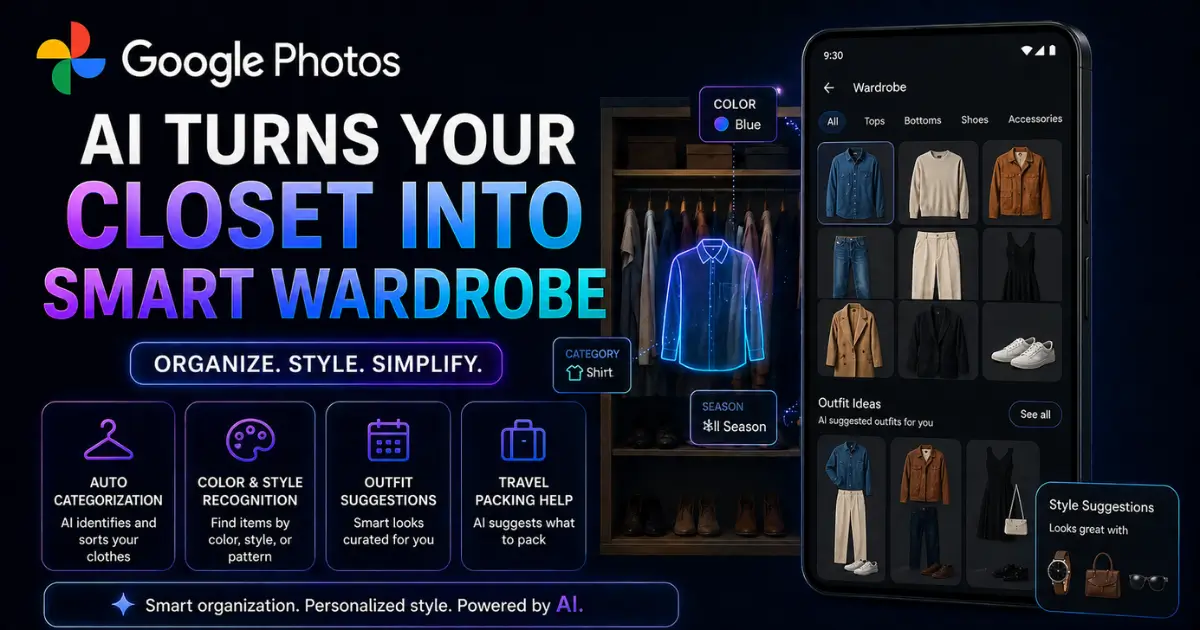
Google Photos is getting a Gemini-powered wardrobe feature that scans your photos to identify your clothes, builds a digital closet, and suggests outfits based on your style, the weather, and what you are doing that day. The feature essentially turns the iconic automated closet from the 1995 movie Clueless into a real product except it lives on your phone instead of a Beverly Hills mansion.
How It Works
Google Photos already contains thousands of images of you wearing different clothes. The new feature uses Gemini to analyze those photos, identify individual clothing items, and catalog them into a digital wardrobe. Users can also add items manually by photographing them.
Once the closet is built, the AI suggests outfit combinations. It factors in weather data from your location, your calendar events, and your past style preferences. Heading to a casual brunch on a warm Saturday? The AI pulls together options from clothes it knows you own. Have a business meeting on a rainy Tuesday? Different suggestions.
The system learns over time. The more you accept or reject outfit suggestions, the better it understands your preferences. It also tracks what you have worn recently to avoid repeating the same combinations.
The Fashion AI Market
Google is not the first to attempt AI-powered wardrobe management. Startups like Cher Dressing, Acloset, and Stylebook have offered digital closet apps for years. But none had access to the data Google Photos has — years of images documenting what users actually wear in real life, not just what they photograph for a closet app.
That data advantage is significant. Most wardrobe apps require users to manually photograph every piece of clothing they own — a tedious process that kills adoption. Google's approach skips that step entirely by mining the photo library users have already built.
The feature also connects to Google's broader AI strategy. Every Gemini-powered feature across Chrome, Maps, Workspace, YouTube, and Google TV reinforces the same message: Gemini understands your life across every dimension. Your search history. Your emails. Your calendar. Your photos. And now, your wardrobe.
Privacy Concerns
An AI that scans your photos to identify and catalog your clothing raises obvious privacy questions. Google Photos already uses AI for face recognition, object identification, and memory creation. Adding wardrobe analysis means the system is now making detailed inferences about your appearance, economic status, and personal style.
Google says the wardrobe feature is opt-in. Users must explicitly enable it. Clothing data stays on device unless the user chooses to sync it. And no wardrobe information is used for advertising targeting.
But the line between helpful and invasive is thin. An AI that knows what you wear, where you go, who you meet, and what the weather is doing has an extraordinarily detailed picture of your daily life. The same data privacy concerns that apply to AI assistants, social media, and health chatbots apply here — arguably more so, because wardrobe data is deeply personal in ways that search queries are not.
The Commerce Opportunity
The feature has obvious commercial potential. If Google knows what you own and what you like, it can suggest items you do not own that would complement your existing wardrobe. That suggestion engine connects directly to Google Shopping creating a seamless pipeline from AI recommendation to purchase.
Google has not announced shopping integration at launch. But the path from digital closet to AI-powered shopping assistant is short and obvious. Fashion is a $1.7 trillion global industry. An AI that can recommend clothing purchases based on what a user actually wears not just what they browse would be enormously valuable to retailers and brands.
The Bigger Picture
Google Photos' wardrobe feature is a consumer novelty. But it illustrates something important about where AI tools are heading. The most powerful AI applications are not standalone chatbots. They are features embedded invisibly inside products people already use every day. You do not open an AI app to get dressed. You open Google Photos and the AI is already there, quietly organizing your life.
Whether users find that helpful or creepy will determine how far Google pushes the concept. But the Clueless closet is no longer science fiction. It is a software update.