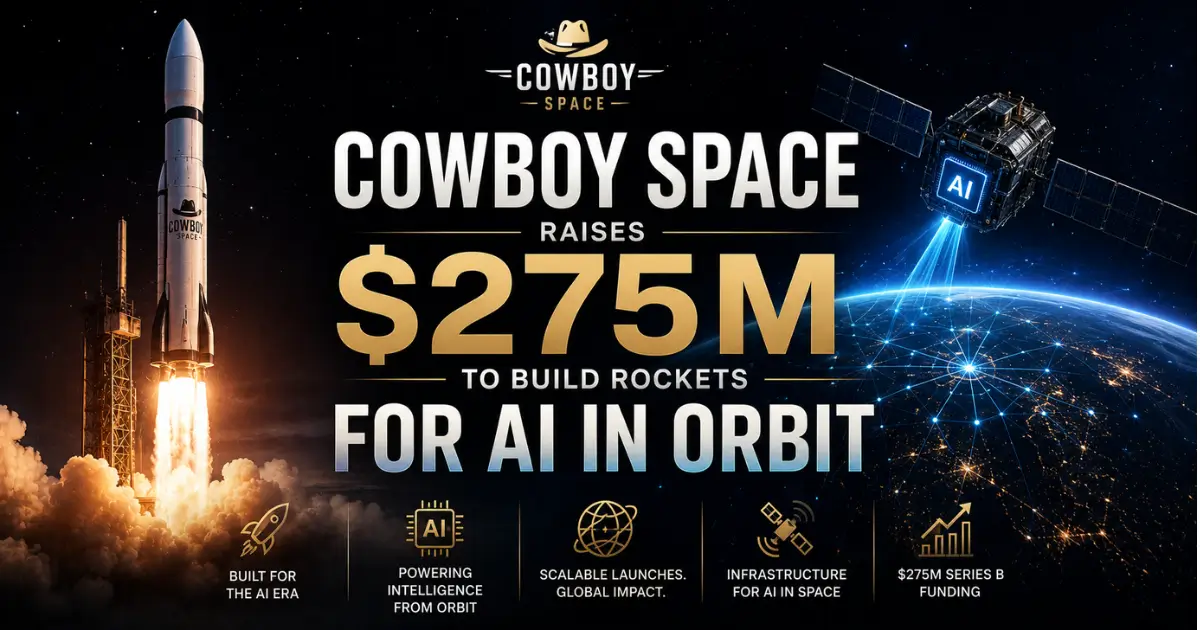
Baiju Bhatt, co-founder of Robinhood, has raised $275 million at a $2 billion valuation for Cowboy Space Corporation — a startup building its own rockets to launch AI data centers into orbit. The company, formerly known as Aetherflux, pivoted from space-based solar energy to orbital computing after concluding there are simply not enough rockets in the world to put data centers in space at scale.
Why Build Your Own Rockets
The space data center concept is gaining traction. Google is exploring orbital data centers. Meta signed a deal for space-based solar power. And an existing orbital compute cluster is already operational. But all of these plans face the same bottleneck: getting hardware into orbit.
SpaceX's Starship is expected to eventually solve the launch capacity problem. But even once operational, SpaceX will prioritize its own satellite business for years. Blue Origin's New Glenn failed to deliver a satellite during its third launch. And no other commercial provider has the capacity to launch data center-scale payloads.
Bhatt spoke to multiple launch providers. He could not find enough capacity to truly scale orbital data centers. Nor could he make the unit economics work with existing rockets. So he decided to build his own.
How It Works
Cowboy Space plans to build data centers directly into the second stage of its rocket. Instead of a separate satellite delivered by a rocket, the rocket stage itself becomes the data center once it reaches orbit. Each satellite will weigh 20,000 to 25,000 kilograms, generate 1 megawatt of power, and house roughly 800 GPUs.
The design simplifies manufacturing. Traditional space missions require a rocket and a separate payload. Cowboy Space combines them. The approach echoes how the first US satellite was built — Explorer 1 was essentially the final stage of its rocket, packed with instruments.
The rocket will be slightly more powerful than SpaceX's Falcon 9 but smaller than Starship. The booster is planned to be reusable. Cowboy Space expects its first launch before the end of 2028. The company is building its own rocket engine — the most complex and expensive component — and hiring veterans from SpaceX and Blue Origin.
The AI Energy Problem Drives Everything
The fundamental driver is AI's insatiable energy appetite. ASML's CEO said the world will not have enough chips for years. Google Cloud has a $462 billion backlog it cannot fulfill. AWS reported its fastest growth in 15 quarters. And terrestrial data centers are hitting power limits that have led to construction bans in some regions.
Space offers a solution. Solar energy is abundant and continuous in orbit. There are no land permits. No grid connections. No neighbors complaining about noise. The challenge is getting the hardware up there affordably — which is exactly the problem Cowboy Space is trying to solve.
Bhatt framed the opportunity simply: the demand for AI is getting more acute. The options on Earth are getting more limited. Space is where the capacity exists.
The Funding and the Risk
The $275 million Series B was led by Index Ventures. Breakthrough Energy Ventures, Construct Capital, IVP, and defense contractor SAIC also participated. The round values Cowboy Space at $2 billion.
The risk is enormous. Only a handful of private companies have ever successfully built and launched commercial rockets. SpaceX took years and multiple failures. Blue Origin has spent over two decades and billions of dollars. Startups like Relativity Space and Stoke Space have worked for years without achieving operational status.
Cowboy Space is attempting to build both a rocket company and a data center company simultaneously. The combination is either visionary or reckless. Bhatt is betting it is the former.
The Bigger Picture
Cowboy Space represents the most extreme response yet to the AI infrastructure crisis. When the world's largest technology companies cannot build data centers fast enough on Earth, when chip shortages affect everyone from astronomers to consumer hardware buyers, and when energy constraints are pushing companies to explore nuclear power and space-based solar — building your own rockets to launch your own data centers into orbit starts to sound less crazy.
Whether Cowboy Space can actually deliver remains years from being proven. But the $275 million bet says something about how seriously investors take the AI energy problem. When Earth runs out of room, you look up.