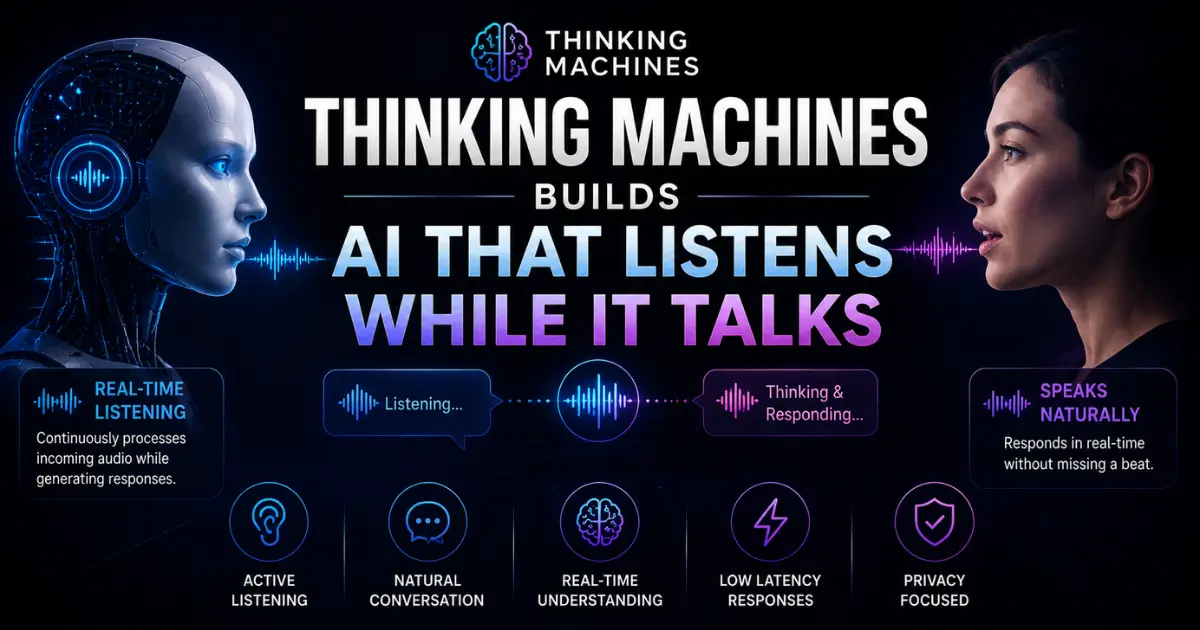
Mira Murati's Thinking Machines Lab has announced what it calls interaction models — AI systems that can process your input and generate a response simultaneously. Instead of the current turn-based pattern where you speak, the AI listens, then it responds while you wait — this model operates in full duplex. It listens while it talks. It responds in 0.40 seconds. And it brings AI conversation closer to a real phone call than a text chain.
Why This Matters
Every AI model today works the same way. You type or speak. The AI processes. The AI responds. You wait, then respond again. The interaction is sequential — like passing notes back and forth. Human conversation does not work that way. People interrupt. They react in real time. They adjust mid-sentence based on what the other person is doing.
Thinking Machines' TML-Interaction-Small model is designed to close that gap. By processing input and generating output at the same time, the model can react to what you are saying before you finish saying it. It can adjust its response mid-stream. And it can be interrupted naturally without losing context.
The 0.40-second response time is significant. Natural human conversation involves roughly 200 to 300 milliseconds of overlap between speakers. Getting AI response times into that range makes the interaction feel conversational rather than transactional. The company claims this is significantly faster than comparable voice models from OpenAI and Google.
A Research Preview, Not a Product
Thinking Machines is not releasing the model publicly. A limited research preview is planned for the coming months. A wider release will follow later this year. The benchmarks look impressive on paper. But whether the real-world experience matches the technical claims will not be known until people can actually use it.
The cautious rollout reflects the company's broader approach. Since Murati founded Thinking Machines after leaving OpenAI, the lab has moved deliberately. It raised $2 billion at $12 billion valuation. It signed a multi-billion dollar Google Cloud deal for Nvidia GB300 access. It hired PyTorch's co-founder and key researchers from Meta's FAIR division. But it has released only one product — Tinker — and kept most of its research direction secret.
The Voice AI Race
Interaction models enter a rapidly growing market. OpenAI launched a voice intelligence API for enterprise phone agents. Wispr Flow is growing rapidly with Hinglish voice AI. Google's Gemini is now embedded in millions of vehicles as a voice interface. And the broader shift toward voice-based AI interaction is transforming how people use AI in offices, cars, and homes.
But all existing voice AI products operate in the same turn-based mode. You speak. The AI responds. The full-duplex approach — where both sides process simultaneously — would be a genuine architectural breakthrough if it works at scale.
The implications for enterprise use cases are immediate. Customer service calls could feel like talking to a human rather than navigating a phone tree. Medical consultations could involve AI that adjusts its questions based on the patient's tone and hesitations. Sales calls could be supported by AI that coaches in real time based on what both sides are saying.
What It Means
Thinking Machines' interaction model is the lab's first public research announcement that reveals something about its technical direction. The company has been the most secretive major AI lab in the world. This announcement signals that its focus extends beyond traditional language models into how humans and AI actually communicate.
Whether full-duplex AI interaction becomes the new standard or remains a research curiosity will depend on whether it works reliably outside the lab. For now, it is the most interesting idea to emerge from the AI industry this week — and a reminder that the biggest breakthroughs may not come from making models bigger. They may come from making models more human.