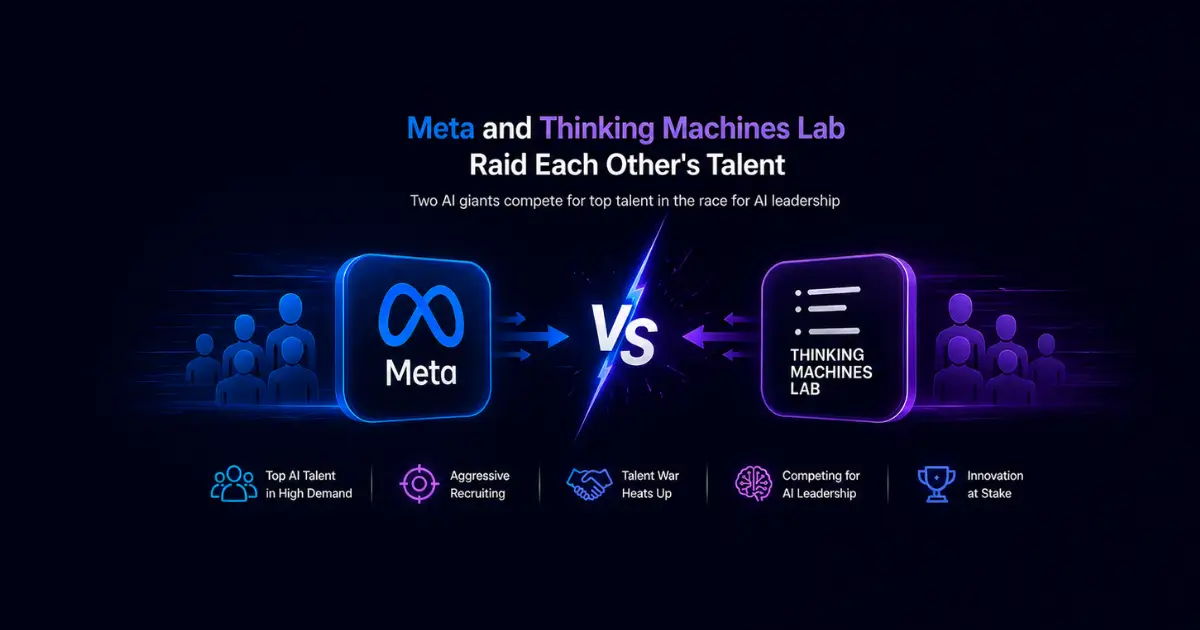
The talent war between Meta and Mira Murati's Thinking Machines Lab has become a two-way street. While Meta has poached seven of TML's founding members, the secretive AI startup is raiding Meta right back hiring more researchers from Meta than from any other company, including the co-founder of PyTorch and key architects behind Meta's most influential AI projects.
The Talent Grab Running Both Ways
Meta has made headlines for poaching TML founders with seven-figure pay packages. But a review of recent hires tells a different story: Thinking Machines has been aggressively recruiting from Meta, assembling a research team that reads like a who's-who of Meta's AI division.
The most prominent hire is Soumith Chintala, who spent 11 years at Meta and co-founded PyTorch the open-source deep learning framework that underpins most of the world's AI research. Chintala left Meta in late 2025 and was appointed TML's CTO earlier this year. His departure alone represents a significant loss for Meta, given PyTorch's foundational role in the AI industry.
Piotr Dollár, another 11-year Meta veteran who served as research director and co-authored the influential Segment Anything model, is now on TML's technical staff. Andrea Madotto, a research scientist from Meta's FAIR division focused on multimodal language models, joined in December. James Sun, a software engineer with nearly nine years at Meta working on LLM pre-training and post-training, also made the jump.
The latest addition is Weiyao Wang, who spent eight years at Meta building multimodal perception systems including SAM3D. His last day at Meta was last week. Kenneth Li, a Harvard PhD who spent 10 months at Meta, joined TML this month.
Beyond Meta
TML's talent pipeline extends far beyond Meta. Neal Wu, a three-time gold medalist at the International Olympiad in Informatics and a founding member of coding startup Cognition, joined early this year. Jeffrey Tao came via Waymo, Windsurf, and OpenAI. Muhammad Maaz previously held a research fellowship at Anthropic. Erik Wijmans arrived from Apple. Liliang Ren spent two and a half years on Microsoft's AI Superintelligence team pre-training OpenAI models for code before joining in March.
The startup's headcount now stands at around 140 still small by Big Tech standards but growing rapidly with an extraordinarily dense concentration of elite AI researchers.
The Infrastructure to Match
The talent grab comes alongside massive infrastructure deals that give TML the compute capacity to put its researchers to work. This week, the startup signed a multi-billion dollar cloud agreement with Google, gaining access to Nvidia's latest GB300 chips and making it one of the first startups to run on the hardware.
The Google deal puts TML in the same infrastructure tier as Anthropic and Meta companies with orders of magnitude more revenue. For researchers weighing whether to stay at a Big Tech company or join a startup, access to cutting-edge compute removes one of the biggest objections. TML can now offer both the intellectual freedom of a startup and the hardware resources of a hyperscaler.
The Financial Calculus
Meta's compensation packages are legendary seven figures, no strings attached. But for researchers weighing their options, the financial calculus may favor TML. The startup is currently valued at $12 billion from its seed round, a figure that would have been unimaginable for a company at this stage in any previous tech cycle. But compared to OpenAI's $852 billion and Anthropic's trajectory toward $800 billion or more, there is still enormous financial upside for early employees.
TML has released just one product Tinker, a tool for automating the creation of custom frontier AI models. The company remains highly secretive about its broader research direction. But with PyTorch's co-creator as CTO, key architects from Meta's FAIR division, and billions in cloud infrastructure secured, TML is assembling the kind of team that could produce something significant.
What It Means
The Meta-TML talent war reflects a deeper structural shift in the AI industry. The researchers building the most consequential AI systems now have enormous leverage they can command seven-figure salaries at Big Tech or take equity bets at startups that could be worth hundreds of billions within a few years.
For Meta, the departures are particularly painful because they involve people who built foundational tools and models not just individual contributors but architects whose work shaped the entire field. Losing the co-founder of PyTorch, the co-author of Segment Anything, and nearly a dozen other senior researchers to a single startup signals that even Meta's resources cannot guarantee talent retention in the current market.
For Thinking Machines Lab, the hires validate the bet that a well-funded startup led by a former OpenAI executive can compete for the best AI talent in the world and increasingly win.