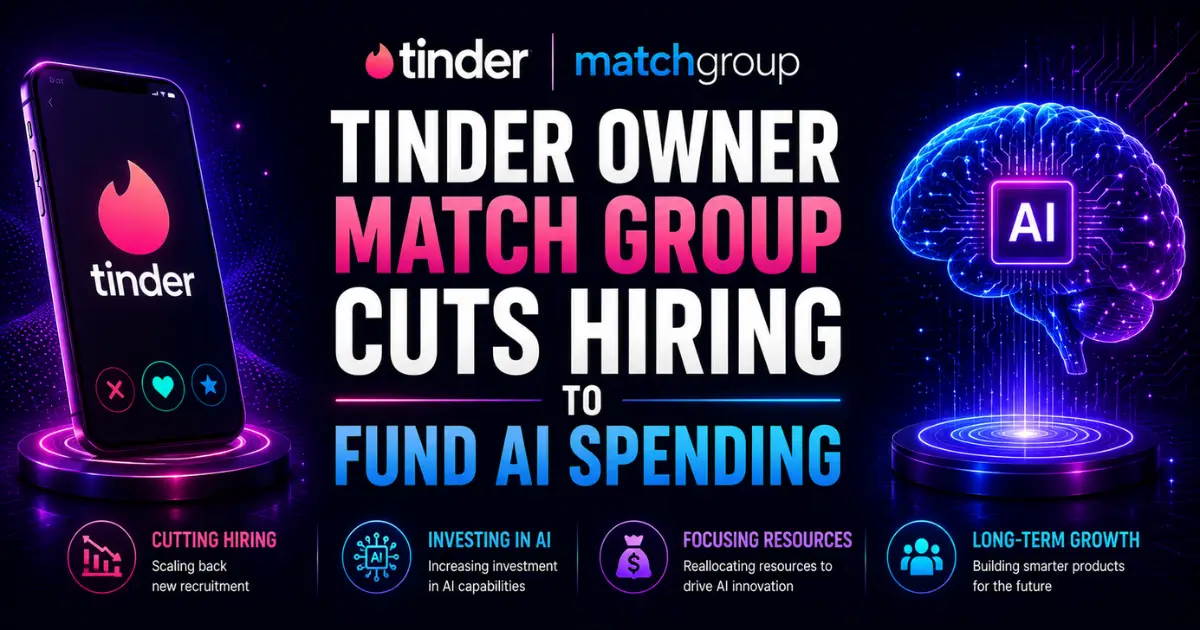
Match Group, the company behind Tinder, Hinge, and OkCupid, is slowing hiring to pay for its increasing use of AI tools. The dating app giant told investors that AI spending is rising faster than expected. Rather than raising prices or cutting existing staff, the company is freezing new hires and redirecting the savings toward AI integration across its platforms.
What Match Is Doing With AI
Match Group is deploying AI across multiple products simultaneously. Tinder recently partnered with World ID to let users verify their humanity through iris scans — a direct response to the growing problem of AI-powered romance scam bots on the platform. The company is also using AI to improve matching algorithms, detect fake profiles, moderate content, and generate personalized conversation starters.
Hinge has been testing AI-powered features that analyze user behavior to suggest better matches. OkCupid is experimenting with AI-generated profile prompts. And across the portfolio, Match is investing in AI safety tools to combat the wave of deepfakes and synthetic profiles that are flooding dating platforms.
The problem is cost. Every AI feature requires compute. Every compute cycle costs money. As Match rolls AI into more products and more markets, the bill is growing faster than revenue.
The Hiring Freeze Trade-Off
Match's response is a trade-off that is becoming increasingly common across the tech industry. Instead of hiring new employees, the company is investing in AI tools that make existing employees more productive. The logic is straightforward: if AI can handle tasks that would otherwise require new hires, the company saves salary costs while gaining AI capabilities.
The approach mirrors what is happening at larger tech companies. Block laid off 40 percent of its workforce citing AI. Amazon cut 30,000 corporate positions while increasing AI infrastructure spending. Meta projects $115 to $135 billion in capex while losing billions on Reality Labs.
Match Group is smaller than those companies. It cannot absorb AI costs the way a hyperscaler can. Slowing hiring is the most direct lever available: reduce headcount growth now to fund the AI transition that management believes will define the company's future.
The AI Costs Problem
Match's situation illustrates a challenge facing every mid-sized technology company. The frontier AI labs are spending hundreds of billions on infrastructure. The hyperscalers are posting record cloud revenue. But companies that are consumers of AI rather than builders of it are discovering that integration costs add up quickly.
Using AI tools from OpenAI, Anthropic, or Google means paying per token, per API call, per compute cycle. As usage scales across millions of users and multiple products, those costs can grow faster than the revenue they generate. Match is not alone in finding that AI adoption is expensive before it becomes profitable.
The AI jobs debate has focused on dramatic scenarios — millions of jobs eliminated, Depression-era unemployment. Match's hiring freeze is a quieter version of the same trend. No one is being fired. Jobs are simply not being created. The positions that would have existed are being replaced by AI tools before anyone was ever hired to fill them.
Why Dating Apps Need AI
The dating industry has a unique relationship with AI. On one hand, AI is the threat. Romance scam bots cost Americans over $1 billion last year. Fake profiles erode trust. And the same generative AI tools that create compelling chatbots also create compelling fake dating profiles.
On the other hand, AI is the solution. Better matching algorithms increase user satisfaction. AI moderation catches harmful content faster than human reviewers. Identity verification through tools like World ID helps users trust that the person they are talking to is real. And personalized features powered by AI can differentiate one dating app from another in a crowded market.
Match has no choice but to invest in AI. The question is how to pay for it. The hiring freeze is the answer for now.
The Bigger Picture
Match Group's decision to slow hiring and redirect spending toward AI is a preview of what thousands of mid-sized companies will face over the next two years. The AI tools are available. The benefits are real. But the costs are significant — and someone has to pay.
For workers, the implication is clear. Companies are not just replacing existing employees with AI. They are eliminating future positions before they ever open. The jobs that would have been posted next quarter are being automated instead. Jensen Huang says AI creates an enormous number of jobs. Match Group's hiring freeze tells a different story — at least in the near term.