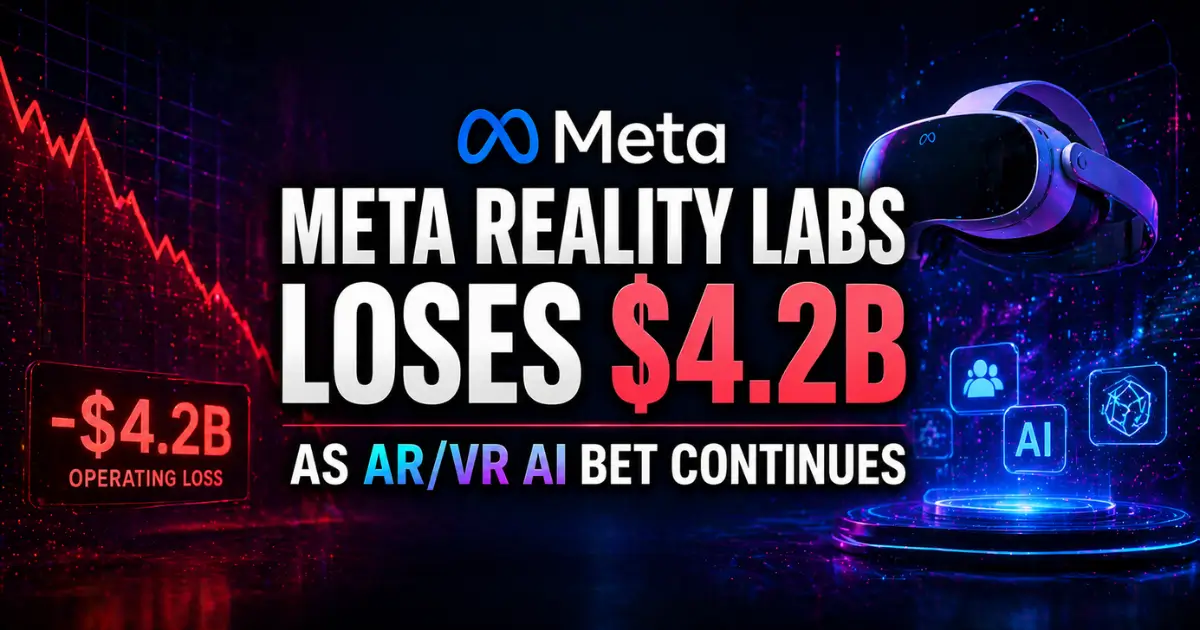
Meta's Reality Labs division lost another $4.2 billion in Q1 2026. The unit responsible for Quest headsets, Ray-Ban Meta smart glasses, and the company's metaverse ambitions has now lost over $65 billion since 2020. Despite the staggering losses, CEO Mark Zuckerberg shows no signs of slowing down — arguing that AR/VR hardware is essential to Meta's long-term AI strategy.
The Numbers
Reality Labs generated $1.5 billion in revenue in Q1 but spent $5.7 billion doing it. The $4.2 billion operating loss is slightly worse than the same quarter last year. Meta's total Reality Labs losses now exceed $65 billion over six years — a figure that dwarfs the entire market capitalization of most technology companies.
The losses come alongside Meta's broader spending surge. The company projects $115 to $135 billion in capital expenditure for 2026, driven primarily by AI infrastructure investments. Meta is simultaneously buying millions of Amazon's Graviton chips, signing deals for space-based solar power, and fighting to acquire AI startups against geopolitical headwinds.
Why Zuckerberg Keeps Spending
Zuckerberg's thesis is straightforward. The next major computing platform will not be a phone or a laptop. It will be something you wear on your face. If Meta owns the hardware that delivers AI to users — smart glasses, AR headsets, or neural interfaces — it controls the distribution channel for the entire AI economy.
The Ray-Ban Meta smart glasses have been the brightest spot. The AI-powered sunglasses let users take photos, make calls, listen to music, and interact with Meta AI through voice commands. They represent the most commercially successful AI wearable on the market — though Meta does not break out specific unit sales.
The connection to AI is increasingly explicit. Meta's glasses are not just cameras and speakers. They are delivery devices for AI agents. As AI assistants become more capable, the glasses become more valuable — offering always-on, hands-free access to an AI system that can see what you see and hear what you hear.
The Competition Is Heating Up
Meta is not alone in pursuing AI-powered wearables. Apple's incoming CEO John Ternus is reportedly exploring smart glasses, AI pendants, and enhanced AirPods. Startups like Era are building the software layer for AI gadgets. And Google, Snap, and Amazon are all developing their own smart eyewear.
The race to define AI hardware is intensifying. Whoever builds the device that replaces the smartphone as the primary interface for AI interaction will control one of the most valuable platforms in technology. Meta is betting $65 billion and counting that it will be them.
The Investor Patience Question
Wall Street has tolerated Reality Labs losses for years because Meta's core advertising business generates enough profit to absorb them. The company reported $42.3 billion in total Q1 revenue with operating margins above 30 percent across the company. The ad business funds the hardware bet.
But patience is not unlimited. Investors want to see Reality Labs move from experimental spending toward products with clear commercial traction. The Ray-Ban Meta glasses are a step in that direction. A future where AI glasses replace smartphones would justify every dollar spent. But that future remains years away — and $4.2 billion per quarter adds up fast.
The Bigger Picture
Meta's Reality Labs losses are the most expensive bet in the AI hardware race. No other company is spending at this scale on consumer AI devices. The question is whether the investment creates an insurmountable lead — or whether a competitor with better timing and lower costs overtakes Meta when the market finally materializes.
For the AI industry, Meta's spending is a signal that the future of AI is not just software. It is hardware, wearables, and the physical interfaces that bring AI into the real world. The software is getting smarter every month. The question is what you will be wearing when you use it.