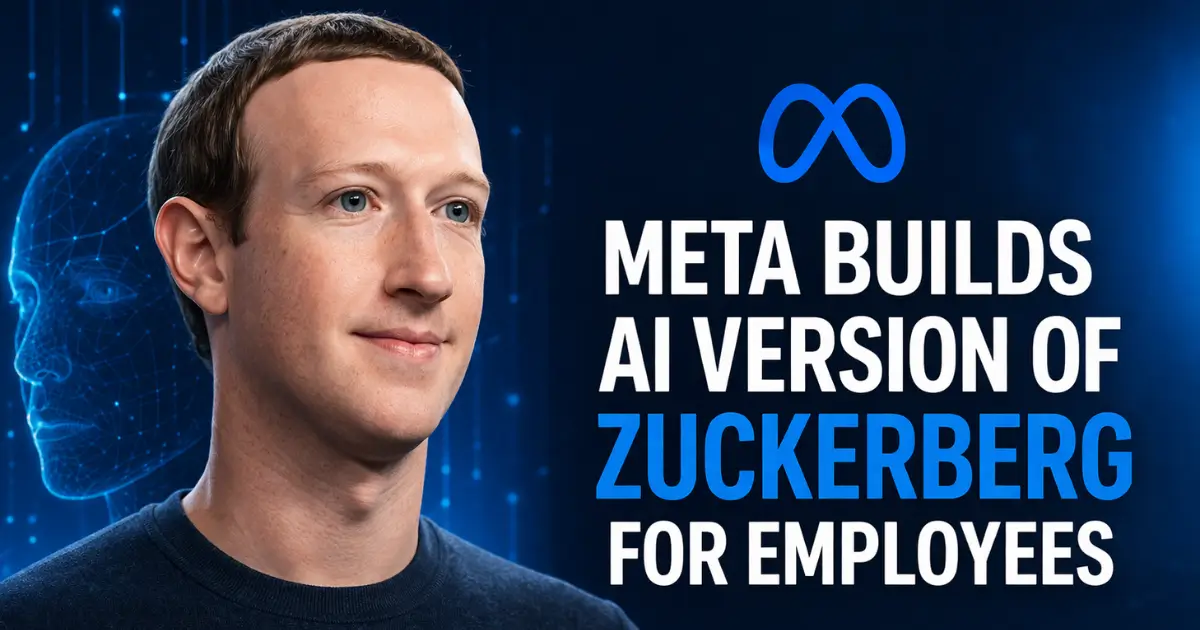
In a move that blurs the line between technology and corporate management, Meta is building an artificial intelligence version of its own CEO. Meta is building an artificial intelligence version of Mark Zuckerberg that can engage with employees in his stead, as part of a broader push to remake the company around AI.
The project, first reported by the Financial Times and sourced to four people familiar with the matter, is unlike anything attempted at this scale in corporate history. It raises profound questions about the future of leadership, employee relations, and just how far companies are willing to go in replacing human interaction with AI.
What the AI Zuckerberg Actually Is
This isn't a simple chatbot with Zuckerberg's name on it. Meta has been working on developing photorealistic, AI-powered 3D characters that users can interact with in real time. The company recently began prioritizing a Zuckerberg AI character.
Zuckerberg is personally involved in training and testing the animated version of himself, which is being built on his mannerisms, tone, publicly available statements, and his own thinking on company strategy — so that employees "might feel more connected to the founder through interactions with it." The character is also being trained on images and his voice.
The goal, in short, is a digital replica that sounds, looks, and thinks like the real Zuckerberg — available to employees at scale, without requiring the actual CEO's time.
Zuckerberg Is Deeply Involved
This isn't a side project being quietly developed by an engineering team. The CEO himself is at the center of it. Sources told the Financial Times that Zuckerberg has become increasingly hands-on as he oversees Meta's AI efforts, spending five to ten hours a week coding on various AI projects and sitting in during technical reviews.
Reports also indicate that Meta has strengthened its voice technology by acquiring firms such as PlayAI and WaveForms — acquisitions that now appear directly connected to the quality of the AI Zuckerberg's vocal performance.
Two Separate AI Projects — Don't Confuse Them
It's important to note that the AI character is distinct from another AI tool Zuckerberg is building for himself. The effort is separate from Zuckerberg's project to build a "CEO agent" to support him in his role — for example, by retrieving information quickly. That idea was first reported by the Wall Street Journal.
That agent has been helping Zuckerberg get information faster, finding answers that would normally require going through multiple layers of people. The AI character, by contrast, is outward-facing — designed to communicate with employees, not assist the CEO himself.
Part of a Massive AI-First Transformation
The AI Zuckerberg project doesn't exist in a vacuum. It's one piece of an extraordinarily ambitious overhaul of how Meta operates internally. Meta is moving toward a "pod" structure with fewer managers, where in some cases up to 50 engineers report to a single manager. AI-generated reporting systems are replacing multiple layers of middle management.
Since February 2026, Meta has incorporated "AI usage" into its employee performance evaluation system, making "AI-driven impact" a core metric for every employee.
The financial commitment backing all of this is staggering. Meta has projected capital expenditure of $115–$135 billion for 2026, with long-term plans to invest up to $600 billion in AI infrastructure by 2028.
Meta Is Not Alone
Surprisingly, Meta isn't the only tech company experimenting with AI CEO clones. During a podcast interview earlier this year, Uber CEO Dara Khosrowshahi said his employees had created an AI clone of their boss. The trend suggests that as AI becomes more capable of mimicking human communication, executive digital twins could become a standard — if controversial — management tool.
The Bigger Picture: What This Means for Work
Zuckerberg has been explicit about his vision for AI reshaping Meta's workforce. On an earnings call in January, he said Meta is investing in "AI-native tooling" so individuals can get more done, adding: "We're starting to see projects that used to require big teams now be accomplished by a single, very talented person."
The AI Zuckerberg is the logical — if unsettling — extension of that philosophy. If AI can replace coding teams and middle managers, why not the CEO's communication function too? Whether employees will feel genuinely connected to a photorealistic digital version of their boss, or simply unnerved by it, remains to be seen. One thing is certain: the future of corporate leadership just got a lot stranger.