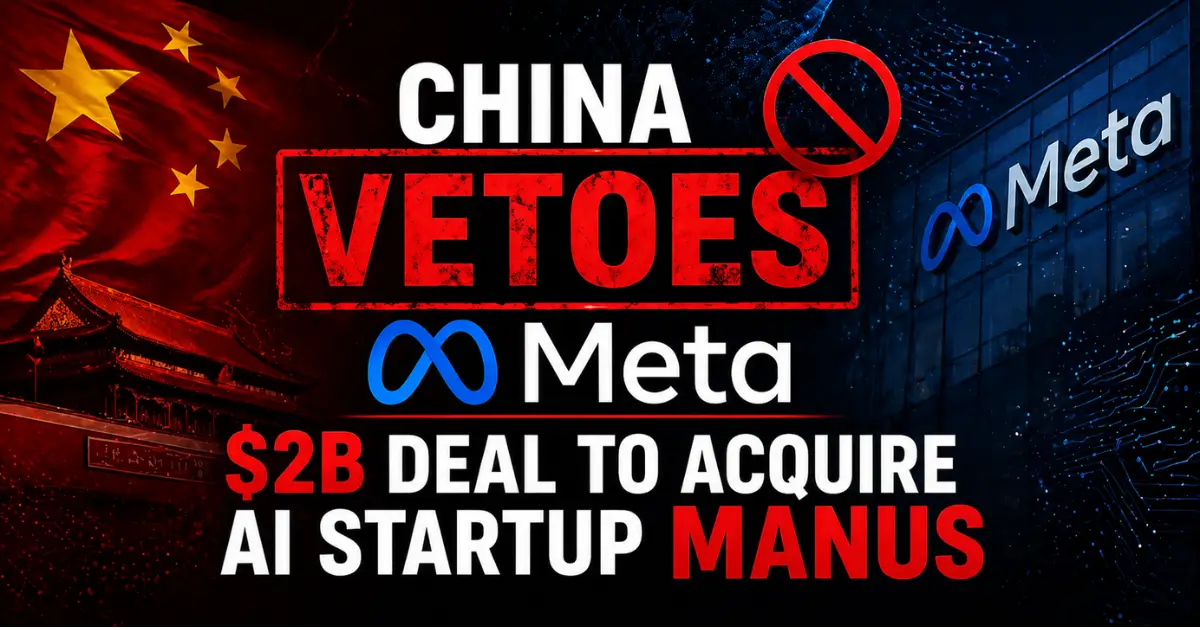
China has blocked Meta's $2 billion acquisition of Manus, the agentic AI startup that went viral last year before Mark Zuckerberg snapped it up. The National Development and Reform Commission ordered both parties to unwind the deal entirely — one of China's most significant interventions in a cross-border AI deal and a major blow to Meta's ambitions in the fast-moving AI agents space.
What Happened
China's top economic planner, the NDRC, issued a one-line order prohibiting foreign investment in the Manus project and requiring the parties to withdraw the acquisition transaction. No explanation was offered. The order was published on the NDRC's official website on Monday.
The situation is already deeply complicated. Around 100 Manus employees have already moved into Meta's Singapore offices as of March. CEO Xiao Hong now reports directly to Meta COO Javier Olivan. Chief Scientist Yichao Ji has taken on an executive role within Meta's AI division. The integration is well underway — making a full unwind operationally messy and legally unprecedented.
To make matters worse, Hong and Ji are reportedly under exit bans, preventing them from leaving mainland China. The founders are caught between a Chinese government that wants to block the deal and an American company that has already absorbed their team.
Meta responded with a brief statement saying the transaction complied fully with applicable law and that it anticipates an appropriate resolution.
Why China Blocked It
Manus was founded in Beijing in 2022 by Xiao Hong, Yichao Ji, and Tao Zhang under a parent company called Butterfly Effect. The startup relocated its headquarters from China to Singapore around mid-2025 — just months before Meta announced the acquisition in December.
The relocation was designed to simplify the deal by removing the Chinese corporate structure. Meta agreed to acquire the Singapore-based entity, with the deal requiring a full exit from Chinese ownership and operations. But China's regulators apparently do not view the relocation as severing the company's connection to the country.
The veto fits a pattern of escalating US-China tensions in AI. The US has accused China of stealing American AI labs' intellectual property on an industrial scale. China has responded with retaliatory actions against US tech companies. And the AI talent and technology flowing between the two countries has become a geopolitical flashpoint.
The Washington Angle
The deal also drew scrutiny from US lawmakers. Senator John Cornyn raised concerns about Benchmark's investment in Manus, questioning whether American venture capital should be flowing to a Chinese-linked AI firm. The political pressure from both Washington and Beijing created a pincer that made the deal vulnerable from both sides.
For Meta, the veto is particularly frustrating because the company had specifically structured the acquisition to avoid Chinese regulatory jurisdiction. The fact that China blocked it anyway sends a signal that Beijing considers any AI company with Chinese founders and Chinese origins to be within its sphere of control — regardless of where the company is formally headquartered.
What Meta Loses
Manus was one of the most talked-about AI agent startups in the world. Its technology was designed to build autonomous AI agents that could handle complex multi-step tasks — exactly the capability Meta needs to compete with Anthropic's Claude, OpenAI's Codex, and the growing ecosystem of agentic tools.
Meta paid between $2 billion and $3 billion for Manus and has already begun integrating its agent technology into Meta AI. Unwinding that integration — extracting Manus technology from Meta's systems, returning intellectual property, and potentially losing the 100 employees who have already relocated — would be an enormous operational and strategic setback.
The timing is particularly bad. Meta is simultaneously managing a talent war with Thinking Machines Lab that has seen key researchers defect, spending billions on AI chips and infrastructure, and racing to keep pace in an AI industry that is moving faster than ever.
The Bigger Picture
China's veto of the Manus deal signals that the AI industry is becoming a theater of geopolitical conflict in ways that go beyond chip export controls and trade restrictions. Talent, startups, and corporate structures are all now subject to government intervention from both sides.
For AI startups with Chinese founders or Chinese origins, the message is clear: relocating to Singapore or incorporating in Delaware does not insulate you from Beijing's reach. And for American companies looking to acquire Chinese-linked AI talent, the regulatory risk now extends across multiple jurisdictions simultaneously.
The deal may still find a resolution — Meta says it expects one. But the precedent is set: in the AI era, the most valuable technology is also the most politically contested. And no amount of corporate restructuring can fully escape the gravity of great power competition.