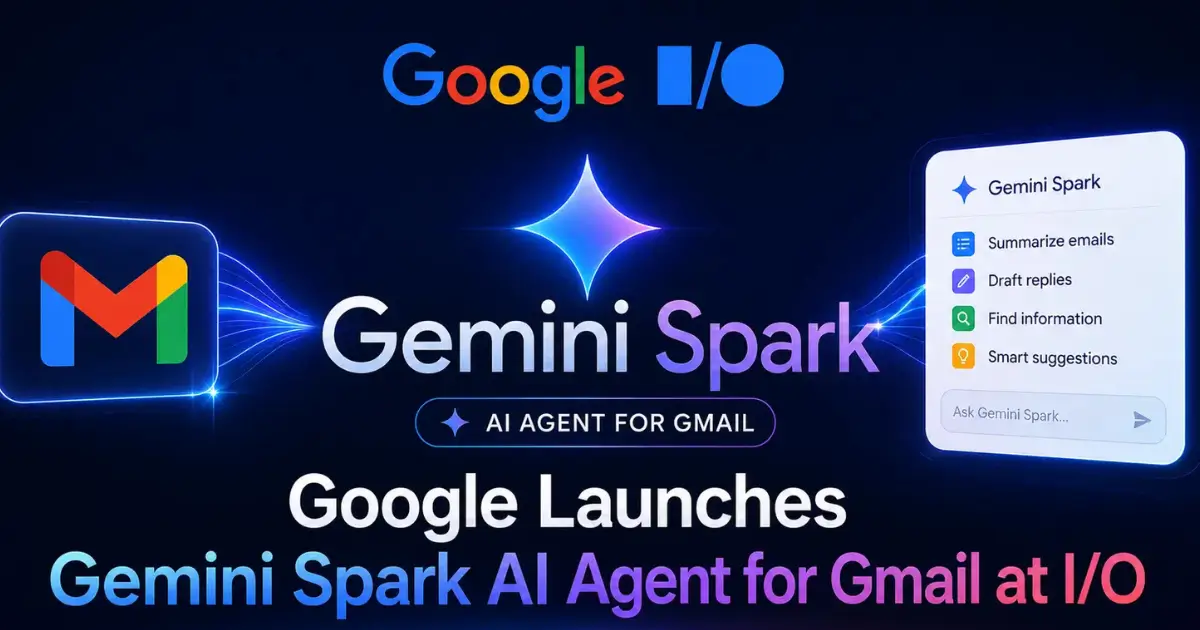
Google has launched Gemini Spark at I/O 2026 — a persistent AI agent that runs continuously in the background and proactively manages tasks across Gmail, Calendar, Drive, and other Google services. Unlike existing AI assistants that wait for prompts, Spark monitors your work context and takes action on your behalf. It drafts email replies. Reschedules meetings when conflicts arise. Surfaces relevant documents before you ask. And sends you notifications when something needs attention.
How Spark Works
Spark operates as an always-on agent inside Gmail. It reads incoming emails. Understands their context. Drafts responses. Flags urgent items. And coordinates with Calendar and Drive to ensure you have what you need before meetings start.
The agent goes beyond reactive assistance. If a meeting gets cancelled, Spark identifies the gap and suggests how to use the time. If an email thread mentions a document you have not opened, Spark surfaces it. If a deadline approaches and a deliverable is incomplete, Spark sends a reminder with the relevant files attached.
Users can customize how aggressively Spark acts. Conservative mode limits the agent to suggestions and notifications. Proactive mode allows Spark to draft and send routine replies, schedule meetings, and organize files without explicit approval for each action. Enterprise administrators control which mode is available to their organizations.
Why Google Built This
Spark is Google's answer to a question the entire AI industry is asking: what comes after the chatbot? Chatbots require users to initiate every interaction. You open the app. You type a prompt. You wait for a response. That model works for questions and one-off tasks. It fails for ongoing work management.
Anthropic's Cat Wu recently described a future where Claude anticipates user needs before they ask. Skye is building an AI home screen that surfaces information proactively. And Microsoft Copilot recently made Agent Mode the default across Office.
Spark is Google's most direct implementation of the proactive AI concept. By embedding a persistent agent inside Gmail — the application hundreds of millions of people open first every morning — Google ensures Spark becomes part of the daily routine rather than an additional tool to remember.
The Workspace Integration
Spark builds on Google Workspace Intelligence, the AI layer Google launched across its productivity suite earlier this year. Workspace Intelligence provided AI-powered writing, spreadsheet generation, and email summaries. Spark takes that foundation and adds agency — the ability to act autonomously rather than just assist on demand.
The combination creates a full AI workflow inside Google's ecosystem. Gemini in Chrome handles browsing. Gemini in Maps handles navigation. Gemini in Gboard handles voice input. And now Spark handles work management. Every surface of Google's product suite is becoming AI-native.
The Privacy Question
A persistent AI agent that reads your email, monitors your calendar, and takes actions on your behalf raises immediate privacy concerns. Spark has access to the most sensitive information in any professional's digital life — confidential negotiations, personnel discussions, financial data, legal communications.
Google says Spark operates under the same privacy framework as Workspace Intelligence. Administrators control data access. Users can disable the agent. And no email content is used for advertising or model training. But the tradeoff remains: the more Spark knows about your work, the more useful it becomes. Restricting access reduces both the risk and the value.
The Competition
Spark puts Google in direct competition with Microsoft Copilot for the enterprise AI assistant market. Both products embed AI into the office tools hundreds of millions of people use daily. Both offer agent capabilities that go beyond simple question-answering. And both are betting that the AI assistant of the future does not wait to be asked.
The difference is distribution. Microsoft has 400 million Office users and 20 million paid Copilot seats. Google has over 3 billion Gmail accounts and a rapidly growing Workspace enterprise base. The winner of the enterprise AI assistant market will be determined not by model quality — both use frontier AI models — but by which platform's users adopt agentic features first.
Part of Google I/O 2026
Spark launches alongside Gemini Omni, the multimodal video generation model also announced at I/O. Together, the two launches demonstrate the breadth of Google's AI ambitions. Omni creates media. Spark manages work. Both run on Gemini. And both embed AI deeper into the tools people already use every day.
Google I/O 2026 is shaping up to be the company's most consequential developer conference since the original Gemini launch. The message to the industry is clear: Google is not just building AI models. It is building AI that works for you around the clock — whether you ask it to or not.