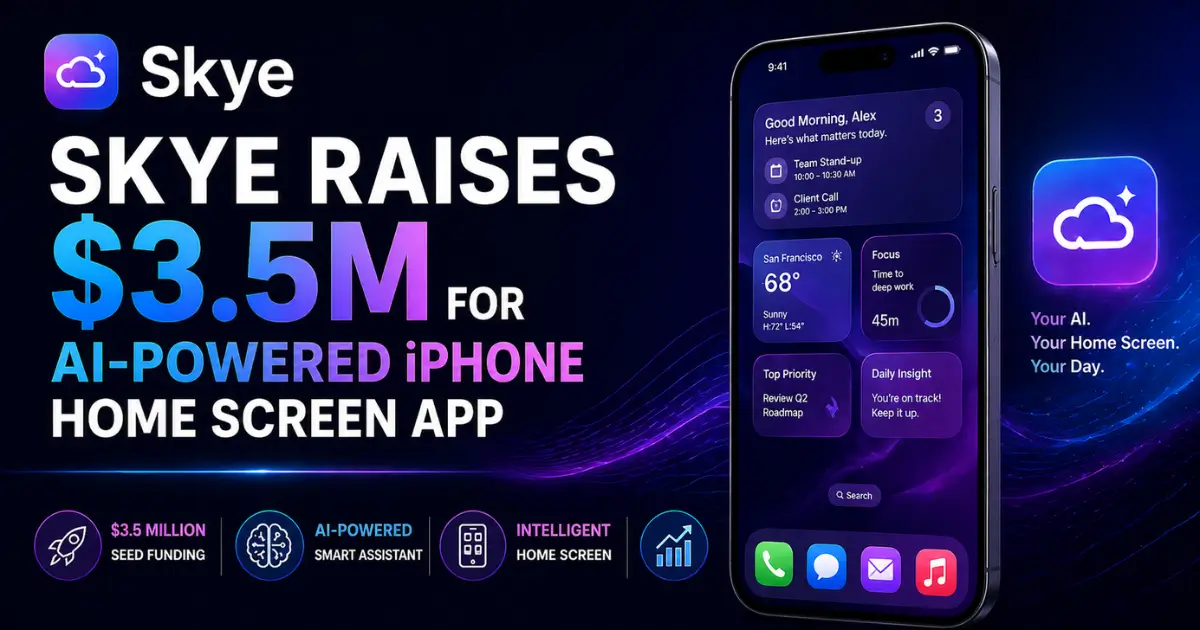
An iPhone app called Skye, built by startup Signull Labs, wants to turn your home screen into an AI-powered command center and it has already attracted tens of thousands of waitlist signups and $3.58 million in pre-seed funding from a16z, True Ventures, and SV Angel before even launching publicly.
What Skye Does
Instead of opening individual apps or talking to a chatbot, Skye uses iOS widgets to create what it calls an agentic home screen. The widgets bring ambient intelligence directly to your iPhone's main screen surfacing personalized weather insights, health data, meeting prep, email draft suggestions, bank account alerts for suspicious charges, and location-specific recommendations about nearby businesses and attractions.
The app pulls data through authorized connections the user grants, building a contextual understanding of your day that updates dynamically. Rather than requiring you to launch an assistant and ask questions, Skye proactively surfaces information it thinks you need a fundamentally different interaction model from the traditional chatbot interface that AI companies have built their consumer products around.
The approach treats the home screen itself as the AI interface no app to open, no conversation to start. Just glance at your phone and the information is already there.
The Team Behind It
Skye was built by a small team led by founder Nirav Savjani, who goes by the pseudonym signüll on social media. Savjani previously worked at Google and Meta. His co-founder background and product vision attracted backing from some of Silicon Valley's most prominent investors, including Andreessen Horowitz, True Ventures, SV Angel, and Offline Ventures.
The $3.58 million pre-seed round closed in September 2025 at a post-money valuation of $19.5 million, according to SEC filings. Savjani has since appeared on the TBPN podcast the media show recently acquired by OpenAI and has been sharing daily usage of the app on X.
Tens of Thousands Already Waiting
After announcing Skye on social media, the response was significant. The launch video reached roughly a million views. Tens of thousands of users joined a waitlist that was already at 25,000. And hundreds of investors and potential partners reached out via email and direct messages.
The demand signals that consumers may be ready for a more AI-native smartphone experience one that goes beyond downloading another AI app and instead reimagines how the phone's entire interface works.
Why It Matters
Skye sits at the intersection of two major trends in AI. The first is the growing push toward agentic AI systems that act on your behalf rather than waiting for instructions. The second is the question of whether AI will live inside existing apps or replace the app model entirely.
Apple's incoming CEO John Ternus is reportedly exploring AI-powered hardware including smart glasses and wearable pendants. OpenAI is building a smartphone with Jony Ive that could bypass the app model entirely. And startups like Era are building the software layer for AI gadgets that could eventually replace phones altogether.
Skye's approach is more immediate: rather than waiting for new hardware, it works within iOS as it exists today. By using widgets a feature Apple has supported since iOS 14 Skye avoids the need for users to change their behavior dramatically. You still use your iPhone. You just see different things when you pick it up.
The Challenge
The biggest risk for Skye is the same one facing every app trying to become the default interface on someone's phone: Apple controls the platform. If Apple decides to build similar widget-based AI features directly into iOS a move that Siri's evolution and Gemini's expansion across Google's ecosystem suggest is likely Skye could find itself competing against the operating system itself.
For now, the waitlist numbers and investor roster suggest Skye has identified a real consumer desire. Whether it can ship, scale, and survive Apple's inevitable response will determine whether the agentic home screen becomes a lasting product category or a feature that gets absorbed into iOS.