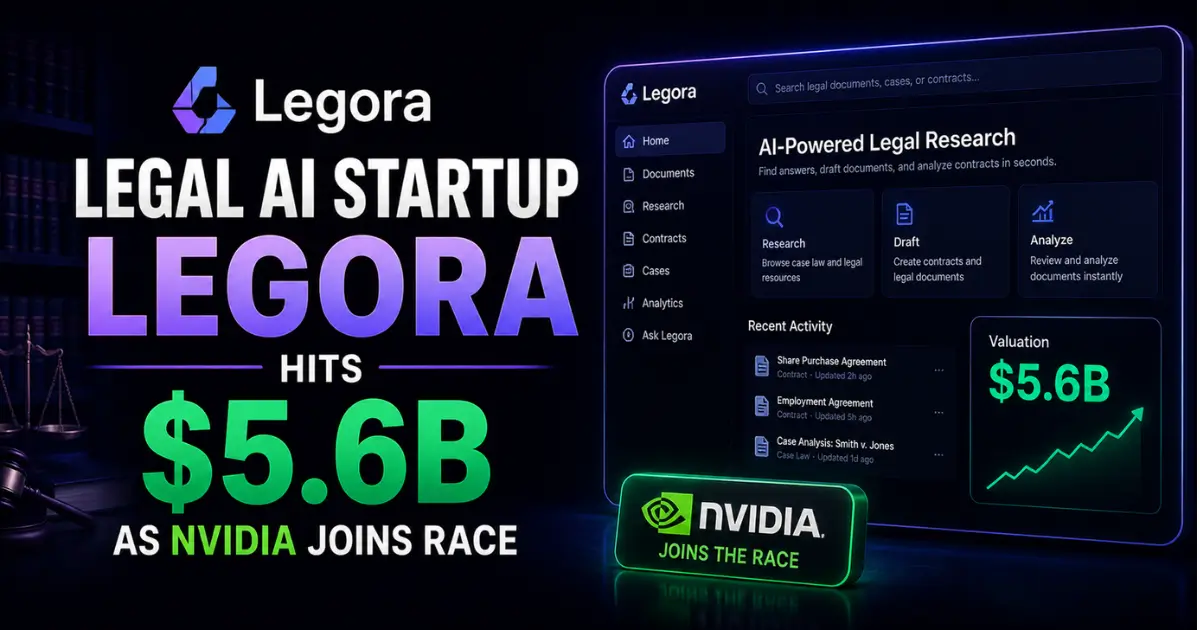
Swedish legal AI startup Legora has reached a $5.6 billion valuation after extending its Series D with an additional $50 million. Nvidia's venture arm NVentures and Atlassian joined the round Nvidia's first investment in legal AI. The funding arrives as Legora crosses $100 million in annual recurring revenue and intensifies its rivalry with US competitor Harvey, now valued at $11 billion.
The Nvidia Signal
NVentures' investment is significant beyond the dollars. Nvidia has been one of the most prolific and strategic AI investors in the world, backing companies across infrastructure, models, and applications. Its decision to enter legal AI through Legora — rather than Harvey — suggests it sees something defensible in Legora's approach.
However, Nvidia is known for hedging. It previously invested in both Anthropic and OpenAI before pulling back from both. The investment in Legora does not preclude a future bet on Harvey.
Legora vs Harvey: The Numbers
The two companies are approaching from different positions. Harvey reached $11 billion in valuation last month with backing from Sequoia, a16z, Coatue, and Kleiner Perkins. It claims 100,000 lawyers across 1,300 organizations as customers, including global firms like Latham & Watkins and corporate teams at T-Mobile.
Legora is smaller but growing fast. It launched just 18 months ago and already serves over 1,000 law firms and in-house legal teams across 50 markets. Clients include Bird & Bird, Cleary Gottlieb, and Linklaters. Crossing $100 million ARR in that timeframe puts it among the fastest-growing enterprise AI startups in any vertical.
The Marketing War
The rivalry has moved beyond product into branding. Harvey signed a partnership with actor Gabriel Macht — who plays power lawyer Harvey Specter in the TV series Suits. Legora responded by hiring movie star Jude Law for a global campaign under the slogan "Law just got more attractive."
The celebrity endorsements are unusual for enterprise B2B software. But both companies recognize that legal AI adoption is driven as much by mindshare among managing partners as by technical features. In an industry where relationships and reputation matter enormously, marketing plays a bigger role than it would in typical enterprise sales.
The Platform Risk
Both Legora and Harvey face the same existential threat: the AI models they are built on top of could become their competitors. When Anthropic launched a legal plugin for Claude earlier this year, several publicly listed legal software companies saw their stocks drop immediately.
Legora CEO Max Junestrand dismissed the concern, arguing that the real value is in how models are applied rather than the models themselves. That is the standard defense of any application-layer company built on foundation models. Whether it holds depends on how aggressively OpenAI, Anthropic, and Google move into vertical applications.
The counterargument is that legal work requires deep domain expertise, regulatory compliance, and trust. A generic AI chatbot that gives medical advice 50 percent of the time would be catastrophic in law — where a single error can cost millions. Specialized platforms with legal-specific training, guardrails, and integrations may have a more durable moat than their valuations suggest.
The Bigger Picture
The Legora-Harvey rivalry is a microcosm of what is happening across enterprise AI. Every major industry vertical — legal, healthcare, finance, manufacturing — is seeing AI startups race to establish dominance before the foundation model providers expand into their territory.
At $5.6 billion and $11 billion respectively, Legora and Harvey are among the most highly valued vertical AI companies in the world. Whether those valuations hold depends on two questions: can they grow fast enough to justify the numbers, and can they build enough differentiation to survive when Google, Anthropic, and OpenAI inevitably come for their market?